After lengthy careers maneuvering the treacherous waters of corporate America, Terry and I decided in August of 2011 that life was too important to take so seriously. We wrote what was to be our final resignation letters, stuffed our backpacks to maximum capacity, and headed south of the border for a Mexican adventure.Read more About Us
“I have no special talents. I am just passionately curious.” ~ Albert Einstein
Passion is that spark that creates the fire in our soul, allows our hearts to expand, and makes us feel vitally alive. As we move through life passion often evolves from a focus on career and accumulating money to finding our authentic self, peeling away the layers to find the real “me” that has been buried under the needs of others. Read more Pursuing Passion
“Physical fitness is not only one of the most important keys to a healthy body, it is the basis of dynamic and creative intellectual activity.” ~ John F. Kennedy Read more Let’s Get Healthy
We would all like to think that chocolate pudding is good for us, but for the most part we would be fooling ourselves, said dessert being chock-full of bad fats and sugars. How about a chocolate pudding that is really yummy and good for you, provided you don’t sit down and inhale the entire recipe yourself (everything in moderation, right?). I think I may have stumbled upon something.
A mere six ingredients tossed into a blender or food processor result in the most velvety smooth chocolate pudding you may ever stick a spoon into. Oh baby, this is sooo good!
Check out the recipe for this fudgey rich chocolate pudding here. It couldn’t get any easier than this. Just toss the cocoa powder, avocado (yep, you read that right), honey, coconut oil, vanilla, and salt into the blender. Spoon it into dessert cups, chill, and you and three of your most favorite friends will be indulging in gooey deliciousness in no time. I like to top it off with my own whipped topping (heavy whipping cream and vanilla) and toasted unsweetened coconut.
NOTE: Even those who do not like avocado should give this a whirl. Seriously, you cannot taste the avocado.
Terry has never failed to lick the spatula, his fingers and mine (was that too much information?). This dessert borders on an obsession with him.
Here are some of the health benefits you will be gaining, along with tantalizing your taste buds:
Cocoa powder ( I use the natural form and a heaping 1/2 cup at that)
rich in antioxidants
good source of magnesium
assists in the manufacture and function of insulin
helps flush out harmful toxins
Avocado
valuable source of monounsaturated fat
high fiber content
high in vitamins B, K, and E
Honey (I use organic raw honey and about 1/2 what the recipe calls for)
relieves seasonal allergies
supports good bacteria
improves sleep
antibiotic and antiviral properties
Coconut oil
Take a peek here for my earlier post on this wonder food.
Vanilla
weight loss aid
reduces anxiety and stress
helps with nausea
You know you want some, so get out in the kitchen and whip up a batch. Your taste buds will love you for it. 🙂
If you liked this blog post, why notscroll up to ‘Follow Us’ and enter your email address? You just might find something that interests you.
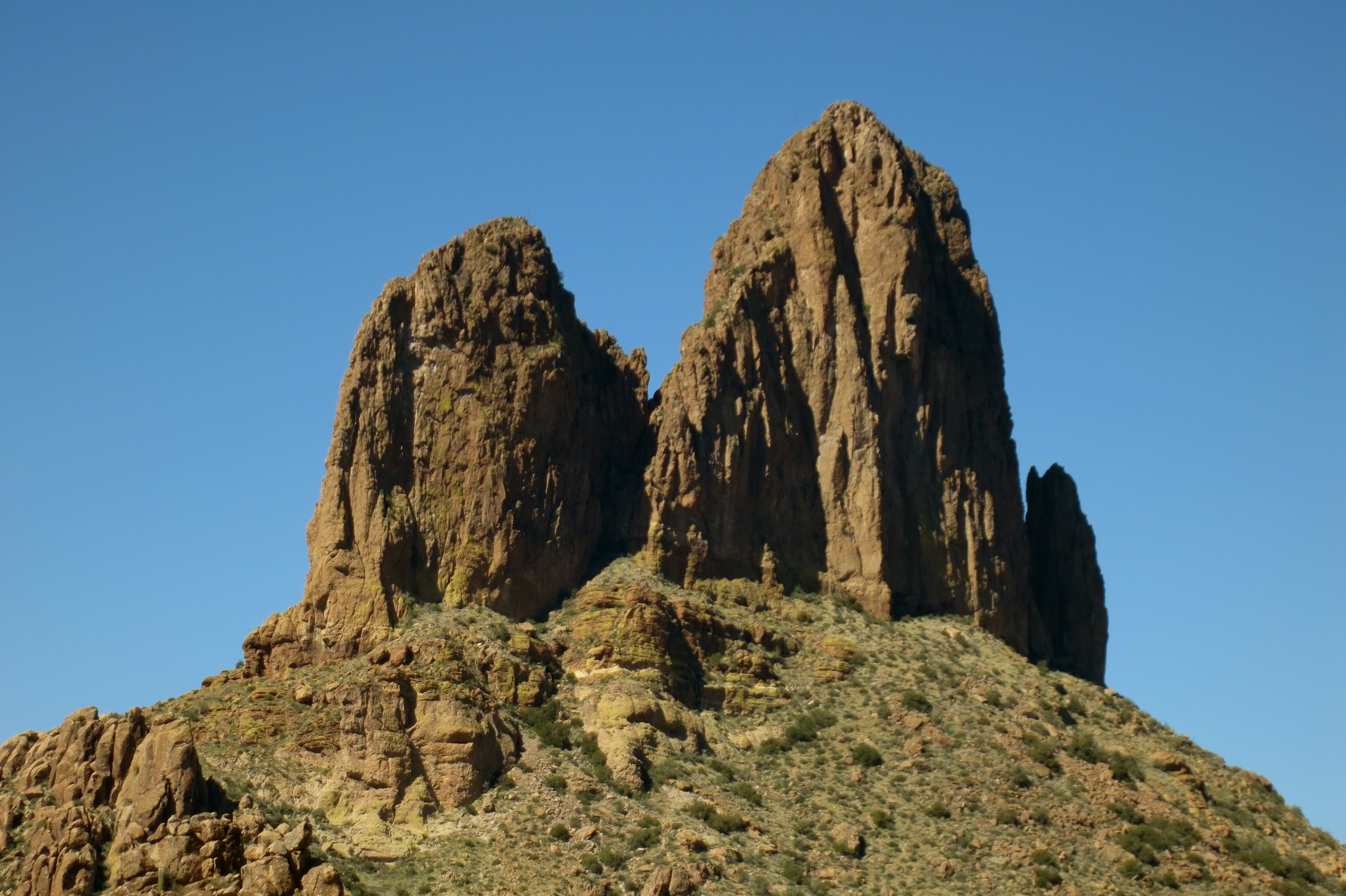
Our hike into the Superstition Mountains took us in search of a needle, Weaver’s Needle to be exact. There are several hikes in this wilderness area that allow for views of this well-known landmark (and the Needle presents differently depending on the angle), but the Terrapin Trail we chose gets you closer than most. The entire hike is a 13-mile loop that circumnavigates Weaver’s Needle but we weren’t able to start early enough to do the entire hike so we opted instead for an 8-mile out and back. This actually was just about perfect, given the section we trekked was fairly aggressive, over rough terrain, and required some boulder-hopping. We threw in a little bushwhacking just for fun so we could enjoy lunch gazing at Weaver’s Needle. If you long for isolation while hiking, this trail is far superior, in our opinion, to the Peralta Trail, one of the most heavily traveled in Arizona.
Weaver’s Needle
Weaver’s Needle was named after mountain man Paulino Weaver and was formed from the erosion of fused volcanic ash. It has played a major role in the stories told of the Lost Dutchman’s Gold Mine. Supposedly the Needle’s shadow points to the location of a significant vein of gold. Many have searched for the Lost Dutchman’s Gold and some have lost their lives in this pursuit. There are even those who feel that the Dutchman mine doesn’t exist within these mountains at all.
The Superstitions are not kind to those who don’t respect her and the wilderness is rugged and vast, with many trails not well-marked. If not careful, you could easily get yourself turned around and never leave. The stories are endless of those who have disappeared, with some estimates of over 600 deaths or disappearances. Earlier this week on the local news we heard of a 51-year old woman who had to be rescued from the Superstition Wilderness and this was not a first for her but has occurred many times during her quest for the Lost Dutchman’s Mine, the last rescue as recent as December 2012.
Lots of running water in the canyon due to snow melt
Terry getting his bearings at the trailhead
Gorgeous agave plant
First view of Weaver’s Needle from the trail, with century plant standing guard
Lovebird menage a trois?
A tough balancing act
Silhouettes at sunset
Many feel there is a curse in this desolate wilderness. The fantastic tales of strange phenomena involving the Superstitions are lengthy and quite bizarre, from Aztecs still holed up in caves, to UFO sightings, to portals into other worlds. Strange coincidences swirl around these mountains as well. Stone from the Superstitions was used to build the Roosevelt Dam on the Apache Trail and 22 died in the construction. The first water that came over the dam was saved and used to christen the famous battleship USS Arizona. Twenty-five years later this same battleship became known as the most devastating loss in the attack on Pearl Harbor, with more than 1000 men going down with the ship.
Wicked accidents are a common occurrence as well, as my husband can attest to. Some years ago, while hiking down a rocky trail out here, he stumbled and fell into a teddy bear cholla forest. Neither he nor the teddies fared very well in this encounter. Lots of blood and a few tears were shed (mine) as I pulled hundreds of barbs out of his body. Luckily his face was unscathed, but the palms of his hands took the brunt, along with a shoulder, stomach, and hip. For weeks afterwards, the teddy bears enacted their revenge on him in the form of secondary barbs that continued to surface in the palms of his hands. Guess they didn’t take too kindly to him tearing away their appendages in his rush to greet them!
Happiest in nature without teddy bear cholla!
The Superstition Wilderness is fiercely rugged country and a fabulous place to hike in pure isolation, provided you watch the signs and follow those stacked rocks (cairns), which could literally save your life or prevent a rescue mission.
If you liked this blog post, why notscroll up to ‘Follow Us’ and enter your email address? You just might find something that interests you.
Our day began at dawn as we loaded up the truck to take the 90-mile journey into Tonto National Forest. It looked to be a glorious day for a road trip. Our destination was Tonto National Monument, home to the Salado ancient cliff dwellings.
Situated within rugged terrain in the northeastern part of the Sonoran Desert, Tonto National Monument tells the story of the migration of ancient peoples who called this land home and is the setting of two 700-year old cliff dwellings. Recessed into shallow caves, they overlook today what is Roosevelt Lake, but in earlier times was a verdant valley with a river flowing through it.
Roosevelt Lake seen from trail to the Lower Cliff Dwelling
The first Tonto Basin inhabitants (between 100 and 600 AD) support evidence of some of the earliest farming communities. The river provided fertile ground for many crops until the year 600, when all who had settled here moved on, perhaps due to adverse climate conditions that laid the land barren. No one was to return for another 150 years.
During ancient times tribes migrated to land that was able to supply most of their meager needs. Off and on through the 12th century a constant ebb and flow of settlers marked this land. Periods of drought and flooding caused these huge migrations as farm crops withered or irrigation canals were washed away in the rushing waters, leaving hundreds of acres of useless farmland in their wake.
Lower Cliff Dwelling
By the early 13th century, thousands once again called the Tonto Basin their home. New immigrants began seeking refuge in the basin’s upper elevations, perhaps because all the prime Salt River Valley floor was occupied or maybe due to strife between tribes. The cliff dwellings that remain have provided archeologists many clues to their lives.
The structures that stand today, the Lower and Upper Cliff Dwellings, are two of hundreds that once stood in the thriving Tonto Basin. The skeletal remains of the rooms within tell a story of people who flourished and struggled with the changing climates. Dump sites have unearthed many important artifacts, along with the remains of a few, lovingly buried where they lived.
The first written record of the cliff dwellings at Tonto National Monument date back to 1880. What the first Europeans who explored this dwelling found was a much larger, well-preserved structure than we see today. The effects of time, weather, visitation, and vandals have taken their toll, which is why President Theodore Roosevelt intervened in 1907 and declared this site a National Monument.
Sacred ground
Upper Cave Dwelling
Park Ranger Jan
Room with a view
Ancient architecture
The Lower Cliff Dwelling, built in 1250 AD, was occupied and maintained for ~100 years and can be viewed as a self-guided tour, a one-half mile paved walk with a 350-foot elevation gain. At its height it housed 20 rooms.
The Upper Cliff Dwelling, also built in 1250 AD, can be seen only by guided tour. Our Park Ranger tour guide Jan has a passion for preserving this site, and gave an excellent tour. Our small group took the 3-mile hike (round trip) into the rugged wilderness, up 600 feet, to the cave which once housed 40 rooms within its depths.
We chose the route back over the Apache Trail. One would think, based on its length (40 miles), that this would be the shortcut, but you would be wrong. Although a part of it is now paved, many miles are rutted dirt road, but passing by some amazing scenery, and the mile-long Fish Creek Hill is not to be missed for some hair-raising fun. Winding, steep, and narrow, if meeting a vehicle coming the other direction, someone must back up to the nearest turn-out. This was once a stagecoach trail that ran through the Superstition Mountains, named after the Apache Indians who traveled through this harsh country.
Roosevelt Dam
Golden glow at Canyon Lake
Layers and layers of desert mountains
Apache Lake
President Theodore Roosevelt had this to say about the Apache Trail in 1911:
“The Apache Trail combines the grandeur of the Alps, the Glory of the Rockies, the magnificence of the Grand Canyon and then adds an indefinable something that none of the others have, to me, it is most awe-inspiring and most sublimely beautiful.”
We arrived back home just as Mother Nature was painting the sky the most delicate shades of coral and lavender, a delightful ending to the day.
Mother Nature’s final gift at dusk
If you liked this blog post, why notscroll up to ‘Follow Us’ and enter your email address? You just might find something that interests you.
Although we had lived in Sedona for many years, we had never visited the Amitabha Stupa and Peace Park. Thanks to a friend, a recent trip to Red Rock Country from the Valley of the Sun brought us to this sacred ground, situated at the base of Thunder Mountain.
Amitabha Stupa with Chimney Rock in background
Stupas have graced the Earth for over 2,600 years and are said to be the physical embodiment of the Buddha’s enlightened mind. One of the oldest forms of sacred architecture on the planet, their blessings are immeasurable and their presence in the West very rare. For millennia stupas have been built to deepen the spiritual life and promote healing, peace, and prosperity, and are a place for meditation and spiritual renewal.
Rosie & Terry at the Stupa
Stupa’s crown
Medicine wheel on the Stupa grounds
Offerings at the base of the Stupa
Red rocks with dusting of snow
Construction on the 36-foot tall Amitabha Stupa began in July, 2003, with a final 3-day consecration ceremony taking place on August 1, 2004. On this final day, marked with offerings, song, and dance, prayers began in the early dawn at 5:00 AM. At this hour the Stupa was bathed in moonlight, but when the rising sun shone on the face of the Amitabha Buddha, the Stupa was born. Since then the Amitabha Stupa has been radiating blessings of compassion day and night.
The external beauty of the Stupa covers many offerings within its walls. A sok-shing, tapered 4-sided, 21-foot long cedar column runs along the central channel and is the life force of the Stupa. It is carved at the top like a stupa and has a thunderbolt at the bottom. A large copper cauldron has been placed in the center as a symbol to protect the environment and replenish the five classical elements (earth, water, fire, air, and space) and is said to restore the Earth’s vital energies. Along with this are holy relics, rolled mantras, semi-precious stones and crystals, and other deity statues.
Red rock serenity
Sacred ground in the high desert
Can you spot Coffeepot Rock?
Image of Amitabha in faceplate
Prayer flags fluttering in the breeze
When you arrive at a stupa, Buddhist tradition teaches that there is great benefit in walking clockwise around the stupa at least three times, while making personal prayers for those suffering and for world concerns. A small offering can be made after this journey to dedicate the merit of these prayers for the greater good.
After the three of us had made the journey around the Stupa, we quietly absorbed the serenity of our surroundings. Soon a lone coyote’s cry pierced the silence. Native Americans feel the coyote teaches us that only when all illusions have fallen away will we connect with the source ~ beautiful symbolism experienced on this sacred ground.
Prayer flag mantra
If you liked this blog post, why notscroll up to ‘Follow Us’ and enter your email address? You just might find something that interests you.
I have a little secret to share. I am an introvert, and being such, I was more than a little nervous about plunging into this RVing lifestyle. Who would we meet? Would I have anything in common with them? When I was firmly ensconced in my career, few saw me as an introvert. I knew my stuff and felt totally comfortable standing up in front of a large group of people, giving presentations. Doesn’t sound much like an introvert, right? This new adventure was taking me out of my comfort zone so I wondered if I might retreat back into my little shell, much like a hermit crab when you pick him up.
Who is that with Terry? Hard to tell with my blurry photo!
I have been pleasantly surprised by the wonderful folks we’ve met in the past 1.5 years on the road. What I have discovered, and should have known had I stopped to think for five minutes, is that we all share the travel bug. We all have a passion for seeing this beautiful country, the good old USA, her exciting cities and all their variety, soaring mountains, stunning desert vistas, rugged coastline, national monuments and parks… so much to offer. A passion for nature weaves a common thread through each of us, so I no longer wonder when we pull into a new campground. I feel certain that we will meet interesting people with whom we can forge that connection, even with just a passing greeting.
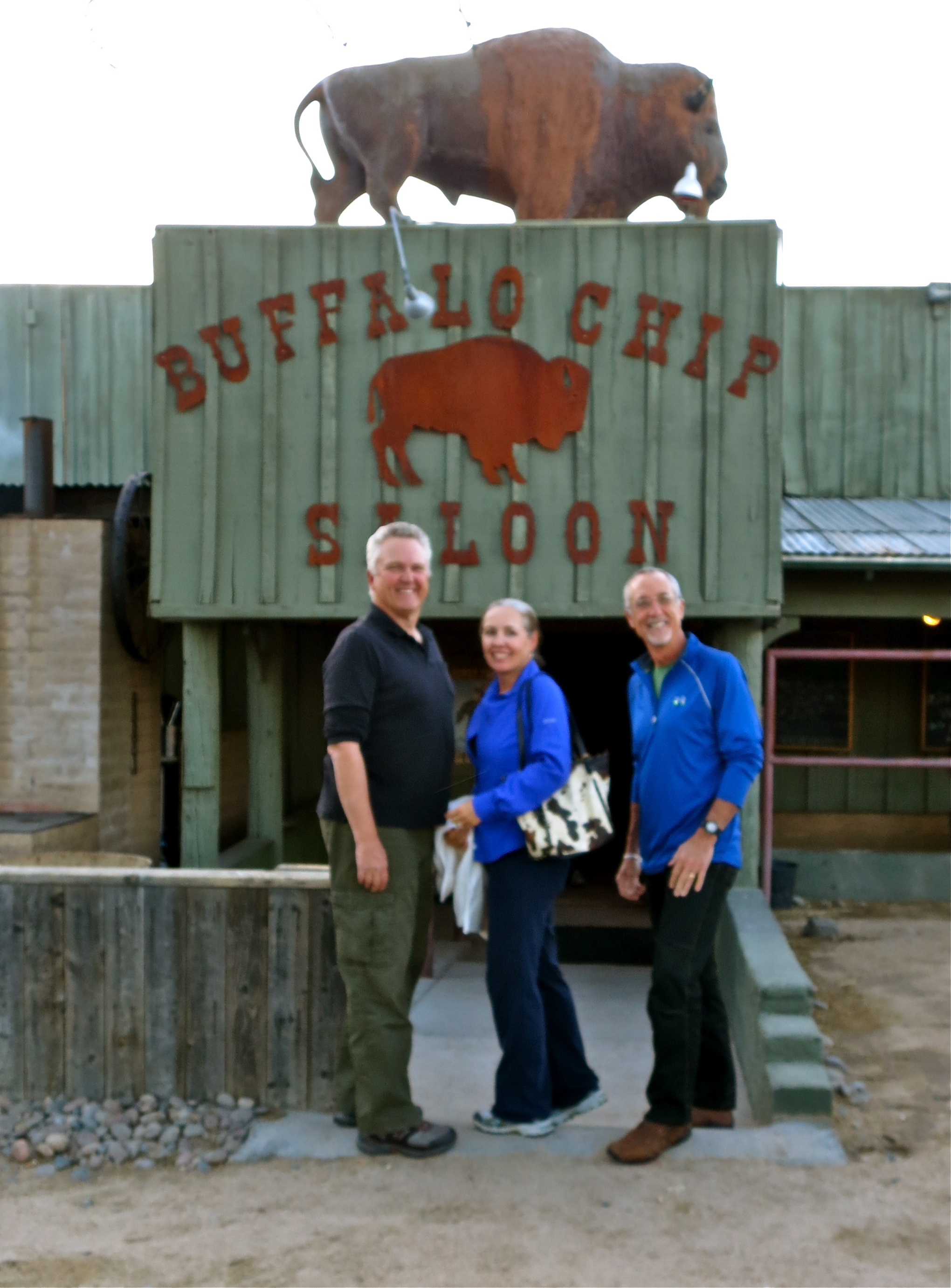
When we booked our reservation into Cave Creek Regional Park, what I did not know was that a couple from Colorado, whose blog I follow, Live Laugh RV, would be parked right next door, a little serendipitous for sure. We have had the opportunity to enjoy a meal at the Buffalo Chip Saloon (cause we are in the Wild West you know) and a few hours around the campfire with Ingrid and Al, swapping stories of where we had been and where we are headed.
Terry, Ingrid and Al
This RV lifestyle, once approached with trepidation, I now look upon as a grand adventure, in awe of the jaw-dropping beauty around every corner and thankful for the great folks who have provided such color and texture along the way.
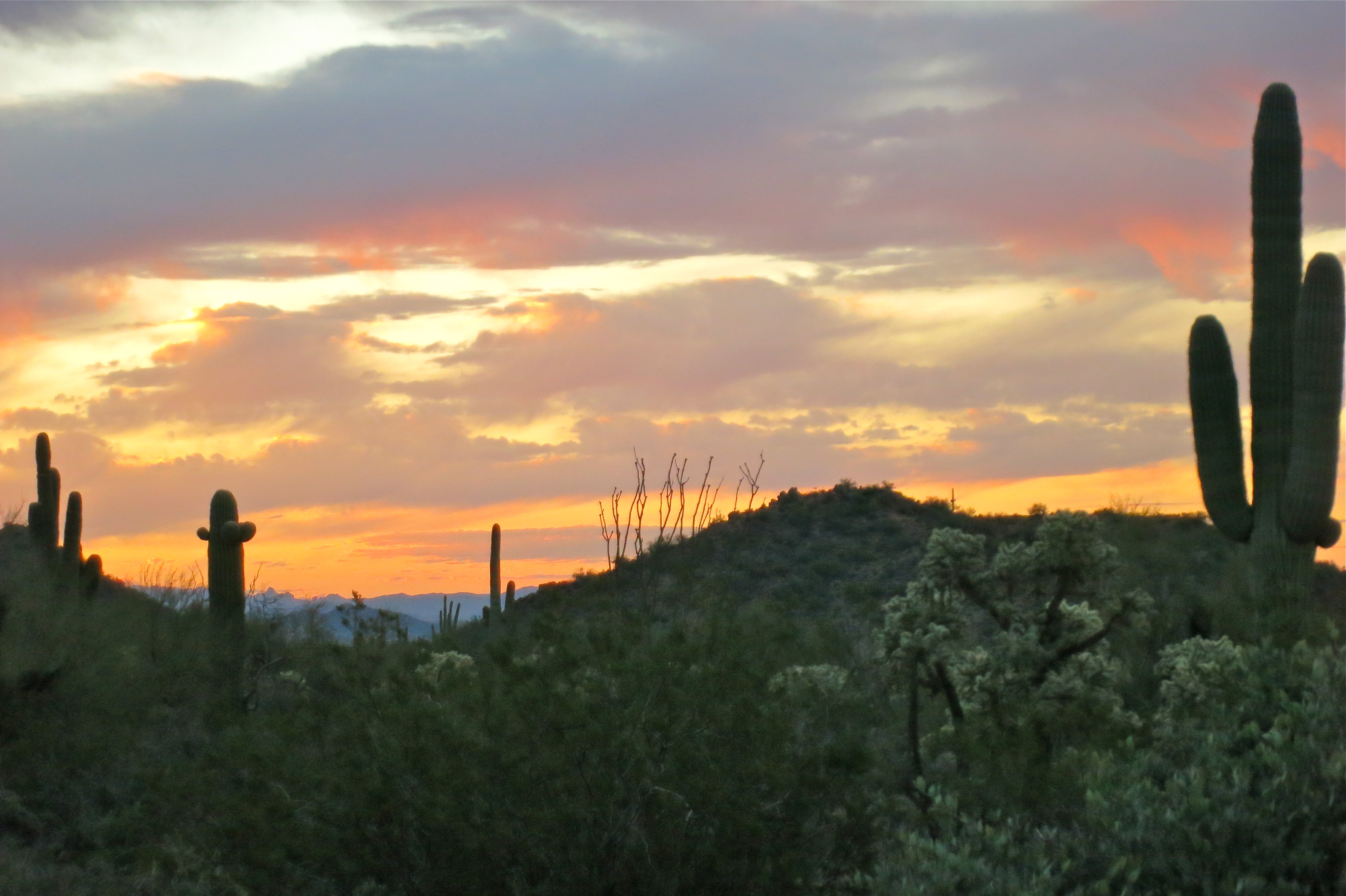
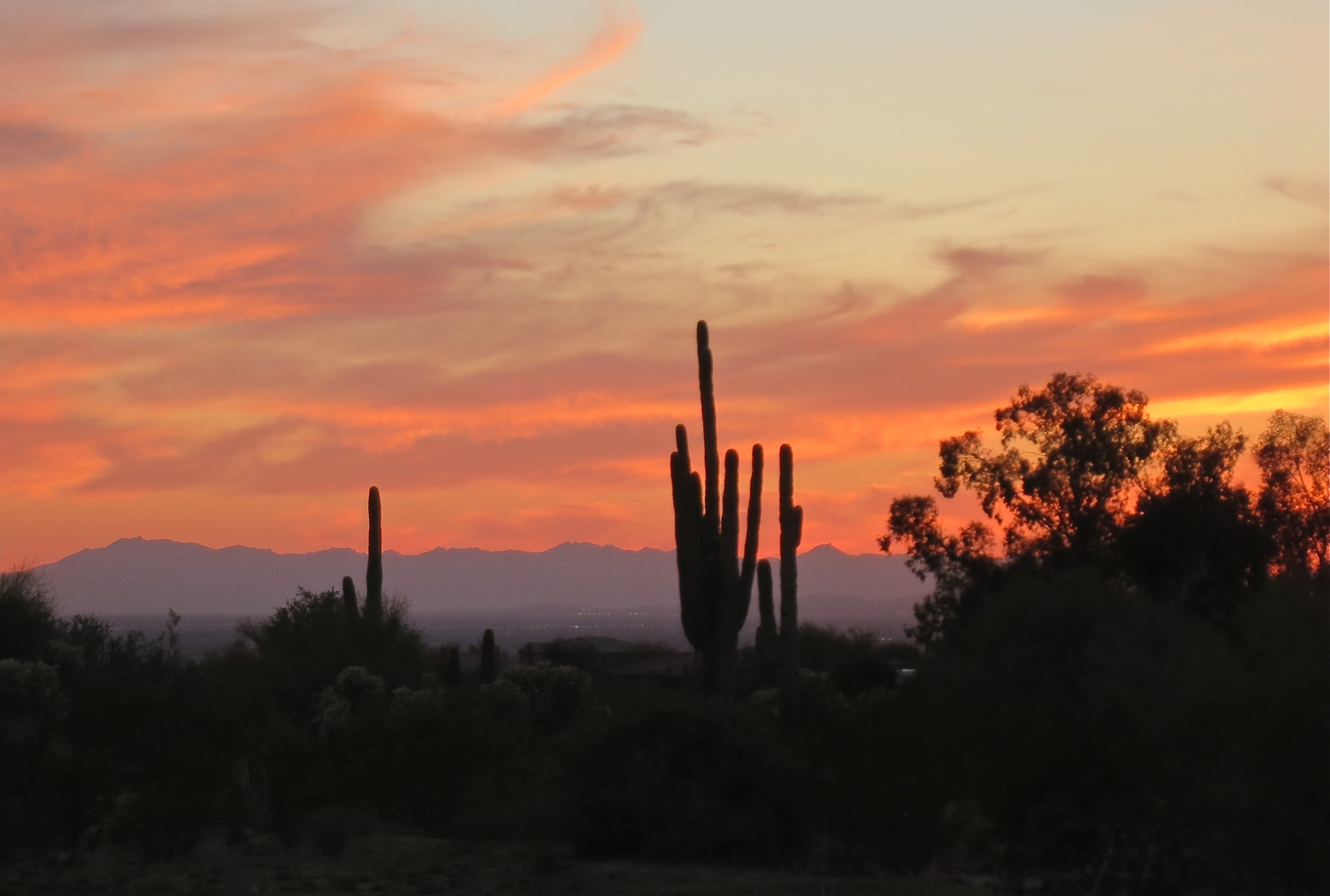
Desert at dusk
If you liked this blog post, why notscroll up to ‘Follow Us’ and enter your email address? You just might find something that interests you.










 Paint Your Landscape