
Chiracahua Mountains ~ Hoodoo You Think You Are?

Chiricahua Mountains…ancient homeland of the Apache, sky island, “Land of Standing-up Rock”?  The Chiracahuas are all this and so much more.
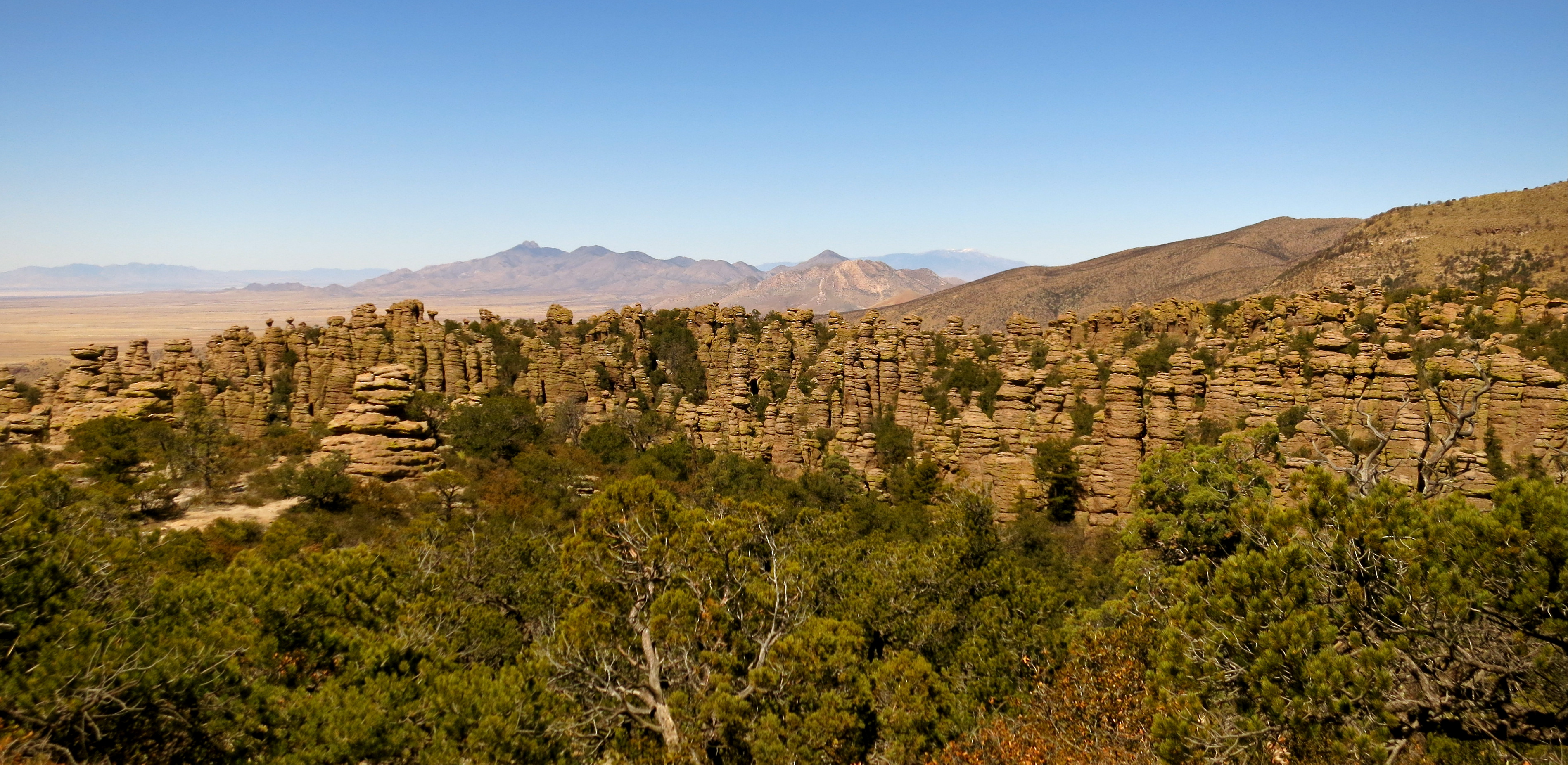
Chiracahua Mountain Range

As I walked among the towering hoodoos I marveled at the fact that we spent 25 years of our lives in Phoenix and Sedona and had never traveled to the Chiracahuas, being the hikers we are.  Granted, it is not a short jaunt across town,  just 50 miles north of the Mexico border, but the mountains are so breathtaking and the history of the area so rich, I’m not sure why we waited.  Perhaps we just needed to be a little more seasoned to appreciate all that is here.

The Chiracahua Mountain range had its origins roughly 27 million years ago, when eruptions from the Turkey Creek volcano spewed ash over 1200 square miles.  This sky island, which is essentially an isolated mountain range rising above a grassland sea, developed over many millenia into the rock pinnacles that we see today.  They stand like guardians of the forest and send the clear message that you are now in Chiracaqua country.

The Chiracaqua Apache claim this land as their ancestral home, with evidence of their existence in these mountains dating back to the early 1400’s.  They named this range the “Land of the Standing-Up Rock” and lived peacefully here until the Europeans stepped in to declare this land theirs.  Led by Cochise and Geronimo, the Apache staunchly defended their ancestral homeland.  The last of the Apache finally gave up the fight in 1886, surrendered, and were later relocated by the government to Oklahoma and New Mexico, never to return to this sacred land. So much more could be said here but I will just add that I felt a sadness as I walked the trails, reflecting upon all the Native Indians have so unjustly lost .

There is such an interesting blend of local and exotic plant and animal species here that it is said to be one of the most biodiverse regions in North America, boasting over 1200 species of plants alone.  Plants and animals from four different ecosystems come together in this range.  Birders flock here for the diversity as well, seeing many species of birds that can normally only be seen in Mexico.  We visited for the hiking, to witness Mother Nature at her finest, rock formations precariously balanced in such a way that it appeared a strong wind could topple these giants.

Chiracaqua National Monument was established in 1924 to preserve and protect these 12,000 acres and in 1934 the Civilian Conservation Corps began to tackle the job of roads and trails.  Today there are ~20 miles of trails for your hiking pleasure and 86% of this sky island lives on as pristine wilderness.

To experience as much of the Chiracaquas as we could in one visit, we chose the Big Loop, a combining of many trails that resulted in a lovely 10-mile hike.  There are a few ways you can tackle this trail and, based on a tip provided to us by a Park Ranger at Fort Bowie the day before, we elected to take the shuttle from the visitor center to the Echo Canyon Trailhead (arrive prior to 8:30 am).  From there we followed this route:  Echo Canyon Trail> Hailstone Trail > Mushroom Rock Trail > Big Balanced Rock Trail > Heart of Rocks Loop (where most of the named formations stand) > Sarah Deming Trail > Lower Rhyolite Canyon Trail. This and a little other meandering will get you a fabulous 10-mile hike, with the last three miles being downhill. 🙂

Heart of Rocks Loop:

Wandering among these geologic wonders that time and weather have painstakingly created, you just might feel the spirits of the ancient ancestors who walked this ground…truly a sacred experience.

If you liked this blog post, why not scroll up to ‘Follow Us’ and enter your email address?  You just might find something that interests you.


A Different Mood in Dana Point, CA

An unusually quiet harbor on a foggy day

After receiving an email recently from someone I follow, I felt compelled to dust off a post that I have had sitting around for some time and present you with a “blast from the past”, Dana Point in a different light.

I doubt you will see any travel advertisements portraying this beachside city in the gray light of a foggy day but sometimes our travel plans present us with one of Mother Nature’s less than sunny moods, and this day was one of those. I decided to go with the flow and for me there has always been something very soothing about being near the ocean when the fog has laid down a quieting blanket of white, muffling all but the pounding surf and squawking shorebirds.

Shorebirds gone wild!

Dana Point, sitting halfway between San Diego and Los Angeles, covers a total area of roughly 30 miles, 7 of those being land and 23 being water.  All things revolving around water draw visitors to this beachside resort city:  romantic walks on beautiful sandy beaches, tide pools teaming with all sorts of fascinating ocean creatures, deep-sea fishing adventures, some of the best surfing around, and a beautiful harbor housing two marinas, 2500 boats, and 30 boutique shops.

Silently a sailboat slips into the harbor

On the land side, 23 beautifully manicured parks dot the city, many with views of the ocean and a three-mile public trail system that link together all those contained within the headlands.

Ocean Institute
Ocean Institute

This city boasts the title of “Whale Capital of the West” because of the many types of whales that use this point as a navigational landmark for their migrations north and south.  I decided to head to the Ocean Institute that sits in the harbor to see what I could learn.

The Ocean Institute, founded in 1977, is a non-profit dedicated to ocean awareness and preservation. It serves 135,000 students annually and is open to the public on the weekends.  It is a blending of museum, small aquarium, and ocean classroom labs, with interactive stations and holding tanks of indigenous ocean species spread throughout its buildings.

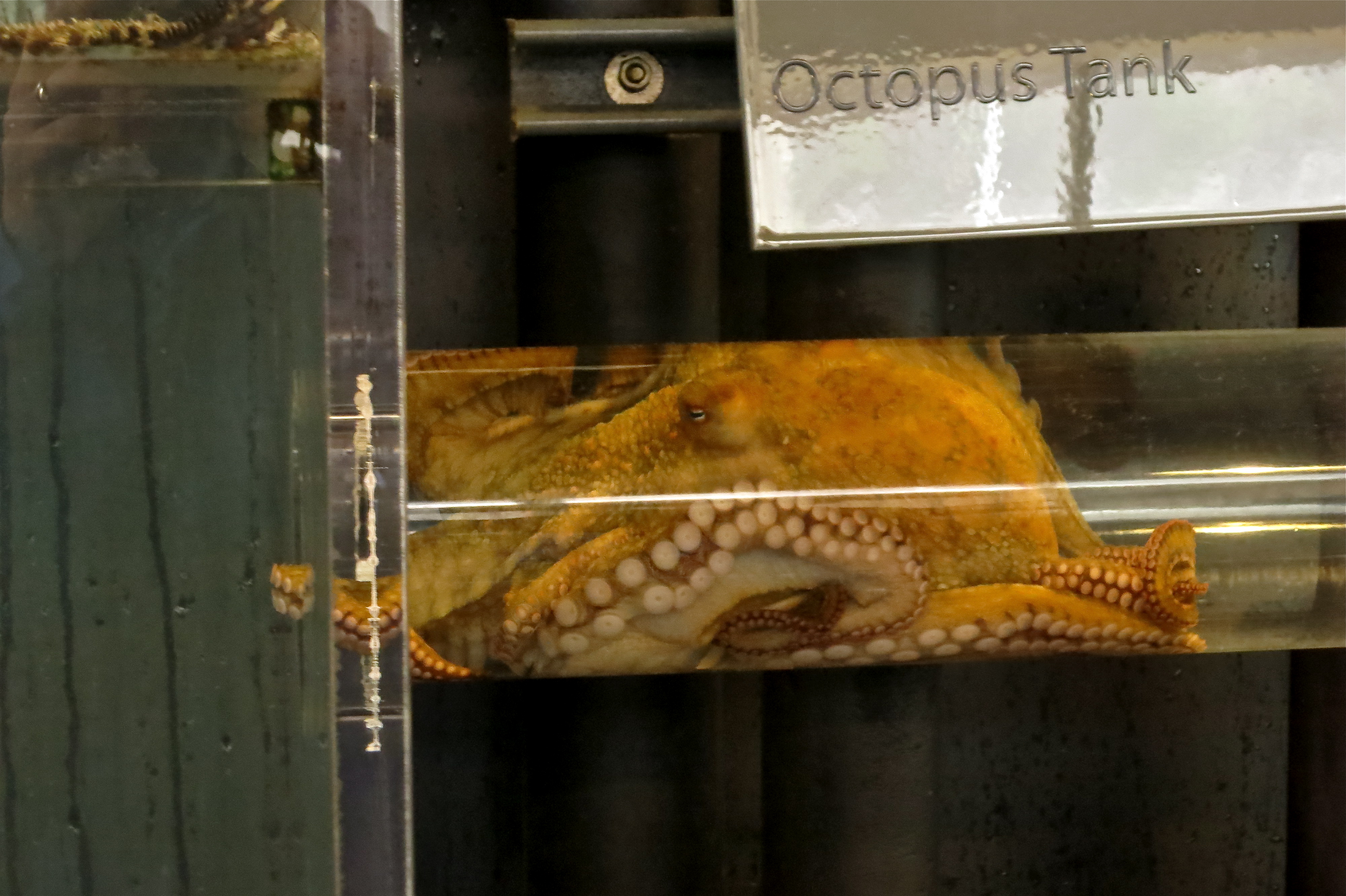
An octopus, moving from one tank to another, awaiting feeding

You can watch the feeding of an octopus, dissect a squid, examine sea life under a microscope, or educate yourself on the life cycle of a jellyfish.  Step outside and tour The Pilgrim, a replica of a hide brig, or hop on a charter boat for a whale-watching adventure.

The Pilgrim
The Pilgrim

While fixating on the jellyfish tanks I saw someone who looked vaguely familiar but, having his back to me, I wasn’t sure.  Does this young man resemble someone you may know?

Mystery man
Mystery man

Click here to learn the identity of this mystery man.  Did you guess correctly? Come on, be honest. 😉

Actually, this was a planned meeting and this young blogger has the same warm, playful spirit that shines through in his posts, not to mention the wicked good photographs he takes!  One of the first posts of his that I read was one in which he took a road trip and brought along his mother, grandmother, and uncle.  He reeled me in after that and I have followed him ever since (not stalking, mind you!). Lucky me to have the chance to spend a few hours with the infamous Rommel of The Sophomore Slump. 🙂

Little ray of sunshine on a rainy day

If you liked this blog post, why not scroll up to ‘Follow Us’ and enter your email address?  You just might find something that interests you.

“Preposterously Beautiful” ~ Patagonia, AZ

This is the way part-time resident, novelist and screenwriter (Legends of the Fall) Jim Harrison describes Patagonia.  We just blew through this funky little town several years ago when we visited so we decided it was time to show her some respect.

Our good friends Stan and Marilyn were hunkered down here for a few days while a winter storm passed by and we wanted to see them one last time before they began their journey back home.  Even though the weather wasn’t perfect, what better place to enjoy nature for a few hours than in a world-class birding hot spot.  Even if you are not a birder, once here we are told, you may discover your inner passion for these colorful, feathery creatures who far outnumber people. This little gem has been named in the publication Fifty Places to Go Birding Before You Die:  Birding Experts Share the World’s Greatest Destinations.

Bridge over Patagonia Lake

Nestled between the Santa Rita and Patagonia Mountains at a 4000-foot elevation, this town has a unique vibe, a quirkiness about it that suits its residents just fine.  Preserving its history, its rich riparian area, and sustainability are some of Patagonia’s top priorities.

Just west of town lies the Patagonia-Sonoita Creek Preserve, “home to one of Arizona’s few permanently flowing streams, endangered fish, butterflies, and birds”.  Adjacent to town the Nature Conservancy has also staked its claim and the organization Native Seeds/SEARCH maintains a farm for preserving and growing seeds of endangered crops that grow in this area.  Scratch below the surface, dig a little deeper, and you will find some hidden gems in small town America.  We will definitely be back.

Patagonia Lake
Patagonia Lake

Although I have bemoaned the fact that I need a camera with better zoom ability to catch the beauty of these little feathered friends, we headed out to Patagonia Lake State Park & Sonoita Creek Natural Area with binoculars in hand (and camera just in case I got lucky).  Our first stop was to the visitor center to ask where the most birds can be seen.  Many agreed that if we stood in their side yard, where their feeders are, we would see a wide variety, but they also decided to share a couple of trails that might offer some enjoyment.  We opted for the birding trail, sans tour guide, where we could get a little exercise and hopefully see some birds.

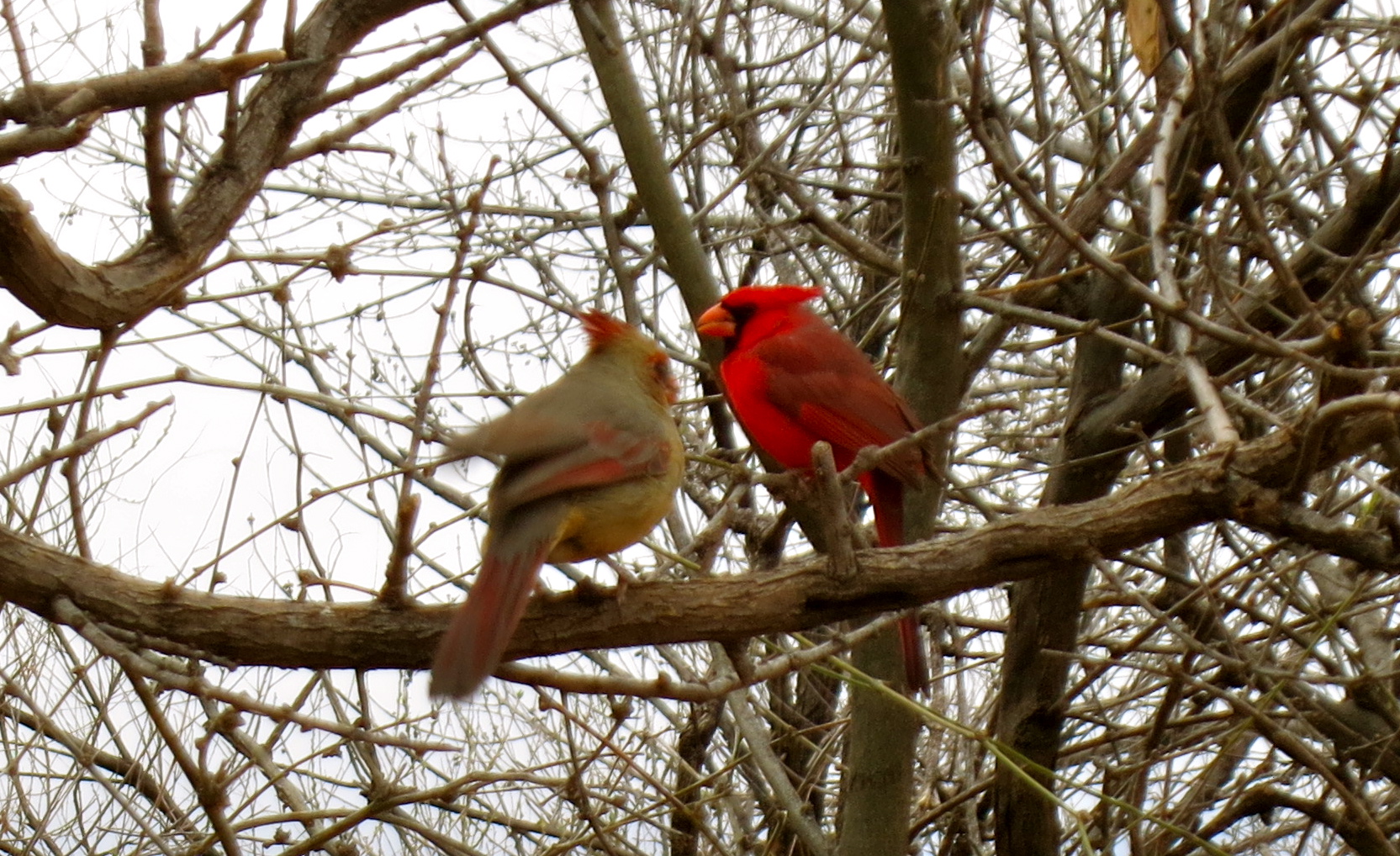
A pair of cardinals hiding in the thicket

For the record, I am not a birder, but I must admit to sending out a little prayer into the universe to have a chance meeting with the reclusive Elegant Trogon, the colorful, tropical bird that brings birders by the thousands to southeast Arizona each year.  Patagonia and its surrounding  mountain ranges are the farthest north this little beauty ventures so I wasn’t very optimistic about my chances.

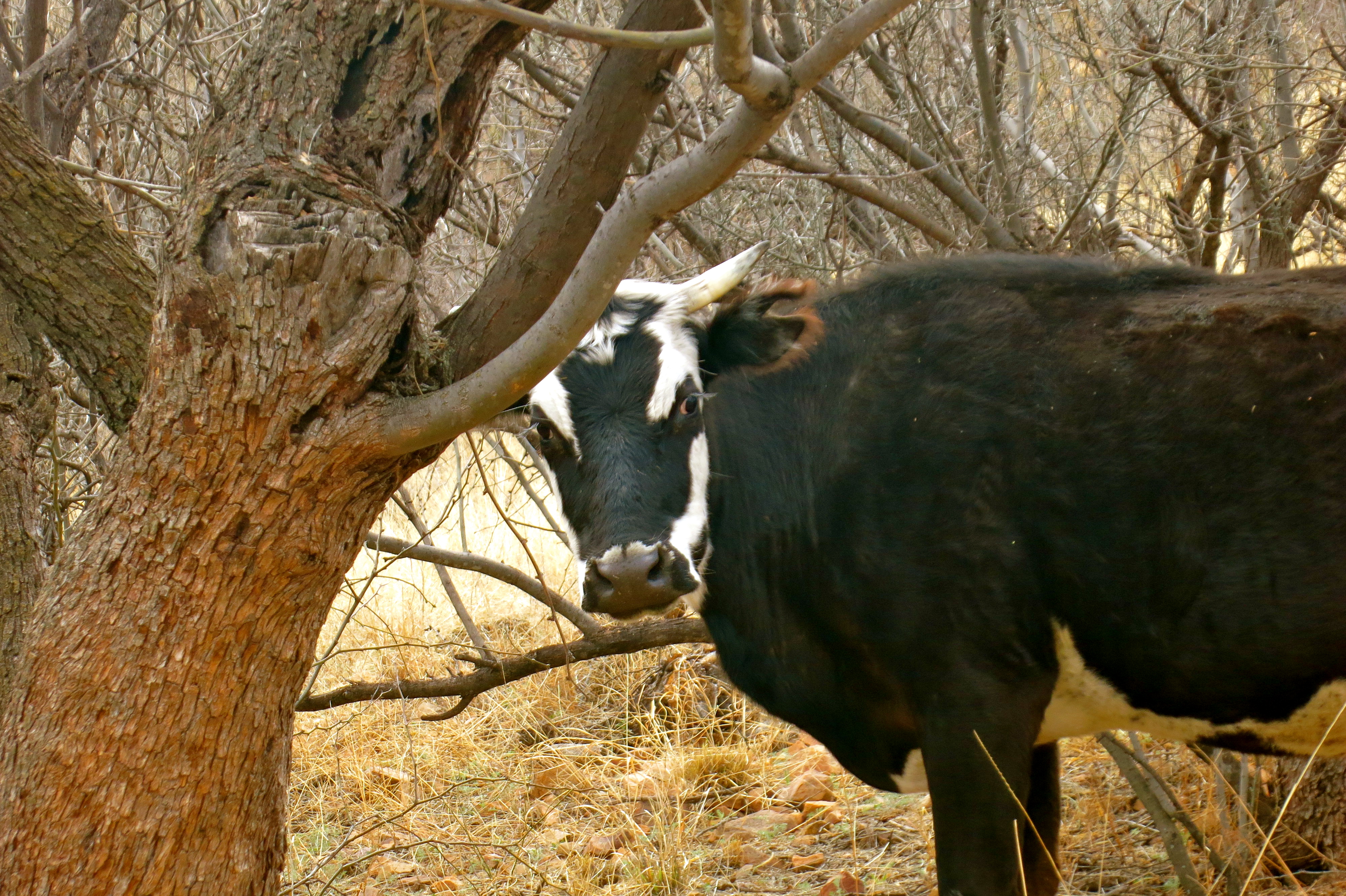
Who are you lookin' at?
Who are you lookin’ at?

The first mile didn’t offer much to entice our sense of sight, other than some inquisitive cows, a burbling creek and the sound of many bird species that filled the air.  We were relishing the fresh air after being cooped up inside waiting out the winter storm.  Following the creek around a bend, our friend Marilyn whispered, “there he is”.  The gods were smiling down on us as we watched this little beauty quietly perched on a branch.  I kept snapping away in the hopes of having a few viable photos then traded off with Terry so I could see him in all his splendor up-close through the binoculars.  Terry was able to creep even closer when the Elegant Trogon flew from his perch to the ground and back up again. Here is what he found to be much more interesting than us:

The big question from everyone we met on the trail was “did you see it?”.  We showed our photos many times before we got back to our vehicle.  We were ready to take off when someone tapped on Stan’s window.  Rolling it down, the group standing there asked to see the photos.  Guess this colorful little fella is something of a rock star!

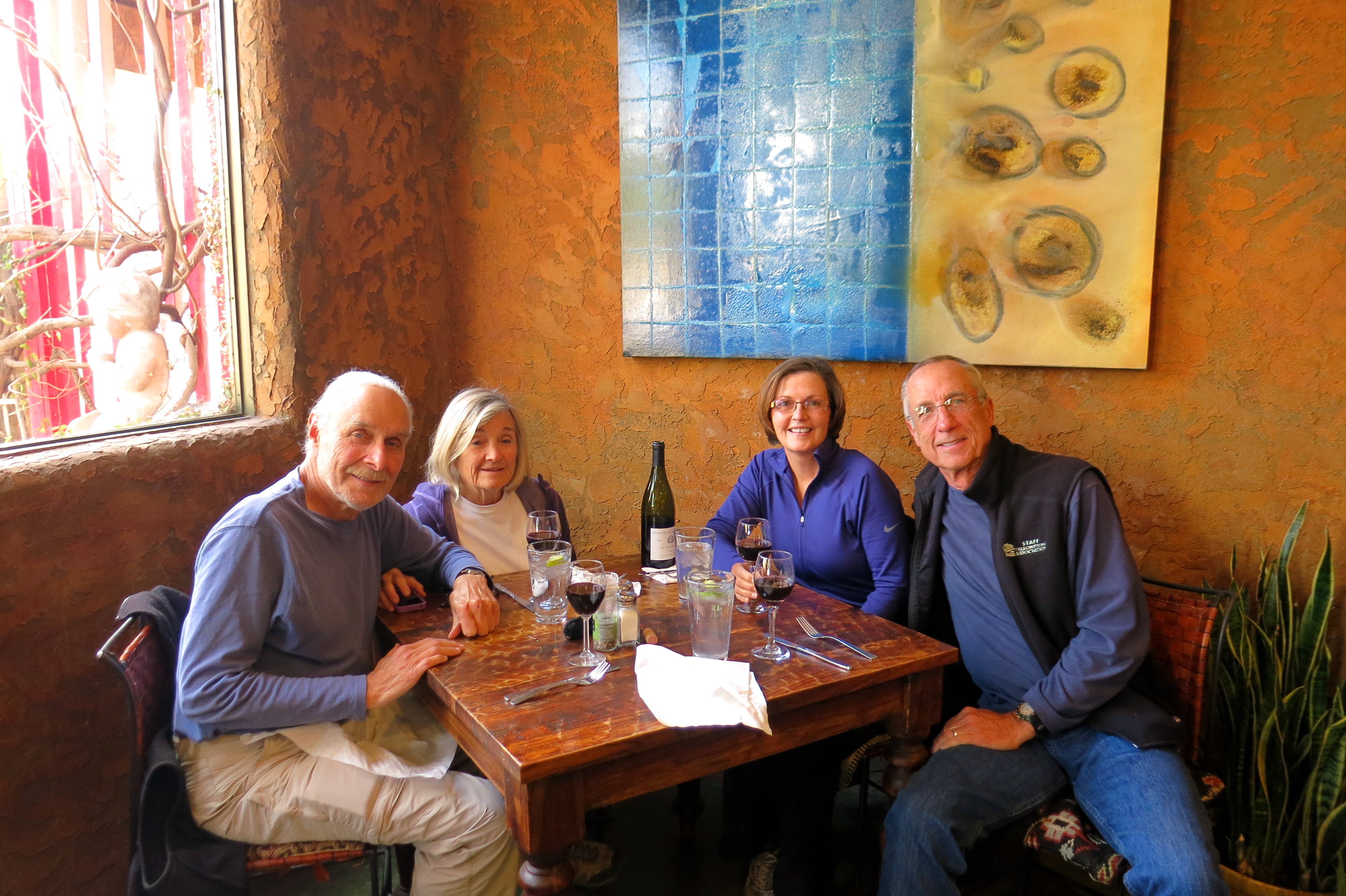
Our time with Stan and Marilyn was coming to an end, and what better way to find solace than to nourish our bodies and toast this heart connection with a glass of nice French wine.  We headed over to the Velvet Elvis Pizza Company, where the lovely Ecuadorian proprietor and executive chef, Cecilia, creates the most delectable dishes.  Her pizzas are gourmet and the remaining menu has a Latin American flair.  What a find in this funky little town and the perfect way to bid adieu to our friends, with the promise of a visit later this summer.

"Last supper" at the Velvet Elvis
“Last supper” at the Velvet Elvis

For a great gallery of Arizona birds, check out the Lowe’s RV Adventures, and while you’re there, spent some time reading about their many wonderful travel exploits.

If you liked this blog post, why not scroll up to ‘Follow Us’ and enter your email address?  You just might find something that interests you.


To the Bat Cave We Go ~ Kartchner Caverns ~ Benson, AZ

Advice from a Cave:  Breathe deep; find beauty in unexpected places; search inward; see the hole picture; good things take time; look beneath the surface; hang tight!  (c) Ilan Shamir  www.yourtruenature.com

We are spending a few days at Kartchner Caverns State Park, at the base of the Whetstone Mountains, near Benson, Arizona, a lovely campground with 360º views of wide-open desert and mountain ranges touching the heavens.  An added bonus is the brief walk to the famous Kartchner Caverns.  Large bands of billowy clouds surround us, whipped around by brisk winds, as a storm fast approaches. There is probably no place better to be right now than underground, so to the “Bat Cave” we go.

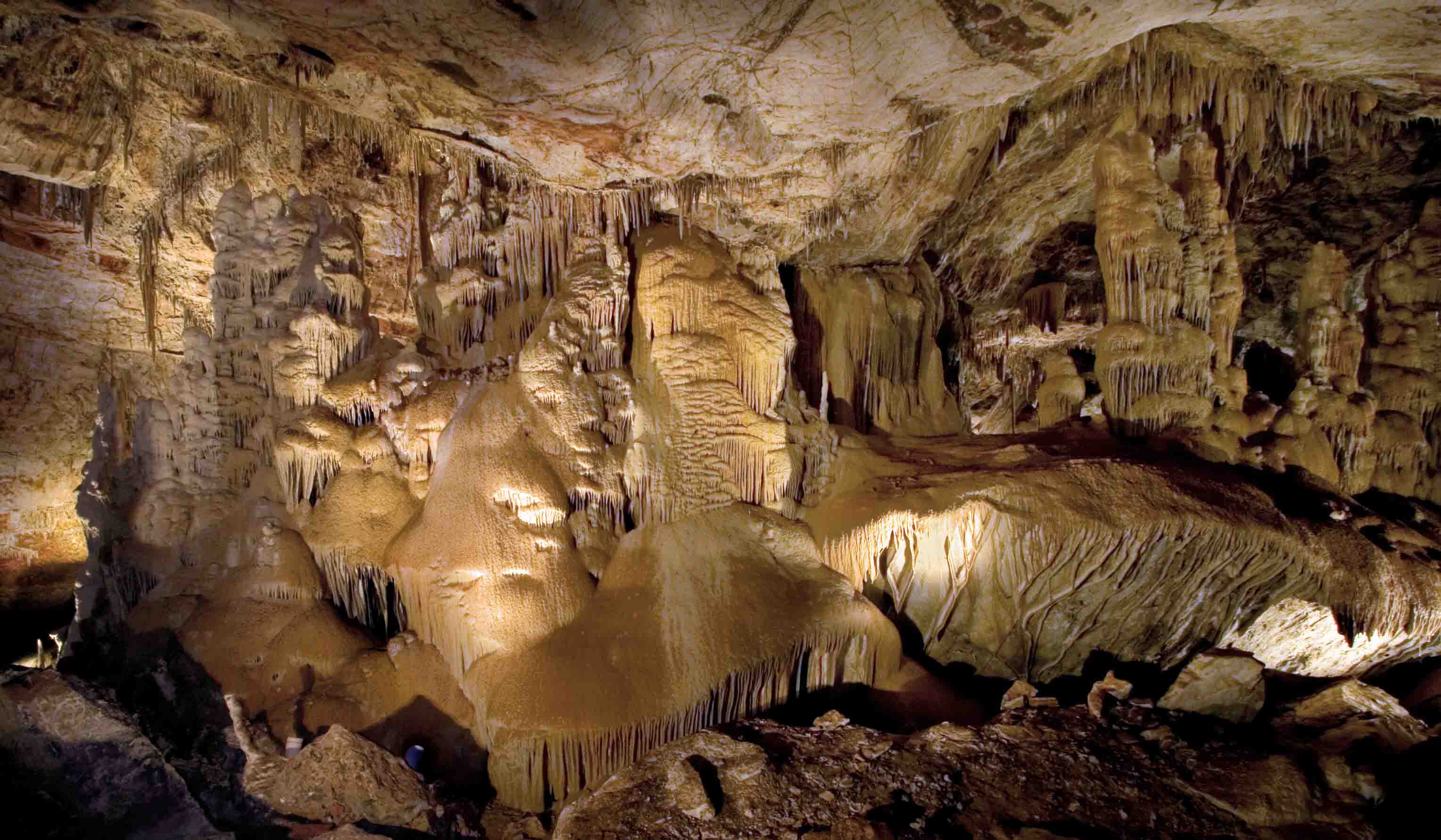
Kartchner Caverns Big Room, image courtesy of Wikipedia
Kartchner Caverns Big Room ~ photo credit Wikipedia

Since we had seen Carlsbad Caverns last year we didn’t know what to expect.  We found the “Big Room” tour at Kartchner to be a wonderful experience, enhanced greatly by our tour guide, Park Ranger Lisa.  A 6-month veteran of the park (impossible to believe), she is a walking encyclopedia of Kartchner Caverns history, presented with passion and humor.  She followed very strict protocol, as we traveled through six air-lock passages and a misting machine, to preserve the cave’s inside temperature of 72º and 99% humidity year-round.  Nothing was allowed inside that might disturb the cave’s health, including cameras.

Image courtesy of azstateparks.com
Photo credit azstateparks.com

We found the history behind the discovery of this cave to be fascinating.  Two cavers, Gary Tenen and Randy Tufts, knew that where there’s limestone, there most likely would be caves.  They set out to explore the limestone hills at the base of the Whetstone Mountains, looking for that perfect cave but anticipating another dry, dusty hole in the earth.  What they found instead was a sinkhole, with a narrow crack in the bottom, breathing warm, moist air.  Two hours of digging around this “blowhole” allowed them enough space to wiggle through and explore 2.5 miles of pristine cave passages.  They knew they had found something very special, something to be preserved.  Fourteen years of arduous work resulted in a bill that protected this cave and in 1999 the Rotunda Room opened to the public, with tours of the Big Room following in 2003.

Breathtaking soda straws - image courtesy of azstateparks.com
Breathtaking soda straws – photo credit azstateparks.com

Kartchner Caverns is a wet cave, very much alive, and if the spectacular displays of stalactites, stalagmites, soda straws and “cave bacon” weren’t enough, the Big Room is closed from mid-April until mid-October when it is turned into a nursery roost for ~1,000 female common cave bats.  The females give birth to a single pup in late June and the babies remain in roost until mid-September, when they leave to begin the migration to their winter home.

Advice from a Bat:  Trust in your senses; spend time hanging around with friends; don’t be afraid of the dark; get a grip; enjoy the nightlife; sometimes you’ve just gotta wing it; guano happens!  (c) Ilan Shamir  www.yourtruenature.com

Our tour guide Lisa explained the birthing process in a rather unique fashion. Picture a 5-foot tall, 100 lb. woman giving birth to a 25 lb. baby (size of a 2-year old), while hanging from her thumbs, enduring a breech birth, worrying about catching her baby before he plunges to his death, and that is what birthing a bat pup is like.  I don’t know about you, but I have a new-found respect for bats, at least the female variety!

Prelude to a storm
Prelude to a storm

If you liked this blog post, why not scroll up to ‘Follow Us’ and enter your email address?  You just might find something that interests you.


An Artist Colony, A White Dove, and Friendship ~ Tubac, AZ

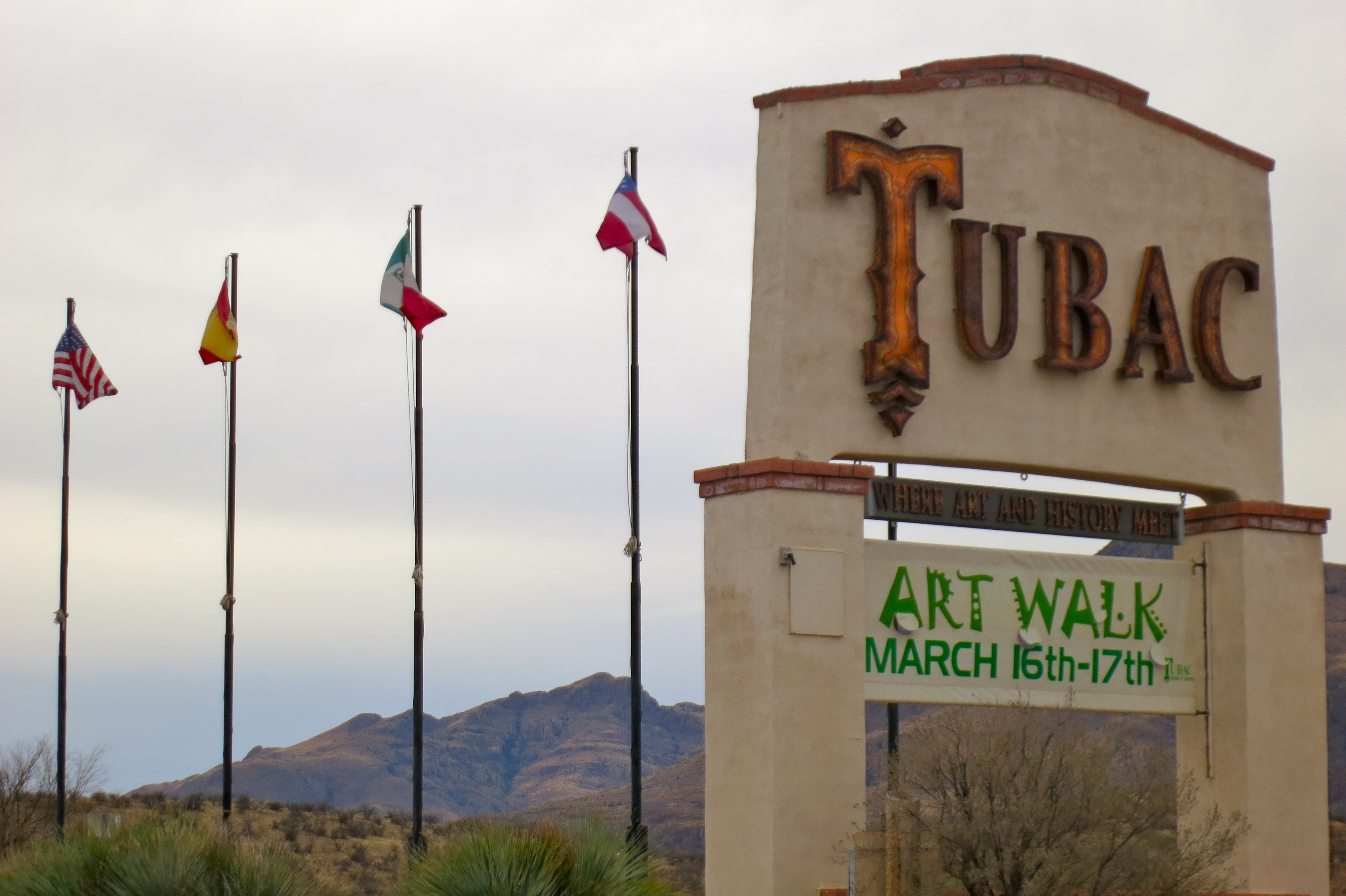
welcome to TubacCombine a growing artist colony, a White Dove of the Desert, and friendship and what you get is a nice day trip from Catalina State Park in Oro Valley, where we are camped, to Tubac, AZ.  I have been mute on our time at Catalina State Park, not because we are not enjoying looking out over and hiking into the Santa Catalina Mountains, but because this is our second visit (here is our first).  We have chosen to lazily pass the time in the company of good friends Stan and Marilyn (also camped here) over posting again about this great state park.

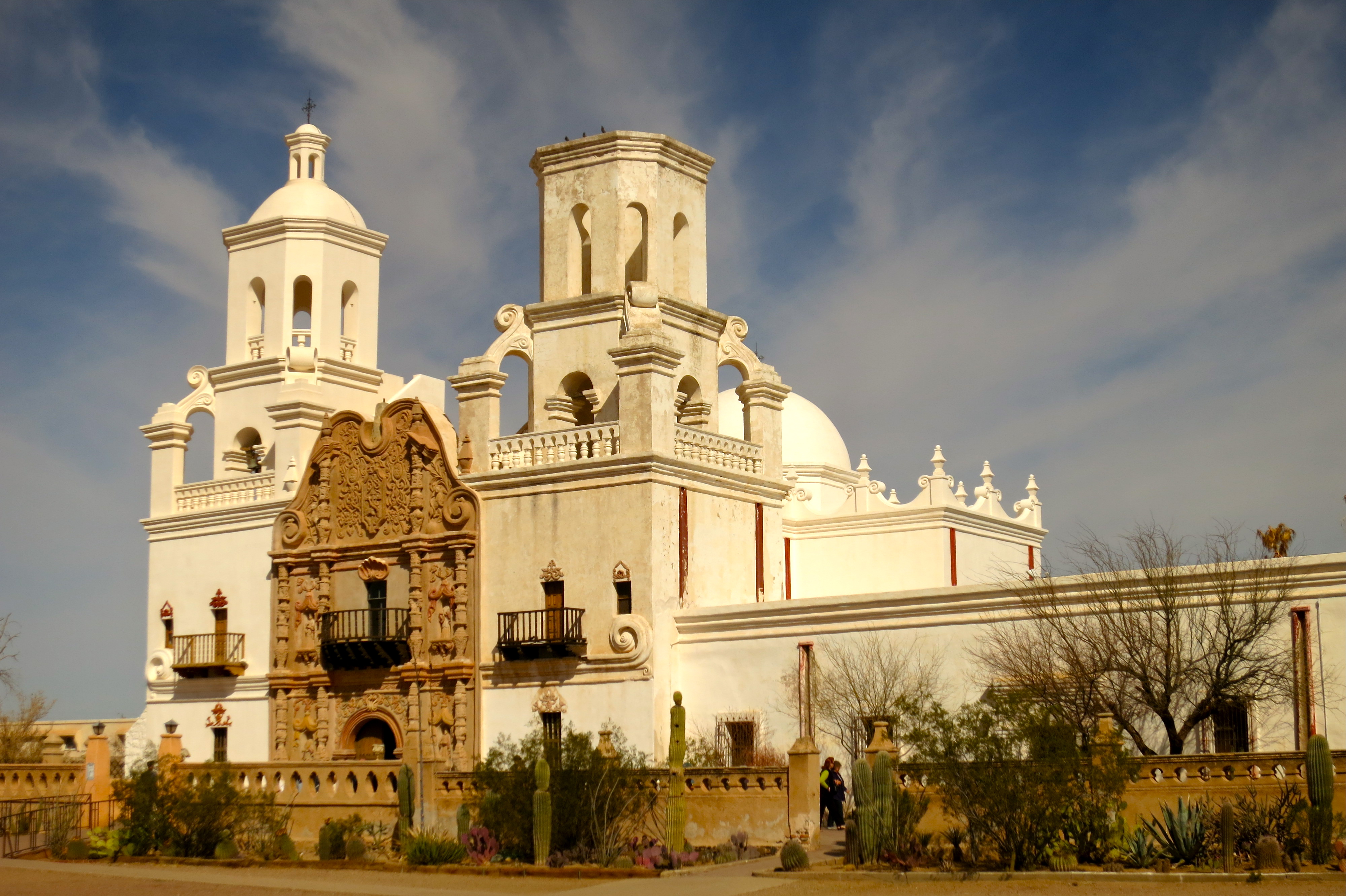
Mission San Xavier del Bac

Stan, Marilyn, Terry and I began our trip to Tubac with a stop just 10 miles south of downtown Tucson to a place I hadn’t visited in many years, Mission San Xavier del Bac, the “White Dove of the Desert”.  This historic Spanish Catholic mission was founded in 1692 by Father Eusebio Kino.

In the late 1600’s, a stranger in dark flowing robes on horseback, a Jesuit missionary, ambled into the village of Wa:k.  The desert people who resided there, the Tohono O’odham, welcomed him with open arms, thus beginning the tenure of Father Kino’s mission work.

Present-day church construction began in 1783 and was completed in 1797. Following Mexico’s independence in 1821, Mission San Xavier became part of Mexico, but with the Gadsden Purchase in 1854, ownership changed to the US.  It is said to be the oldest intact European structure in Arizona, still containing the original mural paintings and statuary within its chapel, the frescoes and back altar quite striking.  It is very much an active mission today, with services being held daily.  A separate, smaller chapel to the side of the church is available for special prayer offerings.

Mission San Jose de Tumacacori
Mission San José de Tumacacori

Mission San José de Tumacácori (Too-muh-ká-ko-ree) was our next stop, four miles outside the town of Tubac.  This historic mission was also founded by Father Kino, one year earlier than that of Mission San Xavier.  No one knows the meaning of the word Tumacácori but it is believed to be an O’odham word.

In January, 1691, on the east bank of the Santa Cruz River, the oldest mission site in what is now Arizona was built, a very modest structure compared to Mission San Xavier to its north.  It’s original name was Mission San Cayetano de Tumacácori and was renamed to Mission San José in 1751 when the mission was moved to its present location on the west side of the river.  The structure was never completed, due to many woes:  Apache hostility, lack of government support, and disease, to name a few.  When Tumacácori lost its last resident priest, scaffolding still hung from the bell tower.  The mission is unfinished yet today, although restoration work has begun on what remains.

Having had our spirits rejuvenated and broadened our knowledge of Arizona history, we headed to the growing artist colony known as Tubac “where art and history meet”.   Established in 1752 as a Spanish Presidio, it houses Arizona’s first state park and European settlement, the Tubac Presidio State Historic Park. There is a museum that is open to the public, but quite frankly, a girl can only fill her head with so many facts and figures in one day.  We chose instead to wander among the roughly 100 eclectic shops and world-class galleries, a very nice way to wind down our day.

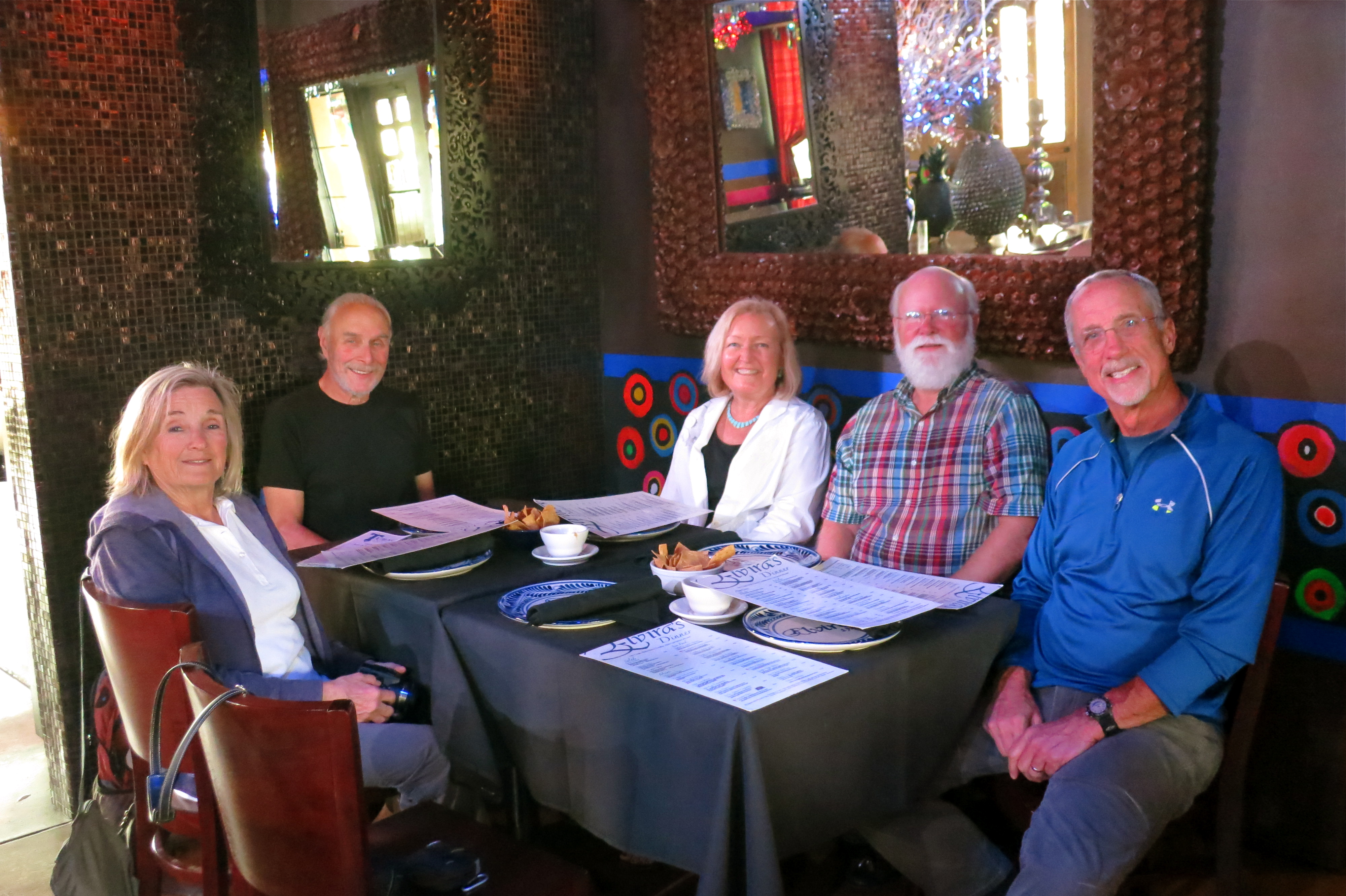
But wait, there’s more!  Our exciting finish to the day took us to Elvira’s to dine at what is probably one of the most popular and funkiest restaurants in Tubac, featuring gourmet Mexican fare.  The is the second Elvira’s restaurant to open, the first being in Nogales, Mexico.  We were thrilled to have friends Stan and Marilyn with us, along with new friends Gary and Christine, who we were fortunate to meet up with while camphosting in San Elijo State Beach in CA.  The food and drinks were yummy, the restaurant interior delightful (so sparkly) due to the hundreds of teardrops and colored balls hanging from the ceiling reflecting the light, and the company superb.

L-R:  Marilyn, Stan, Christine, Gary & Terry
L-R: Marilyn, Stan, Christine, Gary & Terry

We could not have asked for a better ending to our day and with the knowledge that we would see all four of these great folks again next winter in CA, we said goodbye to Gary and Christine.  Tomorrow will be a sad day for us as we part ways with Stan and Marilyn, two amazing friends who have crept into our hearts and will definitely remain there.

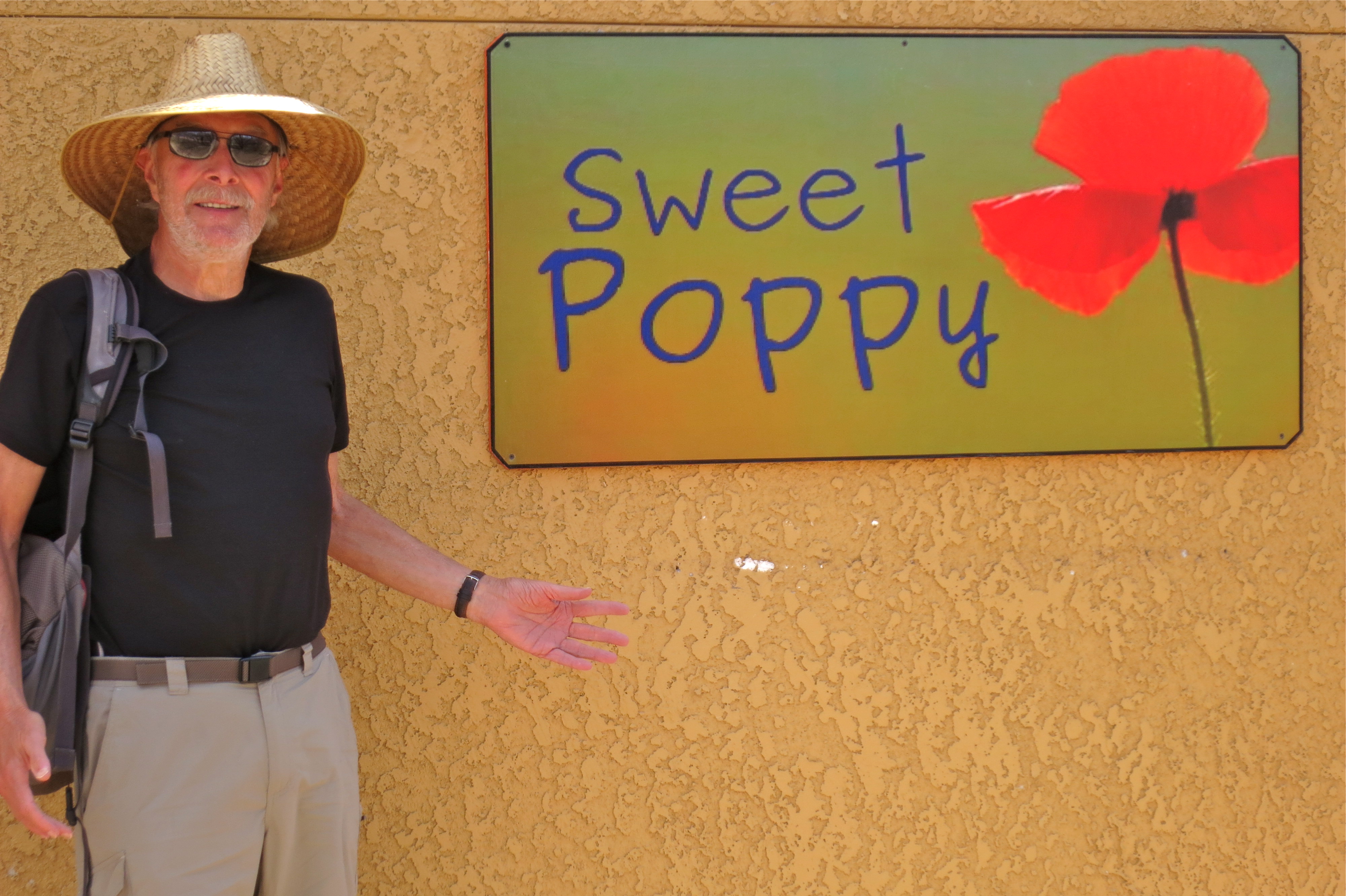
I must share one final photo of this area, as it speaks to the gentle spirit of this man.  He is not near old enough to be my poppy (papa) but I’m certain he was a sweet and gentle poppy to his children.  Sorry Stan, I couldn’t resist!

Stan, one sweet man and our dear friend

If you liked this blog post, why not scroll up to ‘Follow Us’ and enter your email address?  You just might find something that interests you.