We once again met up with RV buddies Nina and Paul for an urban hike in Del Mar. We had given up hope of finding any opportunities for hiking in the San Diego area without driving quite a distance, somewhat of a letdown after trekking through the Sierras with these same pals. As luck would have it, Nina and Paul, having once lived in Del Mar, knew of an “off the beaten path” hike that took us up a winding canyon, through some beautiful Del Mar neighborhoods, along the sandstone cliffs overlooking the railroad tracks and stunning views of the Pacific, and dumping us off onto Del Mar beach, where doggie Polly met a new four-legged friend and romped through the waves with Paul. Not quite like a hike in the Sierras but fresh air, warm sun, and crashing waves can always renew the spirit.
Terry with RV buddies Nina, Ellen, Paul, and Alex this summer
The weather was picture-perfect, a beautiful sunny day that I think Nina and Paul brought with them from the desert, as we had a good bit of gloom until their arrival. We enjoyed a few hours of catching up on each others’ lives before parting, talking of future visits and seeing Alex and Ellen, a lovely RVing couple we met through Nina and Paul earlier this year.
When we began our RV journey I knew we would have some unbelievable scenery to feast eyes upon but as I was saying goodbye to family and friends, I wasn’t sure who we might meet during our travels. We couldn’t be more pleased with the folks we have met along the way, many with the wanderlust that we have, enjoying the simple pleasure of getting in touch with nature.
New RV friends Mike & Tamara
We had the good fortune of meeting yet another lovely couple this past week at San Elijo State Beach, a couple who parked their RV almost across from us. Mike and Tamara are early retirees, as we have been blessed to be, and love traveling and getting out into nature, a perfect match with our passions. We spent a chilly evening around the fire getting to know them and another playing cribbage. Thanks Tamara for reintroducing me to the game and teaching Terry. Santa may just have to bring us a cribbage board this year.
The following morning we said our goodbyes to this charming couple, with the hope of another possible visit before we leave So Cal. One of the best parts of this journey are the people we meet along the way and we are blessed to be meeting some wonderful folks who have a zest for life and the hope of touching other lives.
If you liked this blog post, why notscroll up to ‘Follow Us’ and enter your email address? You just might find something that interests you.
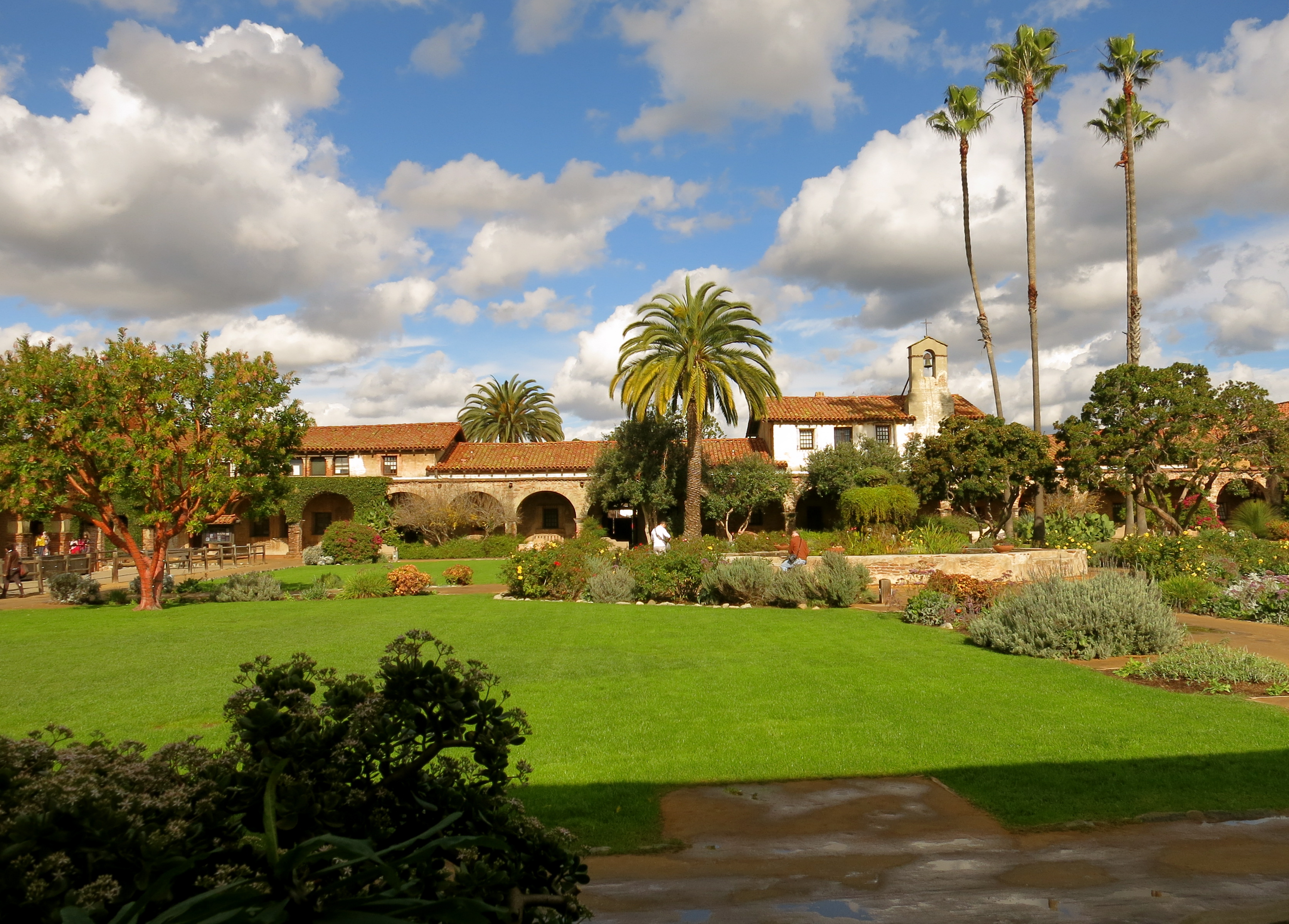
There hasn’t been much sun in sunny So Cal lately but yesterday the clouds parted for a time (a brief respite between rainstorms) so we grabbed our jackets and headed out. I had wanted to visit another of the California missions, one I had not been to in roughly 30 years, the Jewel of the Missions, Mission San Juan Capistrano. Hubby had never been so I was anxious for him to see this magnificent little sliver of California history.
This jewel was consecrated on October 30, 1775 by Father Fermín Lasuén but mere weeks later was abandoned as a revolt in San Diego took soldiers and padres away and it wasn’t until All Saints’ Day, November 1, 1776, that Father Junipero Serra re-founded the Mission. This was the 7th of the 21 California missions, and like the previous six, San Juan Capistrano was established to expand Spain’s territory boundaries and spread Christianity to the Native Americans.
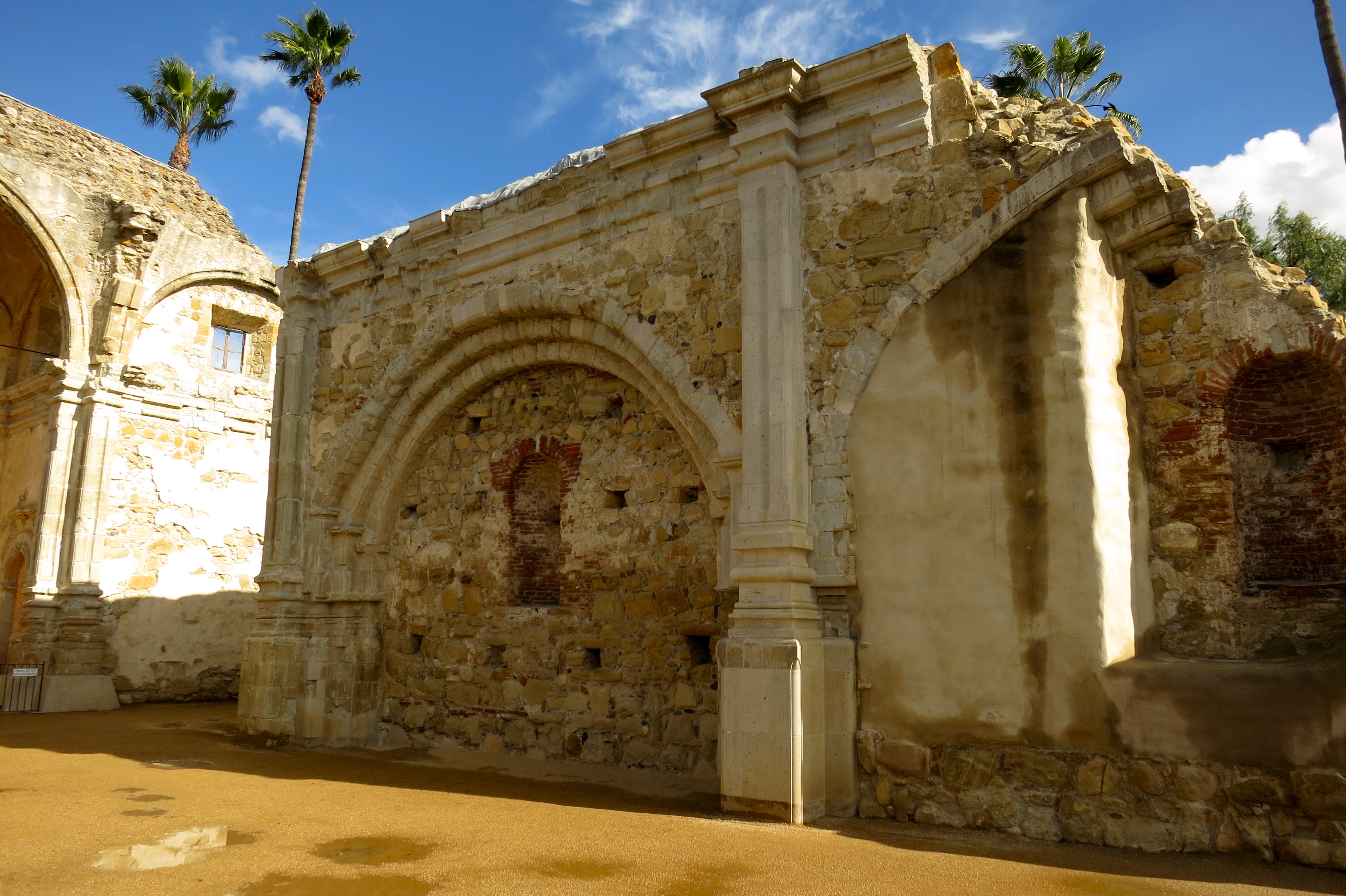
Remaining wall from The Great Stone Church
Despite the dramatic changes that Christianity brought to the Native Americans, the Mission grew to a population of over 1000 by 1806 and The Great Stone Churchhad been completed, a stunning piece of architecture built in the classical Greco-Roman styling. Many modern-day architects have dubbed this the “American Acropolis”.
Bells were vitally important to the daily life of all the missions, being rung at mealtimes, for religious services, funerals, births, etc. and the Great Stone Church had a massive 120-foot bell tower, which could be seen and heard for more than 10 miles. On the morning of December 8, 1812, tragedy struck when a 7.0 magnitude earthquake shook the earth, completely destroying the bell tower and the main body of the church. Forty worshipers who were attending mass at the time, along with two boys who had been ringing the bells, lost their lives as they were buried under the rubble. Thus began the decline of Mission San Juan Capistrano.
Great Stone Church bells
The four bells from the bell tower were salvaged from the wreckage and today stand in a brick companario (bell wall). The Great Stone Church has never been reconstructed as no one at that time had the construction expertise needed for such a daunting task. In 2002 the renown World Monuments Fund put “The Great Stone Church” on its List of 100 Most Endangered Sites. A series of retrofits was completed on the church in 2004 at great cost.
By 1821 Mexico won its independence from Spain and California became a Mexican territory. Within 12 years the Mexican government ended the mission system and the property was sold off to wealthy Californians. The Mission itself became a private ranch.
Mission San Juan Capistrano
Remaining wall from The Great Stone Church
Great Stone Church bells
Archway ruins
San Vicente bell
Garden glimpse
Garden cacti preparing to bloom
Golden garden sunflower
Junipero Serra statue
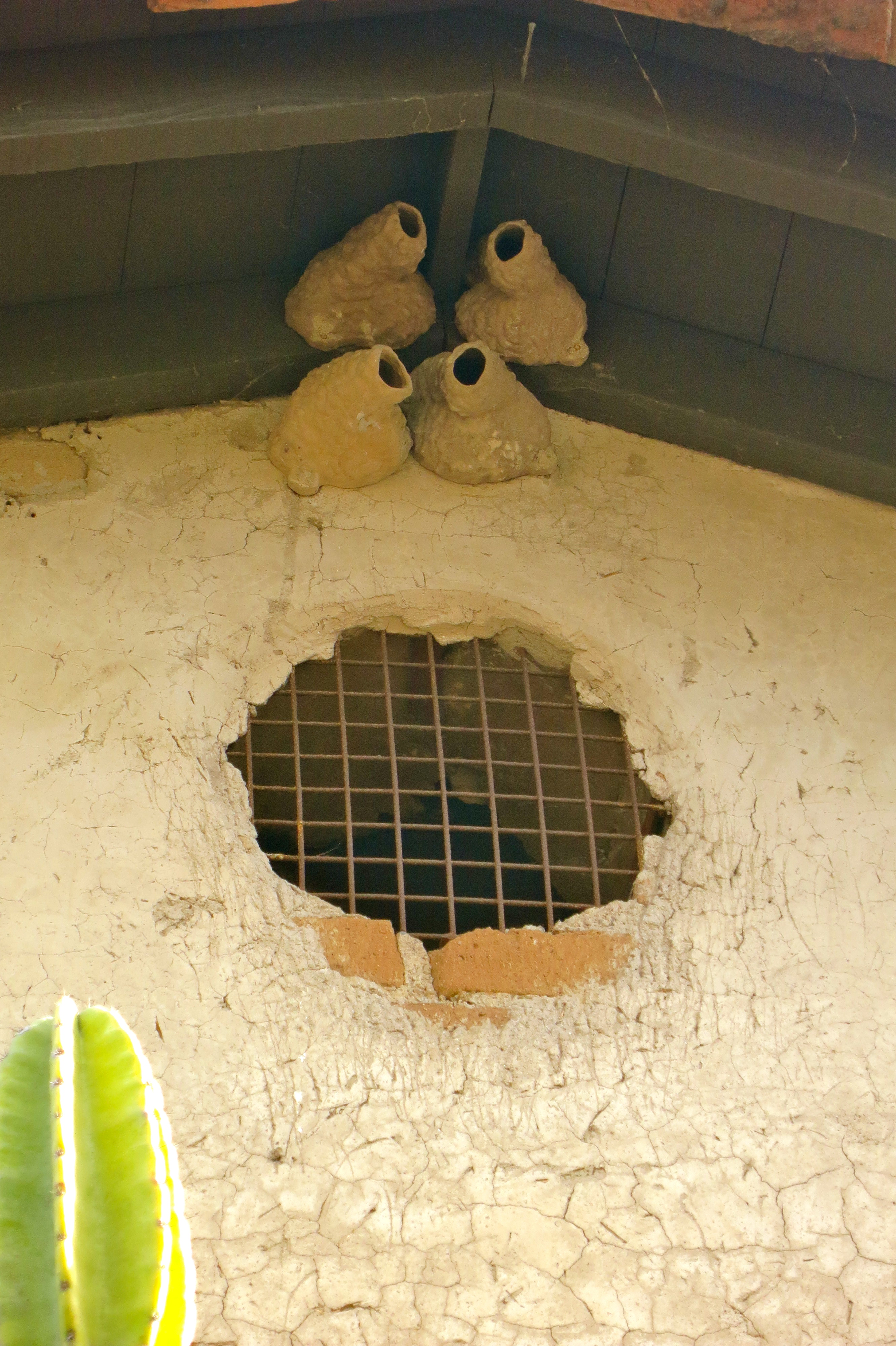
Cliff swallow mud nests
Simple wooden cross
Beaded window
Brick archway
Lone bench for reflecting
Holy water font
Serra Chapel
Mission Basilica back altar
Garden-filled grounds
Delicate water lily
Window into the past
Cemetery monument
Mission Basilica bell tower
A few years later the United States won the Mexican-American War and Mission San Juan Capistrano saw yet another change as the parishioners wanted the mission lands returned to the church. President Abraham Lincoln responded to their pleas and in 1865 signed a proclamation returning the ownership of the Mission to the Roman Catholic Church.
Cliff swallow mud nests
Even with the rich history that swirls around the California missions, the “signature icon” of this particular site is the cliff swallows that migrate here every March, making their 6000 mile trek from Goya, Argentina, their winter home. The Great Stone Church has the dubious honor of housing these beautiful feathered creatures that were so loved by St. Francis. Each March 19th on St. Joseph’s Day, a celebration is held marking the return of the swallows.
Due to a loss of water and food sources with the spread of urbanization, fewer swallows return to the Mission annually, finding refuge closer to creeks. For those who do return, they can be seen building their mud nests in the church eaves and near the end of October they circle the Mission before bidding farewell, beginning their long journey back to South America.
Serra Chapel
Mission San Juan Capistrano is also home to the oldest building still in use in California, the Serra Chapel, built in 1782, where Father Serra was known to celebrate mass. Today some morning services are still held here but most religious observances are conducted at the Basilica next door to the Mission, built in 1986, and designed after the original stone church. Housing a striking 16-ton back altar carved in cedar and covered in gold leaf, it is reminiscent of 17th century Spanish and Mexican colonial altars.
Touring the magnificent landmark of Mission San Juan Capistrano can be done by way of a self-guided audio tour or docent-led. However you prefer to wander these sacred grounds, rest assured you will not be alone. More than 500,000 visitors come here annually to pay their respects to the “Jewel of the Missions”.
If you liked this blog post, why notscroll up to ‘Follow Us’ and enter your email address? You just might find something that interests you.
“Keep close to Nature’s heart…and break clear away, once in a while, and climb a mountain or spend a week in the woods. Wash your spirit clean.” ~ John Muir
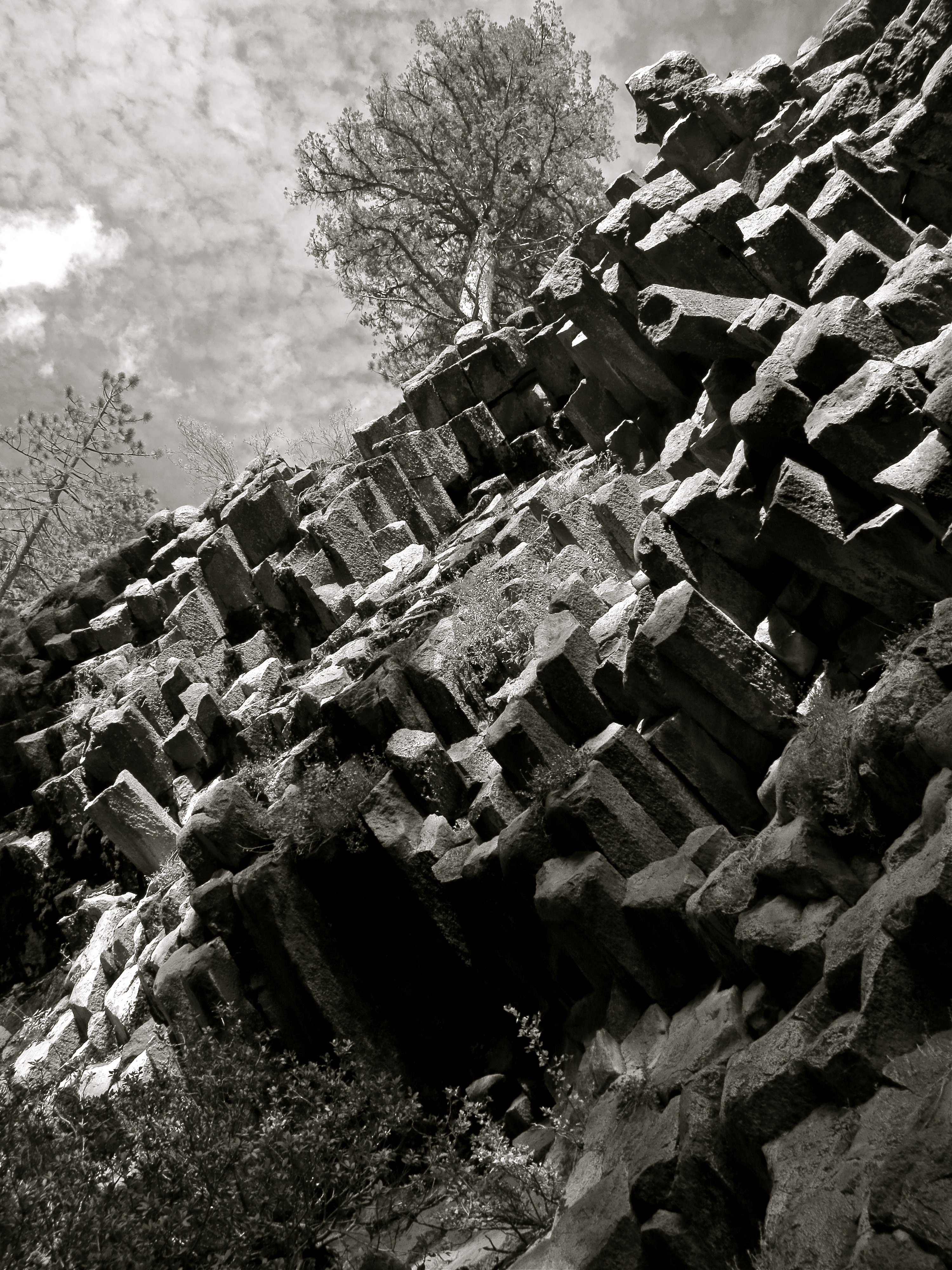
Horizontal to vertical columns
In early October, while “washing our spirits clean” in the Eastern Sierras we decided a visit to Devil’s Postpile National Monument was in order. On an overcast, chilly day we headed up the mountain with friends Nina, Paul and their lovely pooch Polly to see this rare geologic site, about 40 minutes outside Mammoth Lakes.
Lovely fall colors against a tumbled stack of basalt
The lighting that day did not allow for this novice photographer to take photos that were very exciting so I quickly set them aside and decided to pass on writing a post. Today, whether because my spirit longed to walk in the woods again or because I took the time to read a little more about this unusual basalt formation, I decided to dust off the photos and give it another go.
Some say that volcanic lava flow dating back over 100,000 years caused this basalt formation, while other dating methods set the flow as far back as 700,000 years. Suffice to say that Devil’s Postpile has been here a long time. The lava flowing to this site became confined within glacial debris and the thickness of the formations was so great, from 400 to 600 feet, that the lava cooled slowly, with the result being long symmetrical columns. A subsequent glacier polished the surface on the top of the Postpile to a smooth-as-glass finish.
Glacier polished capGray day at the Postpile
Devil’s Postpile columns range from 2 to 3.5 feet in diameter and many reach up to 60 feet in height. Most stand vertically but some are almost horizontal, quite an unusual sight. All the columns would be 6-sided (hexagonal) if the cooling of the lava had occurred perfectly evenly, an impossible feat it would seem. What makes this basalt formation unique is that 60% of its columns are hexagonal, more than most, designating it one of the world’s finest examples of columnar basalt. Sadly each year’s freezes and thaws bring down more of the outer columns.
Rainbow FallsNina, me, Paul, & Polly at the falls
Talks of building a hydroelectric dam at this very site threatened to collapse this unique spectacle into the San Joaquin River. In 1911, before this fateful event could take place, an order by President William H. Taft granted Devil’s Postpile the status of National Monument.
If you venture into the Ansel Adams Wilderness near Mammoth Lakes, where the John Muir and Pacific Crest Trails merge together on the monument land, Devil’s Postpile awaits you along a 2-mile hike that eventually leads to Rainbow Falls, a 101-foot drop into the San Joaquin River, named for its many rainbows appearing where the pounding waters flow into the river. Although no rainbows greeted us on this gray overcast day, Rainbow Falls was an added little bonus at this rare geologic site.
Strong vertical columns falling away
If you liked this blog post, why notscroll up to ‘Follow Us’ and enter your email address? You just might find something that interests you.
Look deep into nature and then you will understand everything better. ~ Albert Einstein
I love the early morning, that quiet time before the pace that takes over the rest of the day kicks in. Today is my day to do sprints, a way for me to “shock” my body, taking it out of its normal routine and kicking up the cardio a bit. I know this is not for everyone and some days my body seems to be asking me, “are you sure this is what you want to do?”, but after it’s over I feel invigorated, so for me 30 minutes once a week works. Being on the beach is the perfect place to do this, a nice soft surface, a cool breeze, the pounding surf, and the salty air. What could be better? Ok, a nice gentle walk along the beach, but I digress.
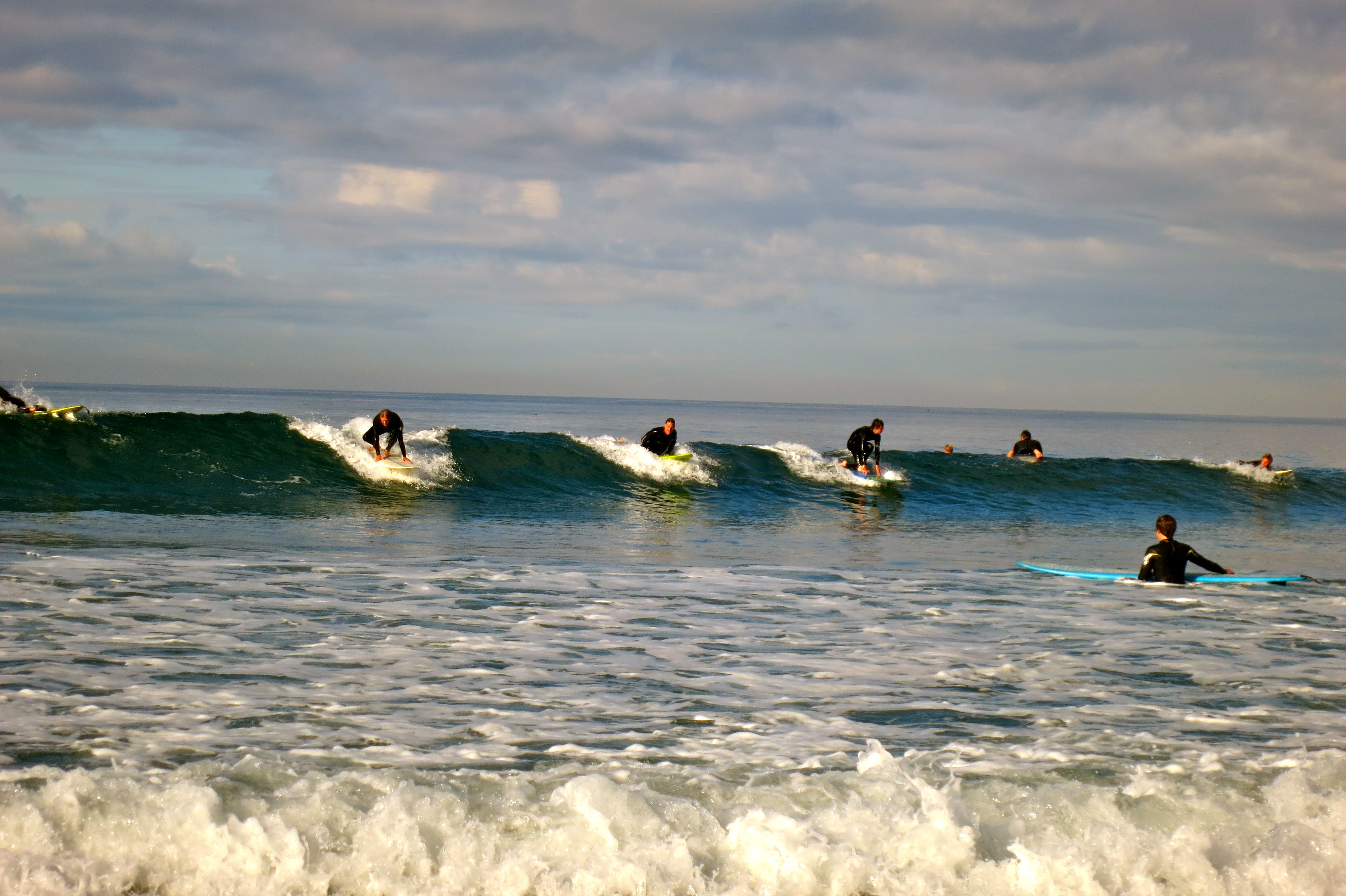
All together now ~ surf’s up!
Exercise time is over so I kick off my shoes and walk back in the surf, another great resistance exercise for the old bod. The water is a refreshing 64º, that ‘just right’ mix of a little gasp when the waves rush over your feet and that feeling of utter bliss when the tide pulls back again and the sand is running through your toes.
Brown pelicans in flight
This is my time for reflection, meditation by the water if you will, and at times I find my thoughts moving back through time to the beautiful, rugged Oregon coast where we spent a few months earlier this year, and thanks to Gunta and her amazing photography, I get my regular fix. San Diego is equally as beautiful and we feel blessed to winter here.
Paddle boarder catchin’ a waveWipeout!
Today began with a mixture of clouds and sunshine. Mother Nature seems unsure which direction she wants to head, enticing us with a little sun, then pulling the clouds back like a nightshade, bringing a little chill to the air. Whichever she decides, it looks to be a glorious day with temps around 70º.
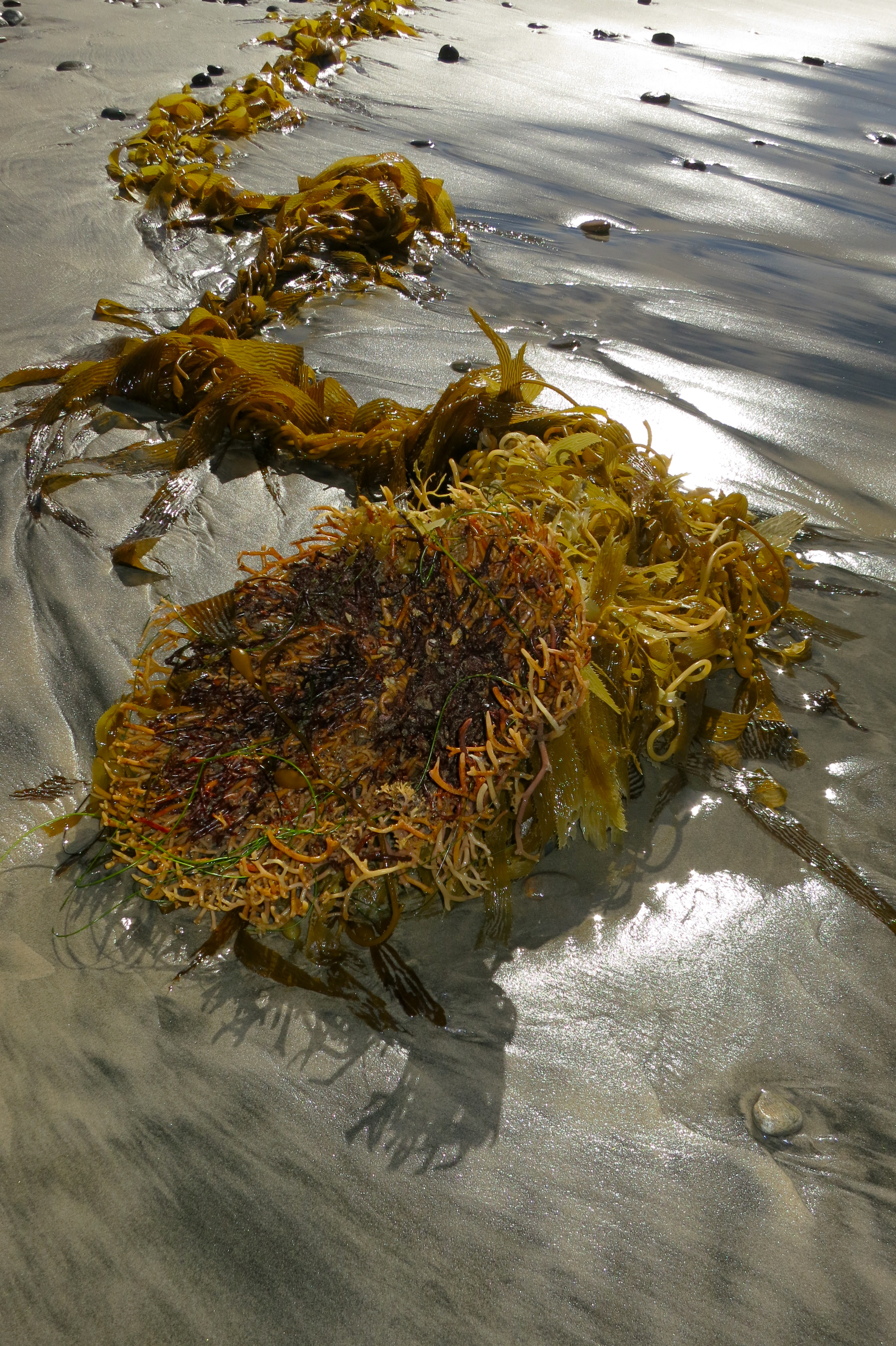
Kelp~the sea’s gift to the shorebirds
My walk back has me jumping over large masses of seaweed which the ocean has presented as a gift for waiting shorebirds. There are a large number of kelp beds off-shore near San Elijo State Beach and what may be viewed as large buggy masses to us is a veritable feast for these birds, and the kelp beds themselves are recognized as one of the most dynamic ecosystems on Earth. Everything has its place in the world…perfect harmony.
Back at the RV, time for some breakfast of my own. Today I’ll share with you one of many smoothie recipes I throw together. We like to get most of our carbs from vegetables, the green leafy kind being most dominant but berries just cannot be beat blended into a smoothie and are oh-so-yummy! Here is what was on the menu today, should you be so inclined to whip yourself up one of these ice-cold treats.
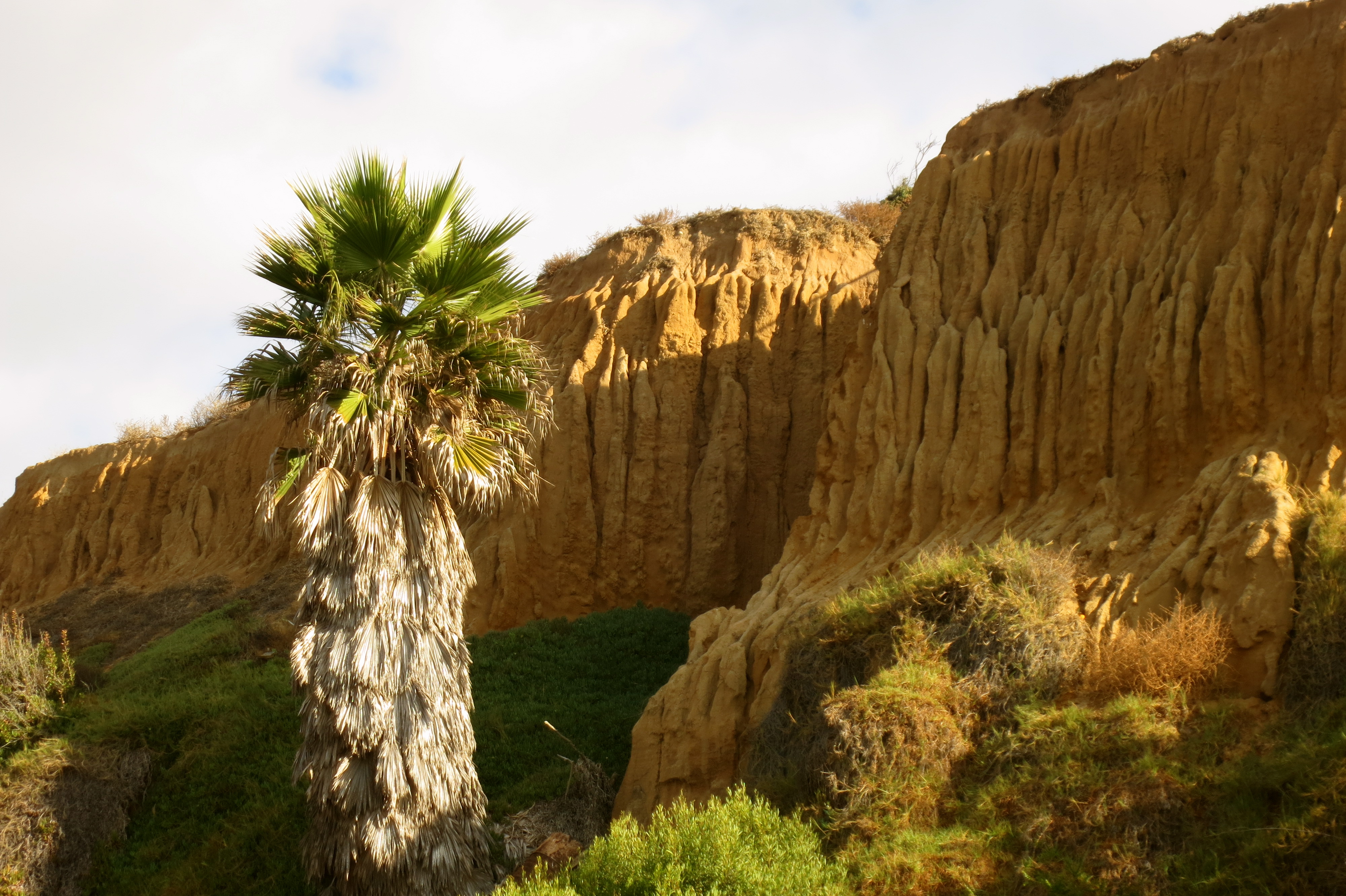
Bluff along the beach.
Berry-Spinach Smoothie
(use organic ingredients when possible~makes 2 large drinks)
2 c. frozen mixed berries
1 c. water
1 scoop protein powder
3 large handfuls spinach
Juice of 1 lemon
1/4 avocado
1 T. flaxseed oil or ground meal
Blend and enjoy!
Mother Nature has spoken; looks like another warm sunny day in paradise. I hope wherever you are, even if the sun isn’t shining, you are having a marvelous Saturday. Now off to work I go with a very big smile on my face.
If you liked this blog post, why notscroll up to ‘Follow Us’ and enter your email address? You just might find something that interests you.
There has not been much opportunity yet for San Diego adventures since we began our latest camp hosting gig at San Elijo State Beach, so I thought I would bring back another “blast from the past”, albeit it recent.
Nestled in the White Mountains in the Eastern Sierras, a spectacular slice of nature in Northern California, lies the Ancient Bristlecone Pine Forest at elevations ranging from 9,800 – 11,000 feet. Our visit in mid-October was perfect timing, immediately after the first snowfall of the season high in these majestic mountains.
Bristlecone back-lit by morning sun
The Great Basin Bristlecone Pine survives here in the harshest of conditions (fire, excessive rainfall, frost, snowfall, little soil), a most amazing feat. These trees have proven to be some of the oldest in the world, many more than 1000 years older than any other species, their existence predating the birth of Christ. Methuselah, the oldest living organism on earth, a mind-blowing 4,843 years of age, stands in a grove of bristlecone pine aptly named after him.
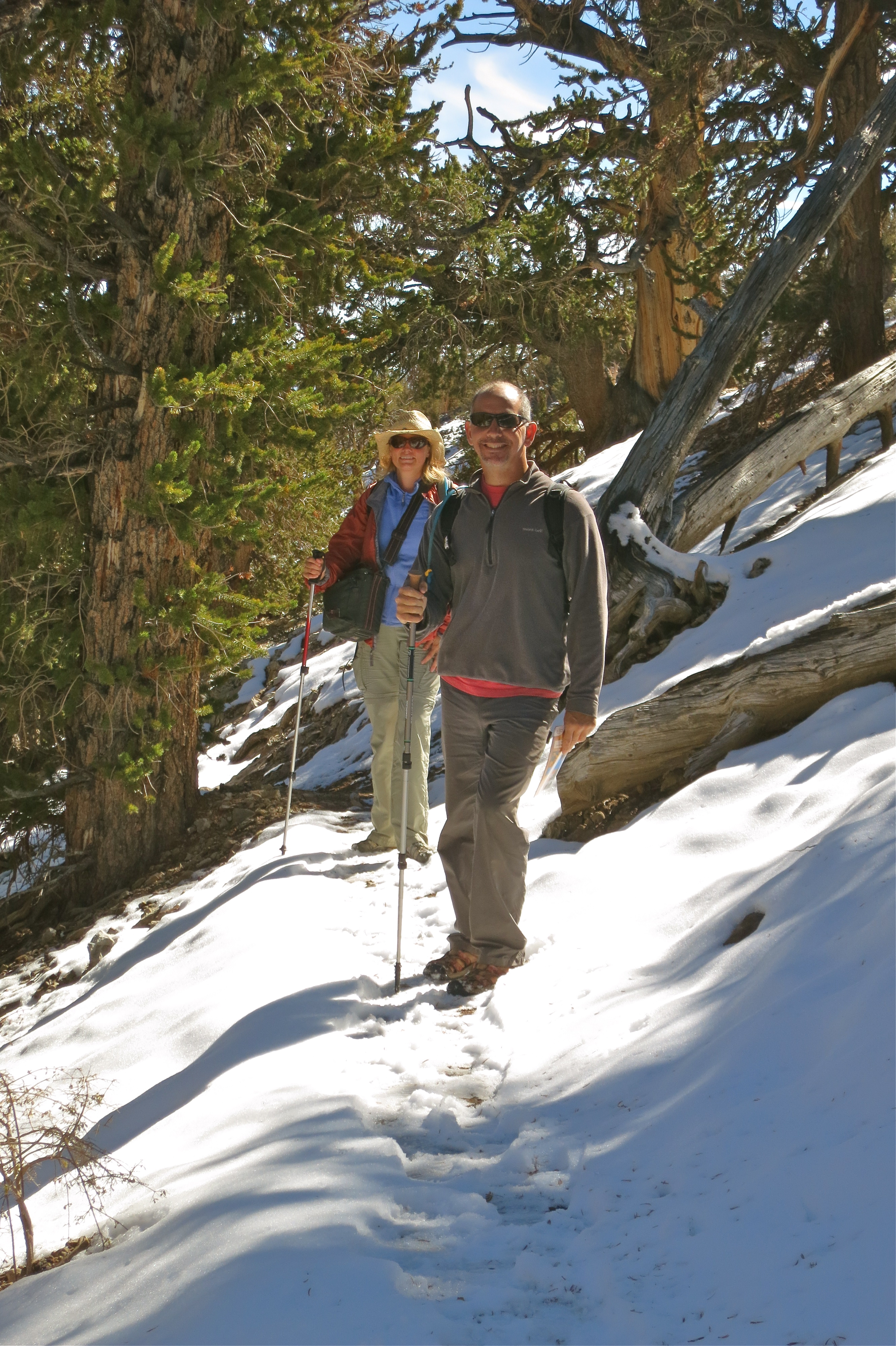
We set out on the Methuselah Trail (a 4-mile loop) with friends Nina and Paul to soak up the beauty and speculate on which of these ancient wonders could be the granddaddy of them all. Her exact location is carefully protected since 1964 when grad student Donald Currey and USFS personnel cut down the bristlecone pine named Prometheus (mythological figure who stole fire from the gods and gave it to man), possibly more than 5,000 years of age at the time.The story goes that these researchers did not know of Prometheus’ age before its felling and resorted to cutting down this ancient only after an attempt at a core sampling led to a special-order drill bit from Sweden breaking off in the tree. Rather than risk the halting of Currey’s research, the decision was made to cut down the tree to determine the ring count. It appears no one raised their hand to take responsibility for the cutting, which will most likely forever remain a mystery.
Terry on the trail in this winter wonderlandNina and Paul slip-sliding along the trail
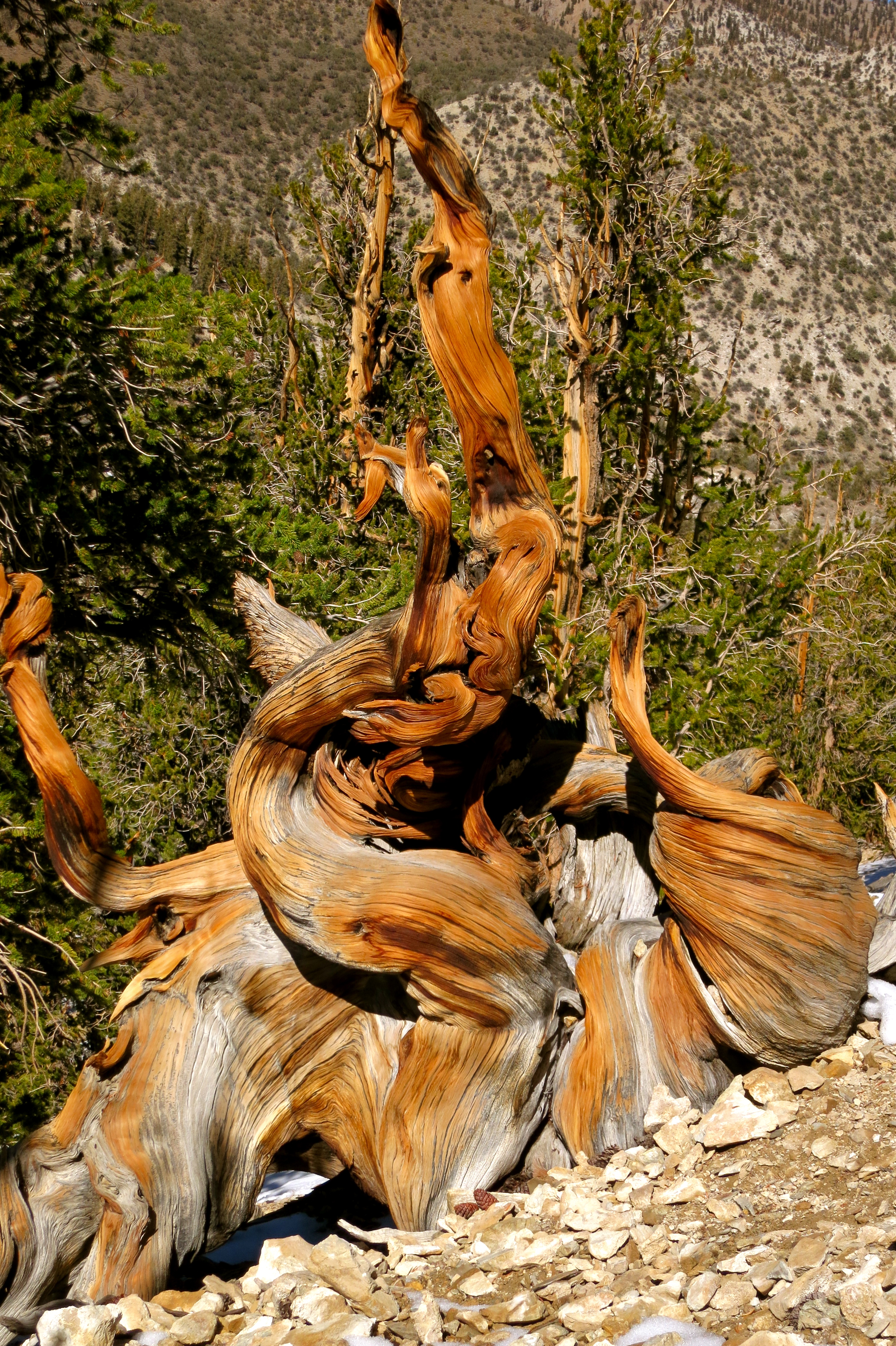
Given their age, you would think that these grand specimen would be of enormous height, like that of the redwood or sequoia, but you would be wrong. The bristlecone are not overly large, but rather medium in size, most ranging from 15-50 feet in height. Their reddish-brown bark with its deep fissures and gnarled, dwarfed growth pattern gives them a most distinctive appearance, unlike anything we had ever seen. As the tree ages, many of its layers begin to die off, leaving only a narrow band of living tissue that connects roots to a handful of branches. Its ability to survive in this state is just astounding.
Many twists and turns in its lifetime
Unlike the lodgepole pine or majestic sequoia, who both need intense heat (fire) to open their tough cones and spread their seeds, the bristlecone pine cones open when they mature, offering their seeds to the winds to continue their lineage. The Clark’s nutcracker happily assists in this endeavor, storing many seeds underground along the way for later consumption.
Bristlecone pine cone ~ WikipediaClark’s nutcracker ~ Wikipedia
The Schulman Grove Visitor Center, named after Dr Edmund Schulman, who began studying this species back in the 1950’s, is a great place to visit before your hike, with informative Park Rangers eager to give information and maps of the trail. It is a new building, due to the work of an arsonist who set fire to the original structure in September 2008, destroying the building, all its exhibits and several bristlecone pines. Add this incident to the list of reasons to support the secrecy of Methuselah’s exact location.
Basin filled with sunlight, snow and ancient treesGnarly!Bizarre growth pattern
While walking the Methuselah Trail, treading on this hallowed ground, we felt a connection to our ancestors who walked this same earth long before us. Listen to the winds and you may just hear their whispers but take note of the condition of the trail. You might find yourself on your backside as I did, thanks to a little vertigo and ice. Enough padding and my daypack made for a soft landing!
Grand vista of the valley below
If you liked this blog post, why notscroll up to ‘Follow Us’ and enter your email address? You just might find something that interests you.



















 Paint Your Landscape