A Welcoming Vibe ~ Ashland, OR

Since we visited the Oregon coast three years ago we have dreamt of returning to explore more of what has become one of our favorite states. Ashland has long been a city on our must-see list, with several friends agreeing that it was a special place. Knowing that our RV buddies Laurel and Eric (Raven and Chickadee) were there when we arrived made it that much sweeter.

Emigrant Lake
Emigrant Lake

Once we settled into our site at Emigrant Lake Recreation Area, my first request was a visit to urgent care to ensure that Terry’s shortness of breath and near constant pain was nothing more than bruised ribs from an earlier fall. Thankfully that was the diagnosis so now we could move on to having some fun, albeit at a slower pace for a while. A lovely dinner that evening at Laurel and Eric’s home set the tone for a very relaxing week.

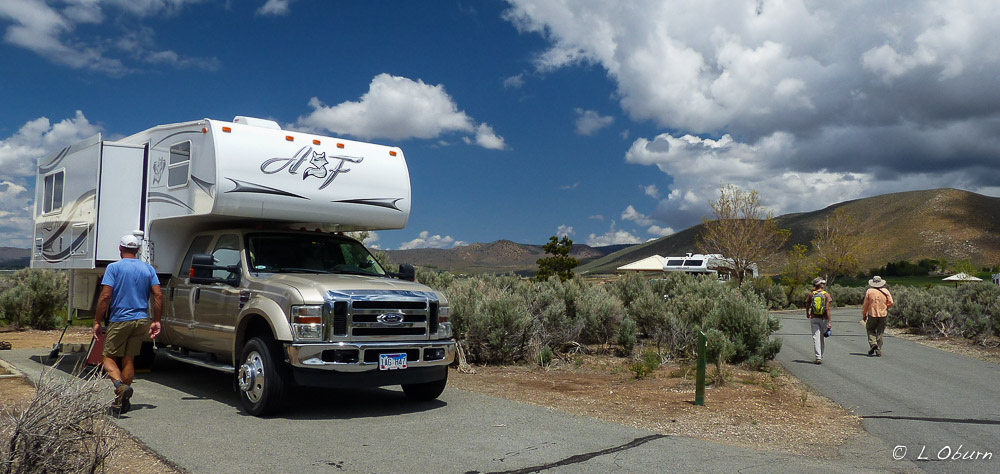
Although unexpected circumstances like bruised ribs and unseasonably hot weather that settled in later in the week changed our plans, as in no hiking or biking for several days, slowing things down a bit allowed us to become the typical tourists and enjoy some quality time with friends.

Laurel and Eric were gracious hosts to their home city, taking us on a lovely hike through Lithia Park, a beautiful city park that I would love to revisit in the fall when the maple trees are at their peak colors. Laurel also shared some of her longtime girlfriends with me, inviting me to a day of arts and crafts where I took away some colorful artwork to brighten up our little Fox.

Lovely Lithia Park
Lovely Lithia Park

First Friday found Terry and I wandering the downtown streets to explore interesting galleries, talk to the artists, and listen to the joyful music of Zimbabwe performed by Sonic Kaleidoscope…great fun! We enjoyed dinner and drinks at the Standing Stone Brewery, where Steel Cut Stout won for favorite brew.

We returned to downtown Ashland several more times, visiting the Saturday farmers’ market, the artisans’ market, and the Ashland Co-op. From the quaint coffee shops we visited in the Historic Railroad District, to the farmers’ market, the artisans’ market, and the wonderful Ashland Co-op, the welcoming nature of the locals confirmed our belief that there was something special about this lovely city. And the folks at Mix make some darn fine gelato. I loved the chocolate truffle and Terry the salted caramel but we both agreed that mixing the two was heaven in a cup!

Ashland may be best known for its Oregon Shakespeare Festival, which runs nine months of the year. We hoped for last minute tickets for the show Pericles, which we were told was a must-see, but unfortunately there were none to be had. What we enjoyed instead was a free performance at the Green Show, the last performance of the season by Sonic Kaleidoscope. It was a joy to watch these talented grade school and high school kids playing the marimba for their final performance of the season. The only downside was the temperature was hovering around 100°. One last stop to sample a flight at Caldera Brewery seemed to be what was needed to slake our thirst on a hot Ashland day. The Pilot Rock Porter seemed to win the taste-test for both of us.

The best part of our week, the gift that fed both body and soul, was enjoying a lovely dinner our last night in Ashland with Laurel and Eric, at friends Ted and Katherine’s home. We had met Ted and Kath at Anza Borrego this past winter and they are delightful.

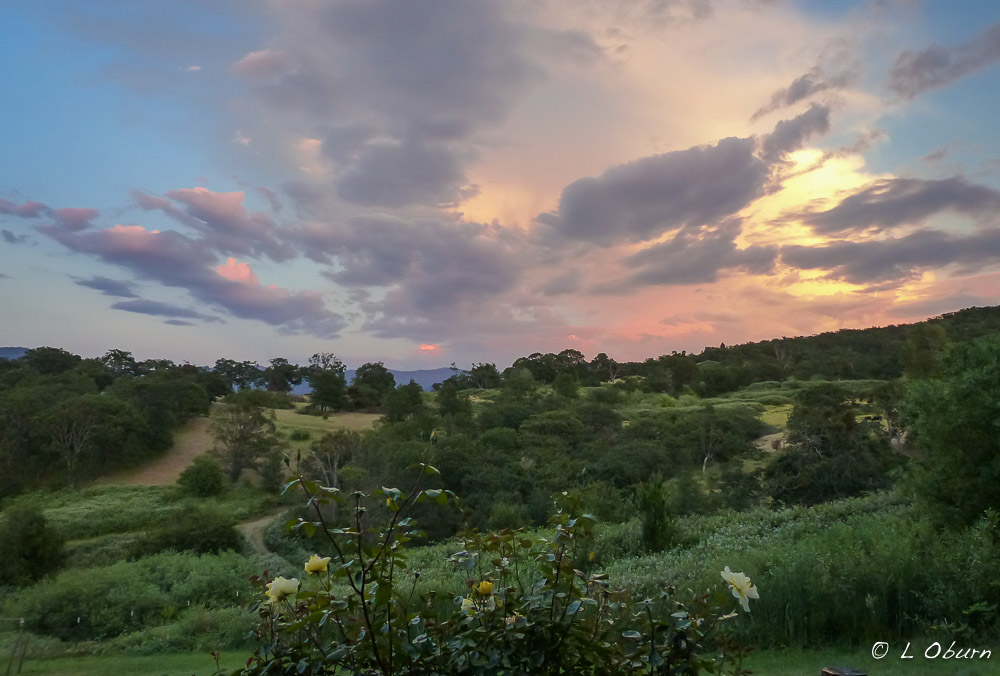
Their fabulous home has breathtakingly expansive views, beautiful gardens, a lovely little vineyard, and some of the most spectacular sunset views right off the deck. Their generosity was so heartwarming, making our time in Ashland special indeed.
A Turbulent Past ~ Lava Beds National Monument

Our last stop in California, Lava Beds National Monument, lies at the remote northern end of the massive Medicine Lake Volcano. During the past half-million years this shield volcano has erupted many times, spewing gas and lava, creating an otherworldly landscape. It is still considered tectonically active, having last erupted ~ 950 years ago. Today you can explore the resulting geologic features – lava tubes, spatter cones, and surface lava flows. The caves were created by lava flowing 10,500 to 65,000 years ago.

Lava Bed’s historic turbulent past mimics its geologic turmoil. Early Euro-American settlers uprooted the peaceful Modoc tribe who lived on this land, forcing their move to the Klamath Indian Reservation, yet another sad time in the history of our nation. Modoc leader Kientpoos, better known as Caption Jack, came back to the reservation with a band of 150 men, women, and children, determined to take back their sacred homeland.   The resulting tension between the Modocs and the settlers brought about the Modoc War of 1872-1873.

The natural fortress where the Modocs retreated, known as Captain Jack’s Stronghold, remains today, a tribute to the fortitude of 60 warriors who held off a much larger army force for five months.

There are over 500 lava tube caves in Lava Beds National Monument, the highest concentration in the U.S. These tubes formed when the outer edges of lava flows began to cool, eventually creating a roof, much like surface ice on a flowing river. If multiple flows followed one channel, lava tubes were created atop one another, like stacked pipes. When the ceiling collapsed from its own weight, access was opened to the caves below. Twenty of the 500 lava tube caves are considered developed, with forged paths through them, ready to explore, rated from least challenging to most challenging.

Entrance to Skull Cave, where many animal and human remains have been found

We have been in many caves during our travels, Kartchner and Carlsbad, to name a couple. I have enjoyed them immensely but they had a few items that were missing in the Lava Bed’s caves, namely large-domed chambers, smooth walking surfaces, lighting and a ranger to show me the way.   For someone who is claustrophobic, this was going to be a challenge.

The lava caves are important habitats for 14 different species of insect-eating bats. In the summer female bats raise their pups in maternity colonies and in winter the caves become refuges for hibernating bats. Other critters slithering through the caves, which I tried not to think about when we were inside, are cave crickets, millipedes, and rubber boas, yet another reason for me not to explore the most challenging caves on my hands and knees.

Many of the caves, no matter the temperature above ground, remain at a cool 55°F. Some exhale frosty breaths that stay below freezing, with year-round skating rinks on their floors.

Entrance to Mushpot Cave

The Visitor Center recommendation for number of light sources in the caves is three flashlights per person. Perhaps this is more for those phobic-souls who would have a complete meltdown should they have a light malfunction. We carried three total, two that we rented from the Visitor Center and one of our own.

Fleener Chimneys, spatter cones that built up as hot gases threw globs of lava into the air

Closed-toed shoes, long pants and a hard hat were also suggested. We passed on the purchase of the hard hats and opted for ball caps instead since I didn’t see the need for hard hats in our future. But, if you bang your head on a low-hanging ceiling, as I did, you might begin to think that a hard hat would be a nice prop to have when you have a yearning to belt out ‘YMCA’. 😉

We explored six caves in the least to moderately challenging categories and poked our head into another in the most challenging. Sentinel Cave, 3280′ in length, was the longest 30-minutes of my life and deathly quiet, with only my occasional outbursts of “I don’t know if I can do this” spoken into the black void.

Golden Dome was the most interesting, with beautiful colors reflecting off water droplets that beaded up on a coating of hydrophobic bacteria. This cave can also be a bit disconcerting as you encounter a figure-8 that could keep you walking in circles if you didn’t pay close attention.

So, would I venture into these caves again?  Surprisingly, yes I would, if you didn’t ask me to do it on my hands and knees. 😉  If you like cold, damp, dark places where the only sounds are the occasional dripping water and your own raspy breaths, this might be something you too would enjoy. It it really pretty awesome when you think about how these unusual caves were formed.

White pelicans at Tule Lake

Of Fire and Ice ~ Lassen Volcanic National Park

Advice from a Volcano: “Stay active; keep your inner fire burning; it’s ok to let off steam; go with the flow; be uplifting; it’s all a matter of time; have a blast!” ~ Ilan Shamir

After living in Yellowstone National Park for two years, I became fascinated with the powerful forces of nature at work below the Earth’s surface, so it was not surprising that I was drawn to the “lava-strewn” landscape of Lassen Volcanic National Park.

Lassen Peak with Manzanita Lake in the foreground

All rocks found in this park originated from volcanoes and all four types of volcanoes can be found here: shield, cinder cone, composite, and plug dome.   The main peak in the park is 10,463’ Lassen Peak, a plug dome volcano, formed when lava is too thick to flow a great distance so rises directly over the vent to form a dome.   She is a beauty and can be seen from many vantage points throughout the park.

May 22, 2015 marked the centennial of the Lassen Peak eruption, a cataclysmic event that blew a cloud of ash almost six miles into the atmosphere. Volcanic ash rained down over 200 miles to the east and boulders weighing as much as 300 tons were carried five miles from the peak. This explosion set the stage for establishing Lassen Volcanic National Park in August 1916.

Seismologists continue to study volcanic activity within the park. Earthscope, a plate boundary observatory station, is part of a network of over 875 stations installed across the western U.S. to study movement of the Earth’s crust.

Lassen Peak viewed from Devastated Area

We stayed at Manzanita Lake in the northwestern part of the park, the only open campground when we arrived on Memorial Day. Lassen is one of the lesser-visited National Parks, possibly because it is a bit “off the beaten path”. With so much beauty and so much to offer, we found ourselves wishing for more time. A return trip is in order, as we felt we had only scratched the surface in 4 days.

Here is what we were able to squeeze into our short visit:

1) Manzanita Lake Trail – a tranquil 2-mile trail that is a must at sunset. Go at various times of the day and you will find something new at each visit.

2) Manzanita Creek Trail – a 7-mile obstacle course of fallen logs across the trail, caused by a severe windstorm earlier in the year. This was a ranger recommendation but the only positive for us was that it could be done from the campground.

Manzanita Creek Trail strewn with downed trees

3) Summit Lake Trail – The entire trail is an ~ 11-mile loop, with lots of crystal blue lakes. We did 7.5 miles to Lower Twin Lake, which brought us past four of them. We would have liked to complete the entire loop but Terry had taken a nasty fall a few nights before and did a fine job bruising his ribs. It seems climbing over downed logs on the trail wasn’t helping them much. 😉 Needless to say I had to hike on my own for the rest of our stay in Lassen.

Summit Lake
Summit Lake

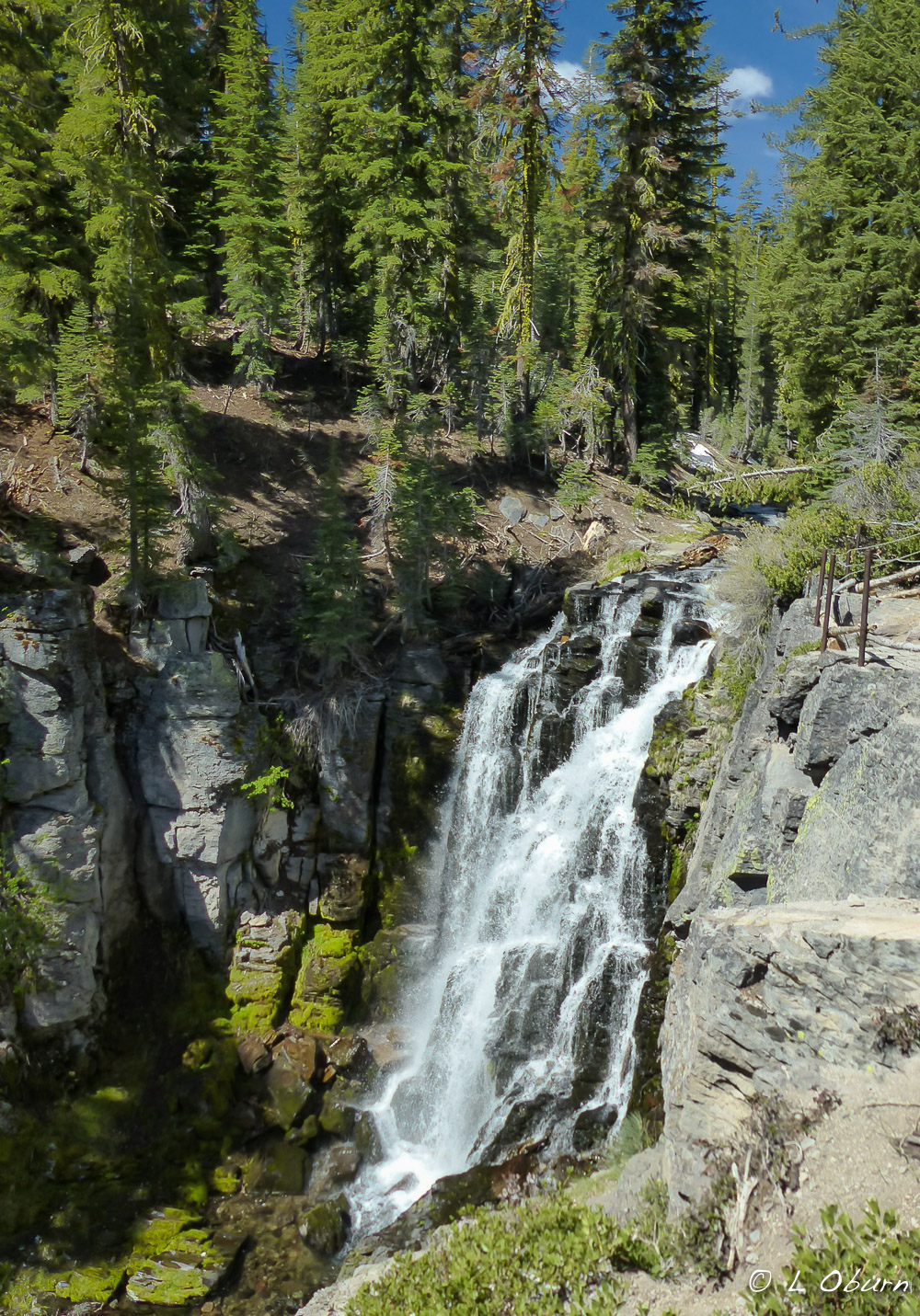
4) Kings Creek Falls Trail – a 3-mile trail down to a large waterfall. The foot trail was closed due to poor trail conditions so partway into the hike you were diverted to the horse trail, a steep rocky descent down to the falls. This hike had great views of Lassen Peak and the falls were quite lovely.

Kings Creek Falls
Kings Creek Falls

5) Road Trip – We drove the winding 30-mile main park road from north to south…gorgeous!

A few items on our list that will have to wait for another visit:

  •  Lassen Peak Trail – closed due to snow
  • Bumpass Hell Trail – closed due to snow
  • Cinder Cone – a hike to the top of a dormant volcano
  • Devil’s Kitchen – lots of geothermal activity in this area
  • Mills Creek Falls – tallest waterfall in the park
  • 185-mile scenic drive beginning in the town of Chester, meandering through forests, geothermal springs, craggy peaks, and lava fields of Lassen National Forest and Lassen Volcanic National Park.

Lassen Volcanic National Park has a quiet calm to it when you gaze upon its stately pines, jagged peaks still swaddled in deep blankets of snow, and crystal lakes. Yet far below the surface a fire still burns, evidenced by the hissing steam vents, bubbling mudpots and boiling springs dotting the landscape, symbols of nature’s powerful forces and diverse beauty.

A Vanishing Act ~ Washoe Lake State Park, NV

It seemed that we were finally leaving behind the cold, wintry weather of the Eastern Sierras as we continued our journey, but unfortunately not the rain. As we pulled into Washoe Lake State Park, with raindrops falling, at least the weather did not chill us to the bone, and we had two fair-sized cities within reach for restocking supplies, Carson City and Reno.

Something that did warm us even before heading to Washoe was receiving an email from a couple we had recently met, letting us know where they were headed, and saying “but you are probably many days behind us”. My reply, “just one day”, and before we knew it we were reconnecting with Life’s Little Adventures Jim and Gayle at the park. Seems we had both decided that Washoe was a quiet destination for avoiding the crowds over the Memorial Day weekend.

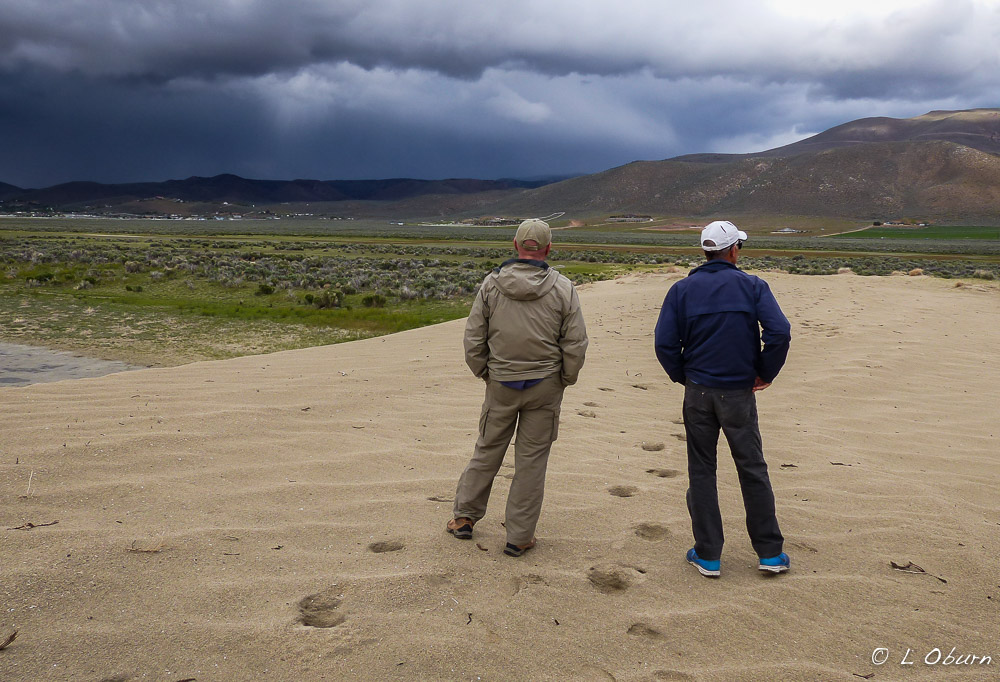
Jim & Terry watching yet another storm roll in before dashing back to the campground

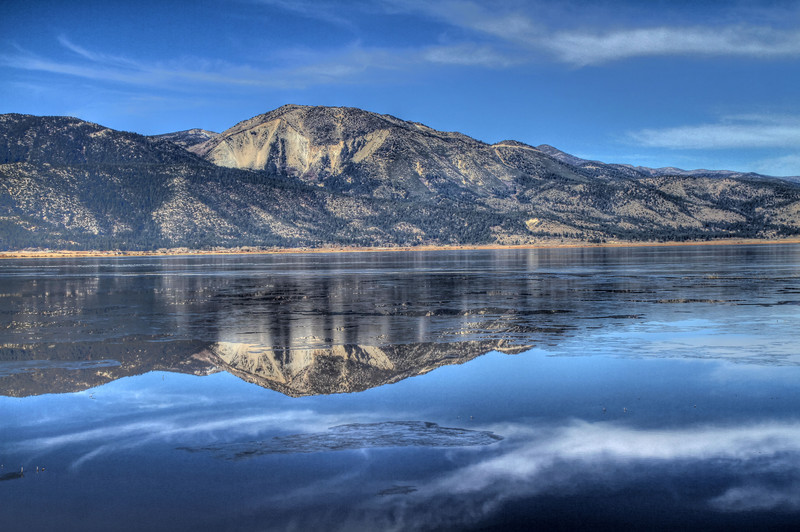
During our last visit Washoe Lake was a mere shadow of itself, but this time it had managed a complete vanishing act, bone-dry due to the drought conditions in the west. Its reliance on snowpack and its normal 12’ depth has rendered it dry several times since the ‘70’s. Someday I would love to see it as an actual body of water, with pelicans bobbing on the surface and herons feeding on the shoreline.

Dry Washoe Lake today
Washoe Lake in its heyday, photo credit wunderground.com

Even without a drop of lake water, we still feel this is a great little find. The Carson and Virginia Mountain Ranges surround the campground, making for dramatic photos of mountaintops crowned with billowy clouds. Taking a walk through the desert right outside your door will reward you with sand dunes to explore, jackrabbits to watch racing across the sage-dotted landscape, and quail scurrying through the brush. Your cozy site will be large, level, and well paved, each with its own cabana, table, and fire ring.

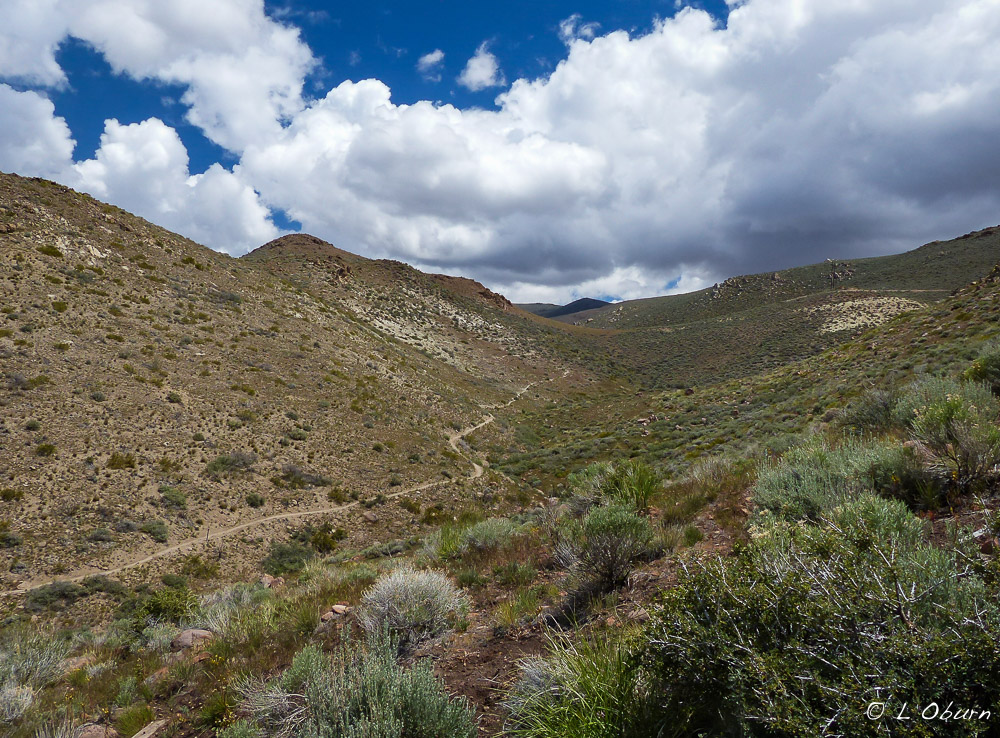
The hillside trail where we finally managed a hike .
The hillside trail where we finally managed a hike
.

After three days of rain, with some short breaks for walks through the park, only to dash back to the warmth of our rigs when the rain fell again, the four of us finally awoke to a sunny day filled with birdsong. We quickly decided that a hike in the surrounding hills was in order to rid ourselves of the cabin fever that had cast its spell over us.

L-R:  Terry, Jim & Gayle clowning around
L-R: Terry, Jim & Gayle clowning around

Nights were reserved for getting to know each other better and for our ongoing lessons in craft brews from two of the “beer sommeliers” we had originally met at Jojoba Hills.

Heading home after a successful day of hiking

I felt a bit heavy-hearted as we left Washoe Lake State Park, sad to be saying goodbye to a couple who we knew that we wanted to get to know better. Before we left we were already contemplating our next rendezvous, such is the beauty of this lifestyle. And Jim sent us off with a list of craft beers that awaited us at the wine store in Reno. 🙂

Hauntingly Beautiful Mono Lake

One of the oldest lakes in North America, at least 760,000 years old, can be seen along Hwy 395 at Lee Vining, near the eastern border of Yosemite National Park. It is the enchanting, mysterious Mono Lake, one of the most productive lakes in the world.  Mark Twain dubbed this lake the “Dead Sea of California”, but he could not have been more wrong.  Not too many species can survive in this harsh environment but those that have adapted do so in prolific numbers.

Fed by five streams, underground seeps, and the Sierra snowpack, Mono Lake has no outlet.  Because of its inability to release water, it is three times saltier than the Pacific Ocean, an extremely alkaline condition.

If you were to swim in Mono Lake, and you can, you would be so buoyant you would bob up and down like a cork in water. As a comparison, below is the saline count of a couple of well-known bodies of water:

  • Lake Tahoe – 0.001% salt
  • Pacific Ocean – 3.5% salt
  • Mono Lake – 10% salt

To convert Lake Tahoe’s waters to that of Mono Lake, you would need to add the following to one quart of water:

  • 2.5 tablespoons table salt
  • 1.5 tablespoons baking soda
  • 2 tablespoons Epsom salts
  • a pinch of borax
  • a pinch of detergent

Is it any wonder that fish cannot survive in these waters? It is amazing to me that anything can. However, brine shrimp and alkali flies seem to like these salty waters just fine.

During the early spring months, the lake is “as green as pea soup”, due to the microscopic algae bloom.   As the water warms, recently hatched brine shrimp and alkali flies feed on the algae. By summer they have consumed so much algae that the lake water becomes clear and returns to a blue color once again.

Mono Lake_150520-1200634

In the warm summer months, an estimate of 4-6 trillion brine shrimp swim in these waters. Alkali flies live along the shore and walk underwater, encased in small air bubbles for grazing and to lay their eggs. These two Mono Lake inhabitants are an important source of food for the millions of migratory and nesting birds who find their way to this salty sea.

Mono Lake_150520-1200681

Interesting chemical reactions occur when freshwater springs (calcium) meet alkaline water (carbonates).  Calcium carbonate (solid limestone) is the result, better known to geologists as a tufa. These hauntingly beautiful formations have their beginnings underwater and continue to grow as freshwater and lake water meet. There is evidence of Ice Age tufa at Mono Lake, which grew beneath the water nearly 13,000 years ago. They have a crystalline structure that differs from more recent tufa. Mono Lake’s “petrified springs” are a fascinating example of what nature can do with a few basic ingredients.

Many photographers come to the South Tufa to capture these unique limestone statues. The best time for photos is at sunrise, if the sun makes an appearance, and she has been a bit timid these past several days.

At its height, Mono Lake soared to a depth of 900 feet, but now its average depth is a mere 50 feet, with a maximum depth of 150 feet.   The lake is currently seven vertical feel lower than its targeted level. About 45” of water is lost annually to evaporation, so freshwater inflow is critical to its health. Although we have been less than enchanted with the rain, sleet, and snow flurries that have pelted this area during our visit, we are comforted knowing that Mono Lake is the better for it.

We begin our journey north in search for warmer temps, as we can’t seem to will the thermometer to move beyond the 50 degree mark yet.