If you like color, texture, or the heady scent of jasmine, orange blossoms, rose or scented geraniums, you might want to spend a few hours at a botanical garden. The San Diego Botanical Gardens are bursting with color and yummy smells and was a wonderful place to while away the day. I had been here earlier in the season, and although very nice, Mother Nature appeared to be slumbering, not ready to strut her stuff. She was standin’ tall for this visit!
Nestled in a neighborhood in Encinitas, this urban oasis boasts 37 acres of lush landscape. It is divided into 15 geographical regions, Mexico, Australia and the Mediterranean, to name a few. It was recently voted one of the 10 Spectacular Gardens Around the World; quite an honor I would say.
The emphasis here is on sustainability and conservation and the staff works to protect and restore many endangered plants. They pass on their knowledge through a wide array of classes and have some great children’s programs I am told. While there I watched as the friendly staff staged a wedding to take place later in the day. Quite the romantic backdrop to say ‘I do’. Besides all this, the San Diego Botanical Gardens features monthly events, the most recent earlier this month being their Chocolate Festival. Sure sorry I missed that one!
So much beauty compressed into 37 acres. If you like color, hope you enjoy the slideshow below.
This slideshow requires JavaScript.
If you liked this blog post, why not subscribe to my blog via feed reader or e-mail?
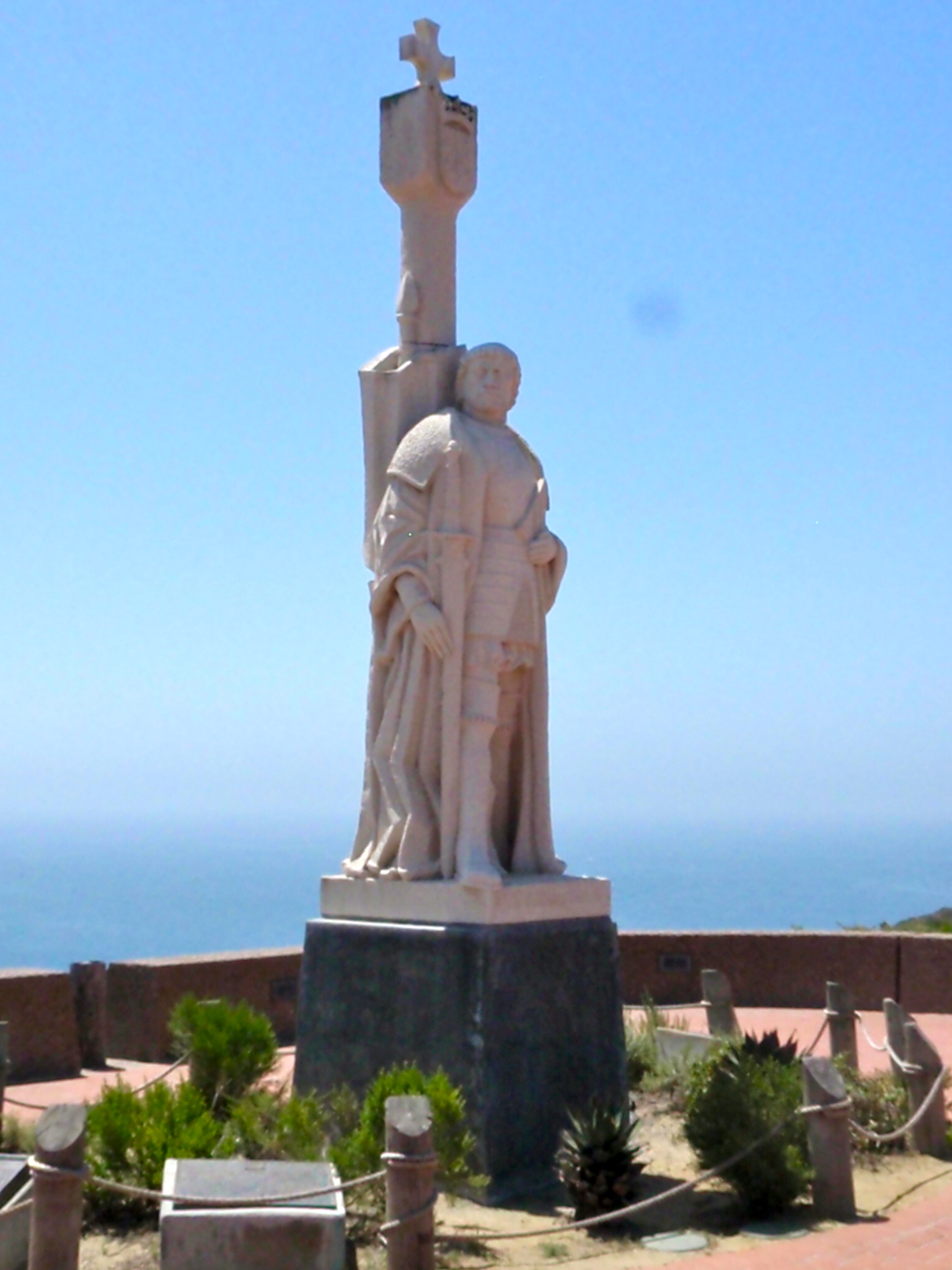
September 28, 1542 is when it all started here, California that is, at Point Loma. The Cabrillo National Monument displays the sandstone icon commemorating the exploration of Juan Rodriguez Cabrillo, which aptly overlooks the San Diego Bay.
Cabrillo was something of a mystery man. No one knows for certain where he was born or where he is buried. What we do know is that he was a Spanish conquistador and explorer and the first European, along with his expedition, to set foot on the West Coast of the U.S., right here in San Diego Bay. He had grand ambitions when he sailed north from Mexico, to chart the mythical passage from the Pacific Ocean to the Atlantic and search for gold, just to name a couple of his dreams.
After a six-day stay to wait out a storm, Cabrillo’s flotilla continued to sail north, sighting the islands of Santa Catalina and San Clemente and on to what is now San Pedro Bay near Los Angeles. No one knows for certain just how far he sailed as his original navigation log was lost. Details of his voyage and the events of his death came from an accounting that was gathered after the expedition returned to Mexico without him.
On January 13, 1543, his exploration goals short-lived, Cabrillo allegedly died on one of the Channel Islands from an apparent infection that set in after he suffered a broken leg. Although he did not live to see his exploration dreams fulfilled, the knowledge gained of winds and currents and landmarks charted made later exploration safer.
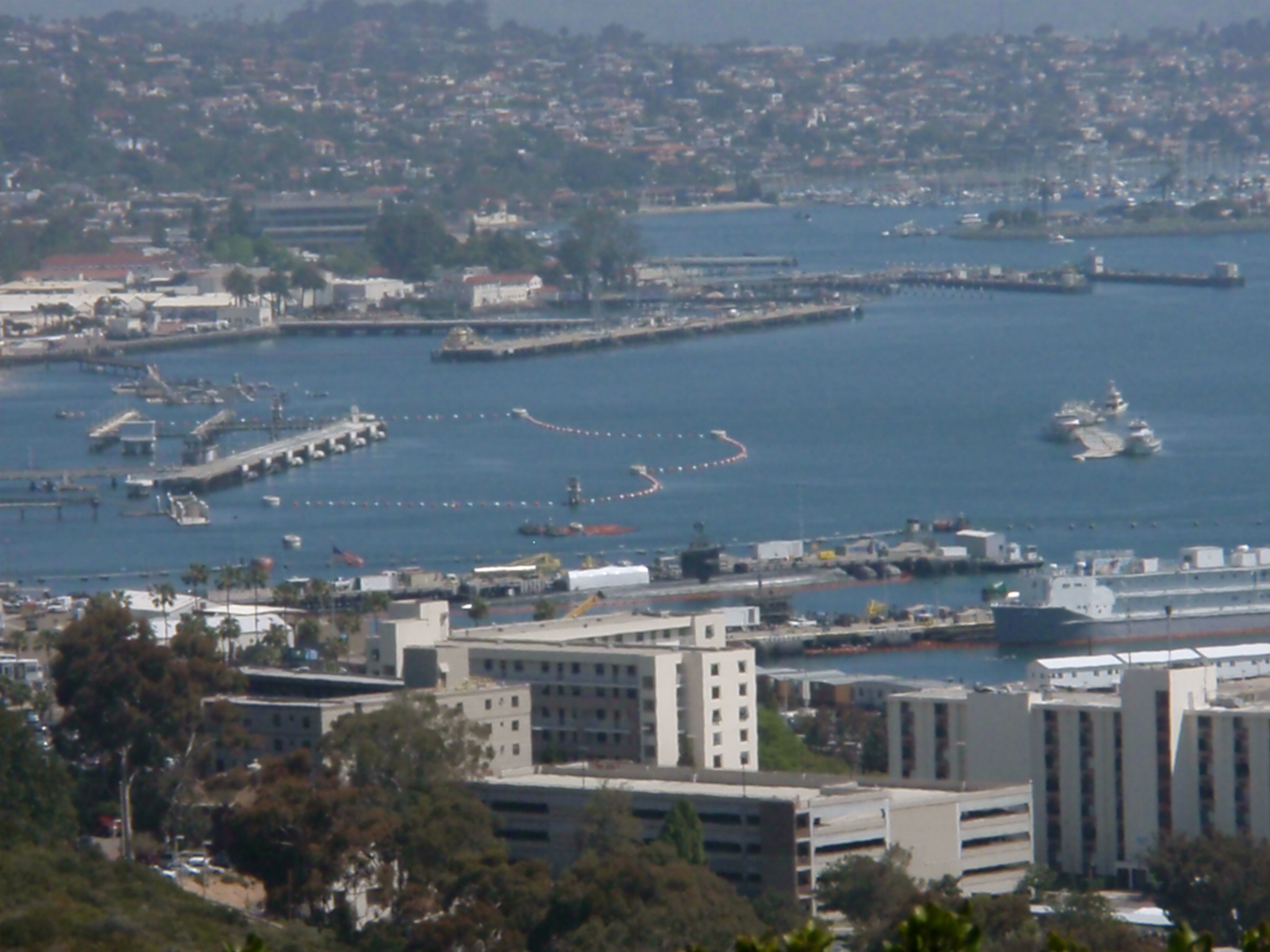
From the Cabrillo monument, on a clear day you can catch views of the San Diego Harbor and skyline and Coronado Island, along with the Naval Air Station North Island, dubbed the “Birthplace of Naval Aviation”. Although a little hazy when we were there, we were thankful the marine layer stayed further offshore during our visit. While standing out on the point we were fortunate to see (and hear) a squadron of fighter jets take off from the Naval Air Station, out on maneuvers.
Naval Air Station North Island Operations
San Diego is headquarters to the Eleventh Naval District and is one of the busiest and largest U.S. naval ports in the world. Many of the Pacific Fleet’s cruisers, carriers, destroyers and amphibious ships are stationed here. The U.S. Coast Guard, part of The Department of Homeland Security, conducts extensive operations out of San Diego.
U.S. Coast Guard Facilities
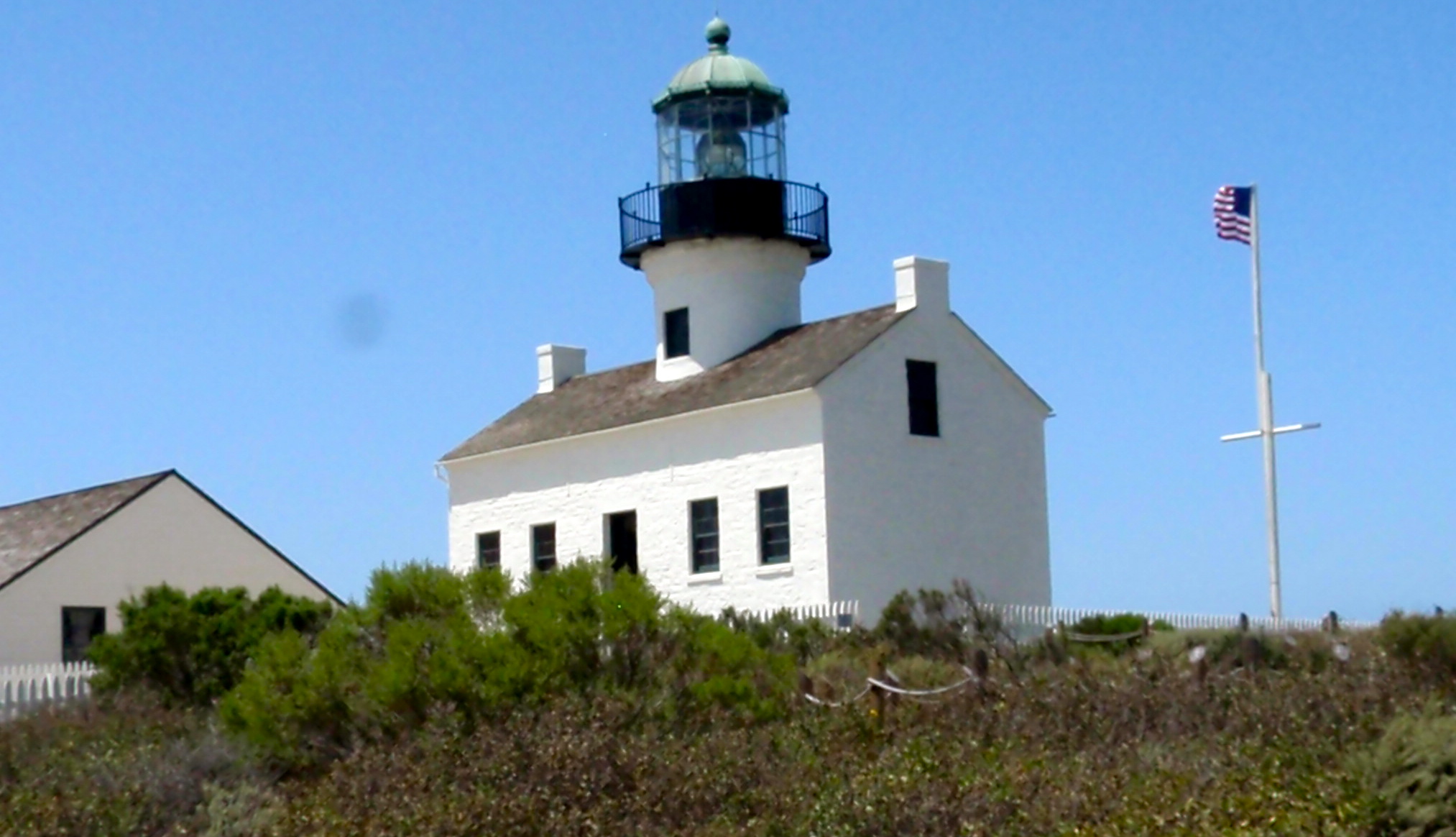
Another prominent structure standing watch over San Diego Bay is the Old Point Loma Lighthouse. Built in 1854, it was one of the first lighthouses on the West Coast. It was taken out of service after 36 years as fog and clouds could often shroud the light. It was lit for the first time on November 15, 1855 and its light was extinguished on March 23, 1891.
The lighthouse stands 422 feet above sea level and, at the time, it seemed like the perfect location for it. Sandstone was carved from the hills for the walls and the floor tiles were taken from a Spanish fort ruins. A five-foot tall 3rd order Fresnel lens, which was tops in technology at the time, was shipped in from France. This lens made the light visible at sea for 25 miles, that is when fog and clouds weren’t obscuring the view. There was no foghorn at the time so a shotgun was fired to warn ships away from the menacing rocks below. Today the interior of the lighthouse, which has been refurbished to its 1880’s appearance, and the out buildings, are open to visitors.
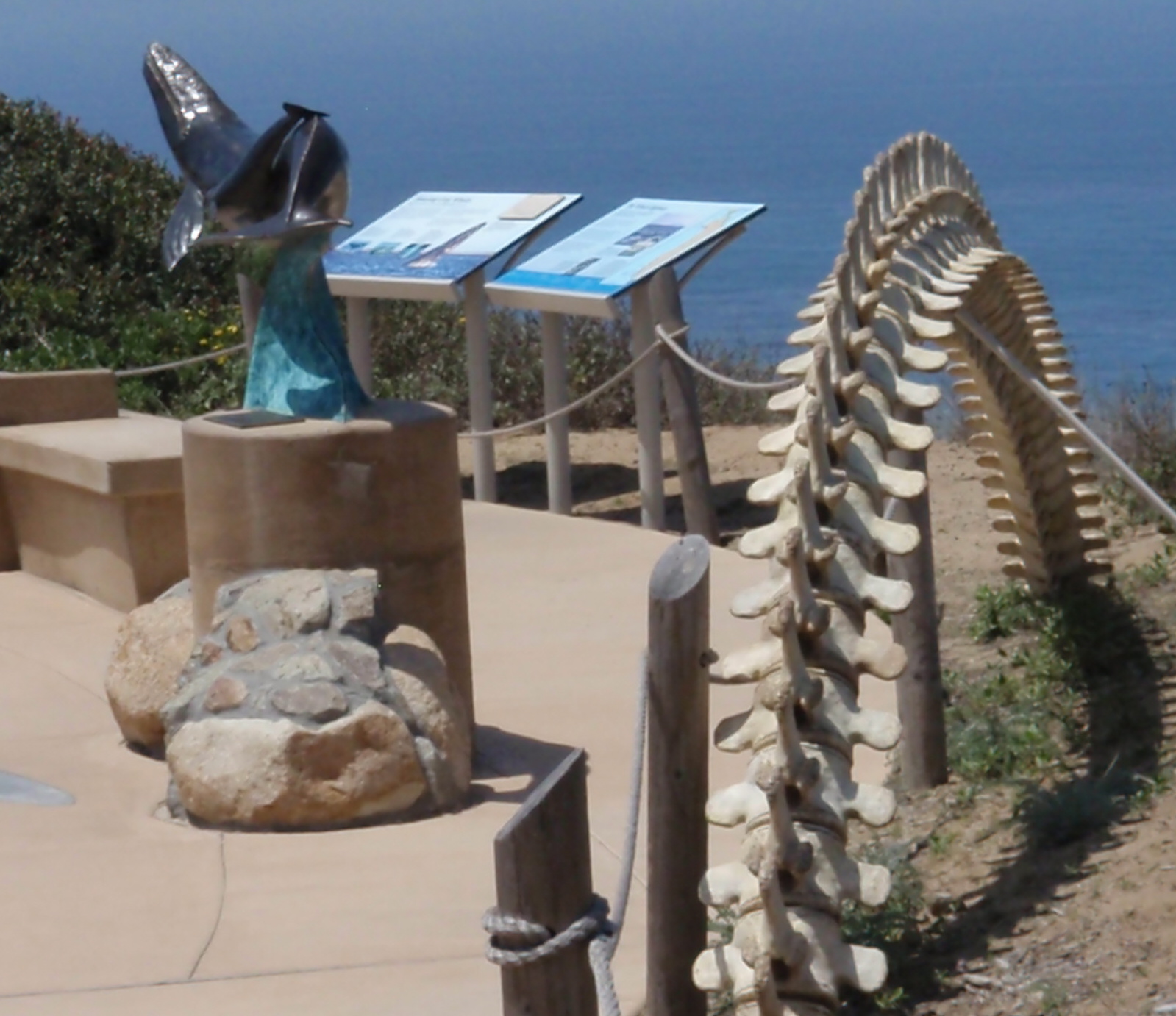
Located at the southern tip of the Point Loma Peninsula, a Pacific gray whale display can be seen, with sitting areas to watch these majestic mammals make their southerly 12,000 mile migration from the Arctic to the Baja. Gray whale sightings are fairly common here from December through March but are not seen at all making their trek back north in May.
Display of the migration of the Pacific gray whale
We timed our visit here to coincide with low tide so we could check out the tide pools, which are some of the best around we have heard. All things finally came together to make for a near perfect day. After watching a 30-minute film on the intertidal zones, we headed to the western side of Point Loma, where from late Fall until Spring the tide pools are visible. Within the tidal zone is the 4 square mile Point Loma kelp forest, the largest on the West Coast.
There are two low and two high tides every day in California, something new to me. The low tide that would have been best for viewing life in the pools was at 3:00 am but we were hoping for a good showing for the one at 1:00 pm. With three intertidal zones (high, middle, and low), we would be viewing the high and hopefully some of the middle.
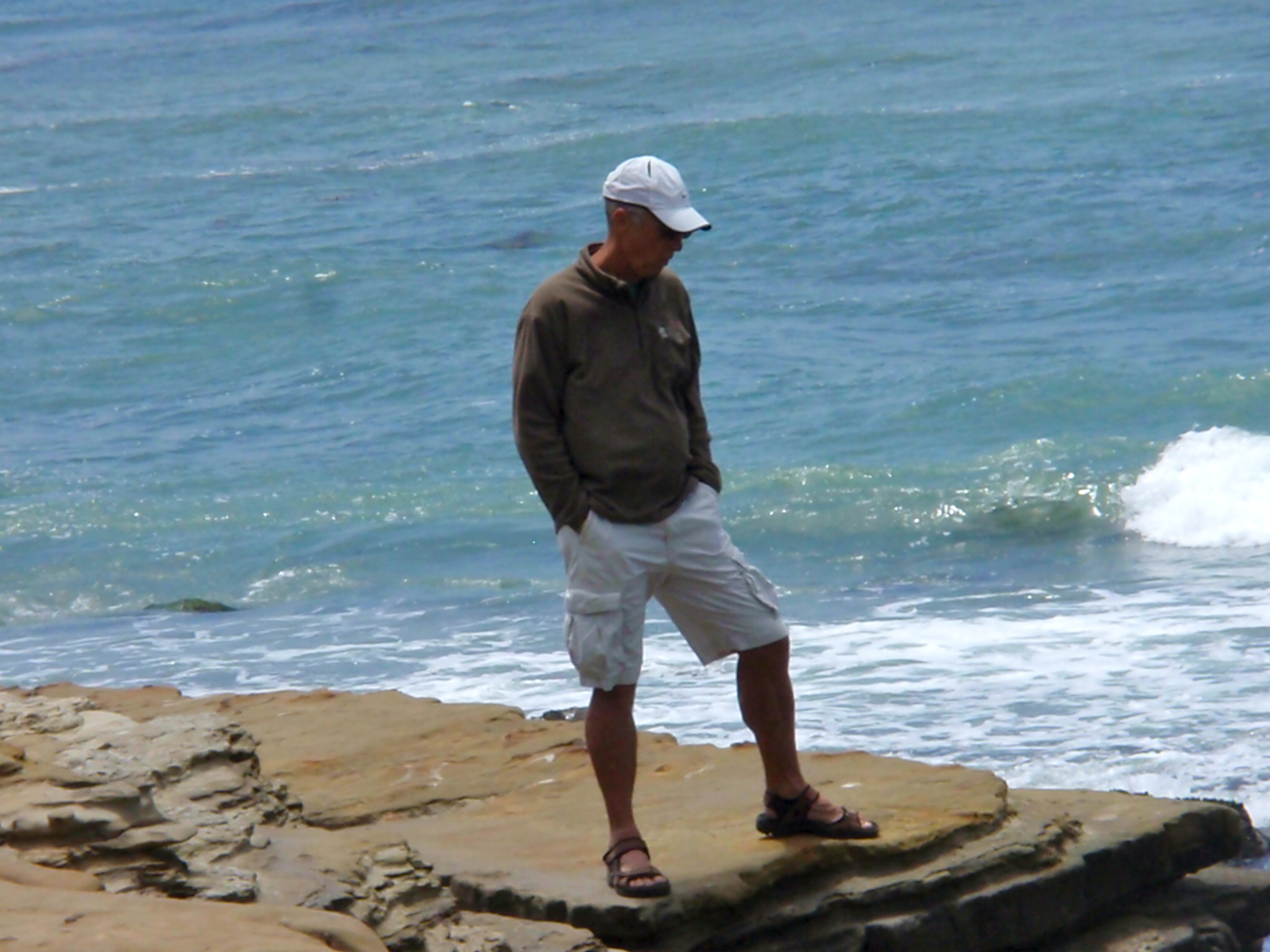
Terry, waiting for low tide
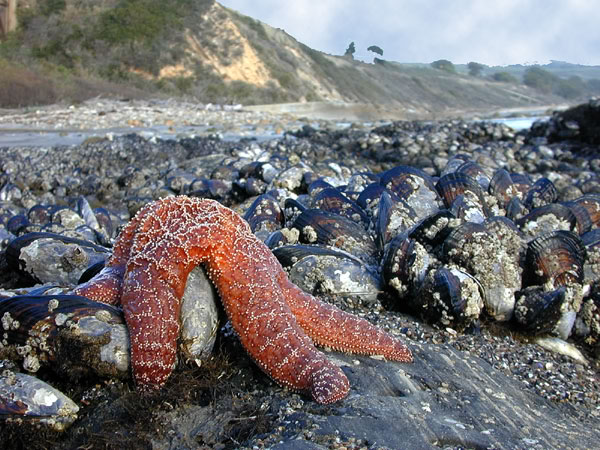
Although the tide wasn’t as low as we would have liked and we did not see any of the stars of the pools (sea stars that is), the pools were still teeming with life.
Sea star, compliments of marinebio.net
Treading lightly and close inspection is what is needed to find the diverse life here.
Wading in the pool, searching for the unusual
Camouflage is the name of the game as sea life here have many natural-born enemies. The tide pools are really a window into the rest of the ocean. Here is just a little of what we were able to find:
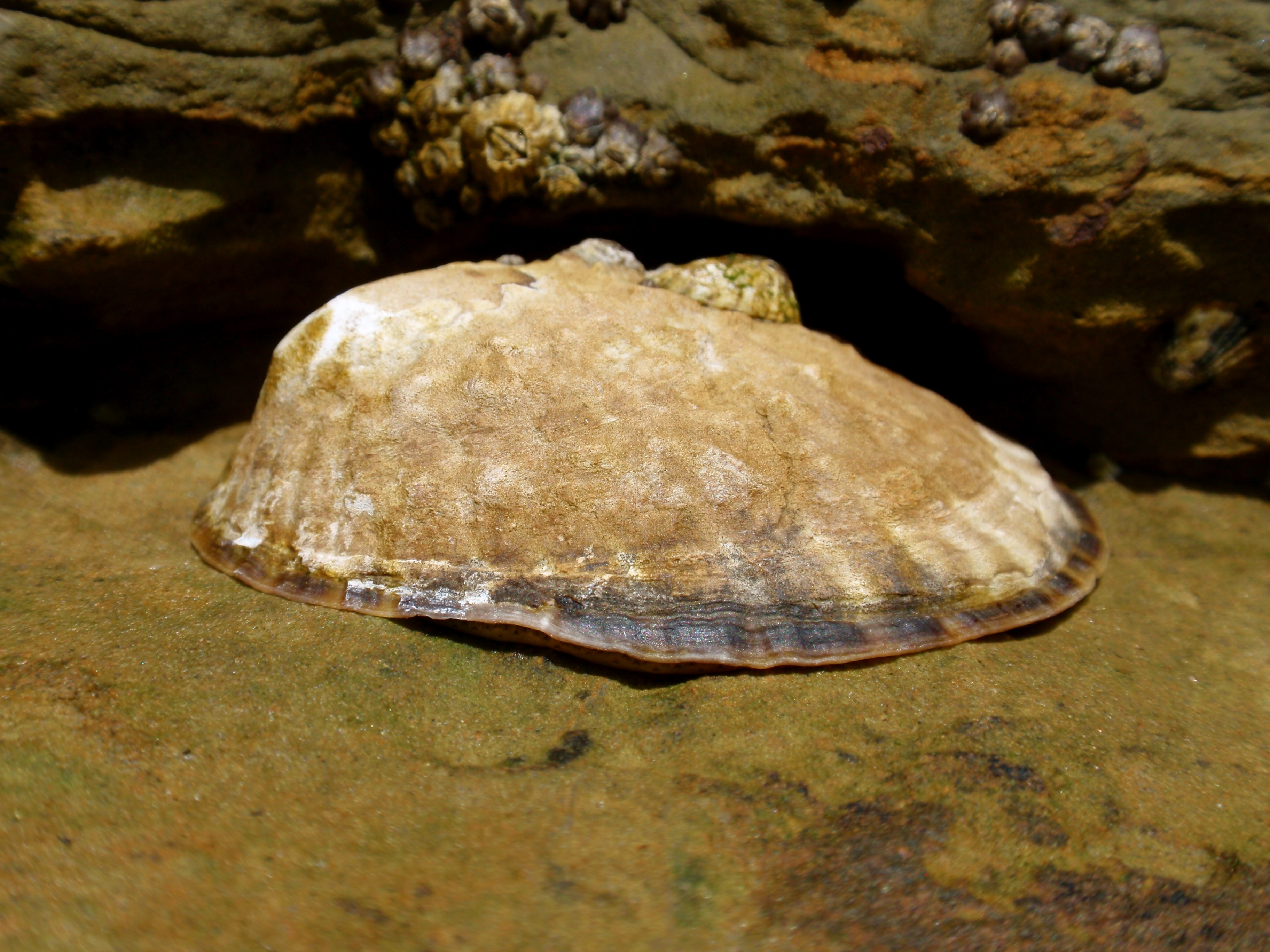
Starburst anemone ~ a voracious eater!Owl limpet
The owl limpet has a muscular foot that holds its body and shell tightly to the rock. It is a hermaphrodite, beginning its life as a reproductive male and if lucky to live long enough, transforms itself into a female.
Sea lettuce
Sea lettuce is a bright green algae that can tolerate heavier levels of pollution than most sea life. Where there are large populations, pollution level alert!
Barnacles draped with sea lettuce
Barnacles live upside down, attached by antennae to rocky outcroppings.
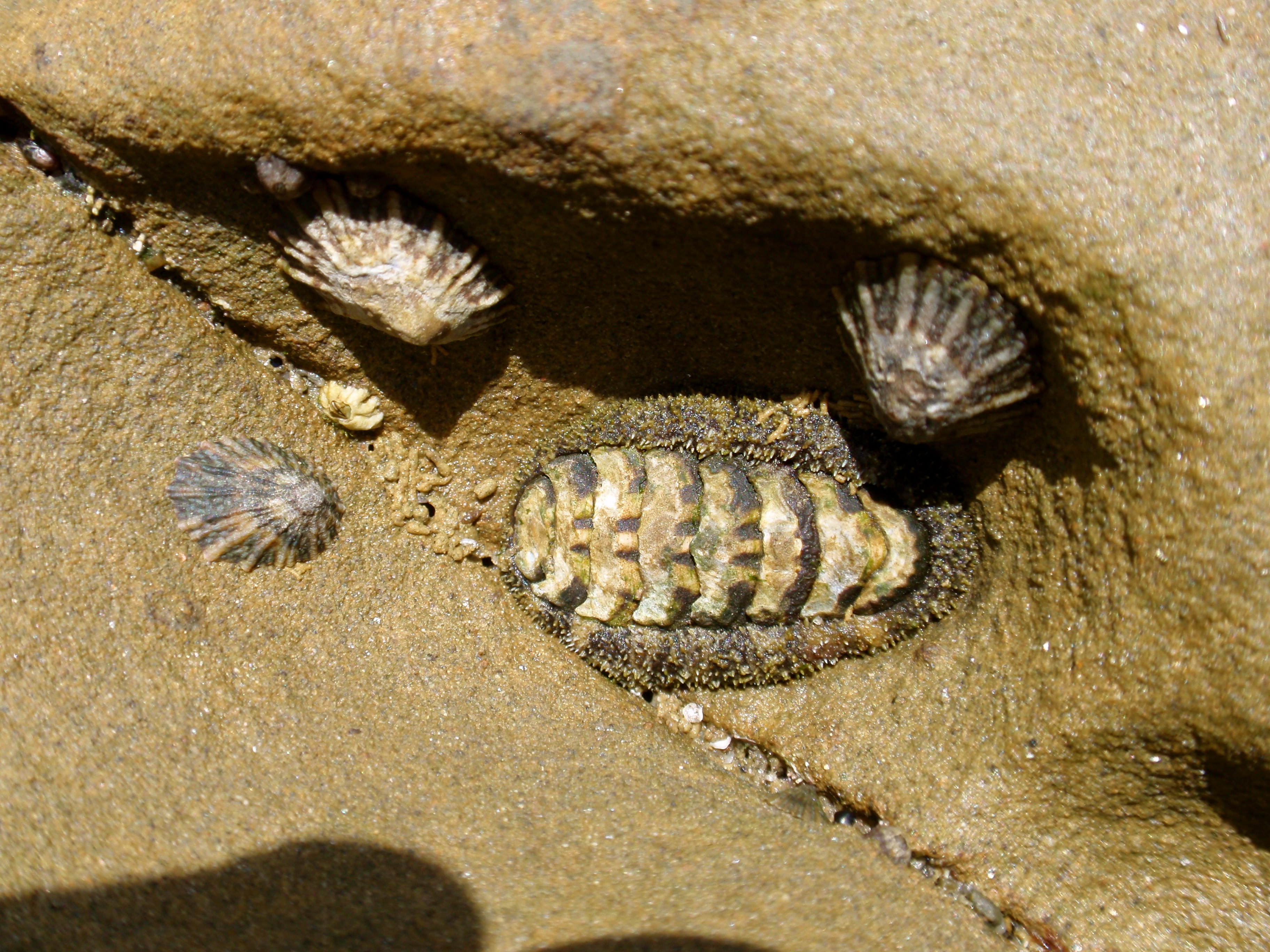
Conspicuous chiton nestled in a rocky depressionHermit crab sitting atop a disguised sea anemone
These “squatters” take up residence in empty shells of other animals, moving on when they outgrow their homes.
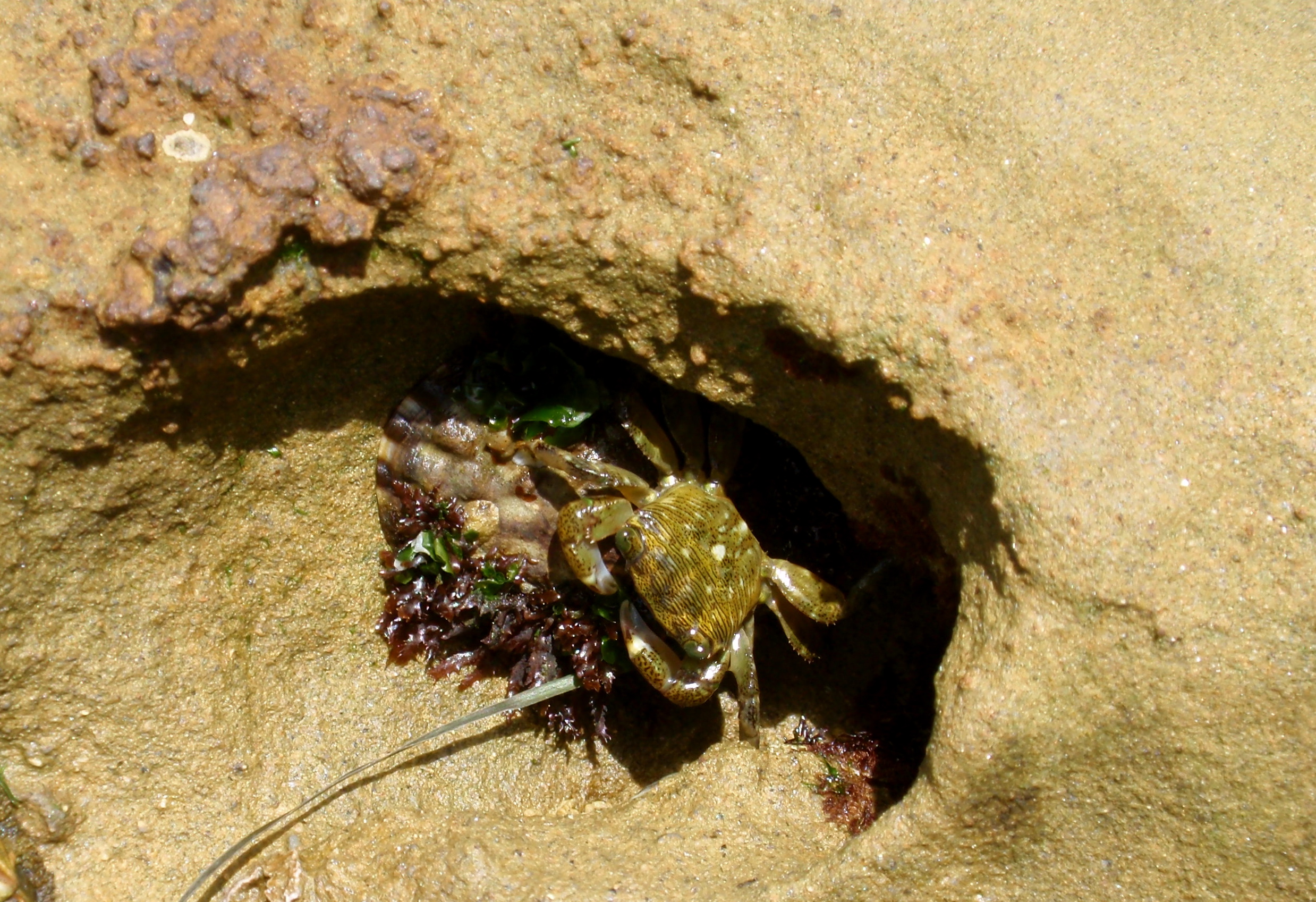
Striped shore crab
I chased this skittish little guy around for a while before he agreed to just one photo!
So much going on where it all started and so much left unseen in the low tidal zone, these mysterious creatures of the sea.
It’s a balancing act!
If you liked this blog post, why not subscribe to my blog via feed reader or e-mail?
So what the heck is watchful waiting anyway? Well, in medical terms, for someone facing prostate cancer, it can be the standard treatment, given your test results. Hubby Terry received this cancer diagnosis almost 5 years ago, one that roughly 1 in 6 men will receive sometime in their life, not unlike breast cancer statistics for women. Unfortunately, given his age at the time and his Gleason Score, he was not a candidate for watchful waiting, too young and tumor too advanced. A prostatectomy was in order instead and he has been blessed to have a wonderful surgeon. Ever the vigilant one, Terry has done his follow-up tests like clockwork ever since.
Our change in plans came about as a result of a regularly scheduled PSA blood test earlier this year. Although not alarming by any means, the finding did not fall within the ‘normal’ range, which should be negligible once the prostate has been removed. Additional PSA tests done here within the past two weeks have all provided the same conclusion, which could indicate any number of things. Terry received the news from his doctor’s office that a battery of tests was to be the next course of action, to rule out a few things. However, after further analysis and given that the PSA test score has not continued to increase, his doctor notified him yesterday of the decision to forego further tests for 90 days and practice watchful waiting instead. What to make of this? It feels like we are in limbo, as nothing has changed except to move the date out for yet other procedures.
A good lesson to be learned during this watchful waiting is to get back to the present; live for now; and not focus on what may be 90 days down the road. None of us knows the road ahead so why not look at what is around us instead? Given the beauty found in this country, it sounds like a sound plan! Special thanks to everyone who sent warm thoughts and prayers our way.
If you liked this blog post, why not subscribe to my blog via feed reader or e-mail?
As I have written about in earlier posts, Yellowstone National Park was on our calendar for May through October. Our planned 5-month stay involved working for Yellowstone Association in their Old Faithful bookstore, where we were looking forward to reacquainting ourselves with old friends and meeting some new folks. Well, as life would have it, a change of plans is now in the works as some unforeseen medical tests needed for Terry have caused us to postpone our trip. Given the abundance of excellent doctors and medical facilities in the San Diego area, we feel it prudent to stay put for the time being.
Now for the positive news. A cancellation here at San Elijo State Beach has allowed us to stay right where we are for the next 30 days (thank you so much Bill). During this period of waiting for test results and possible other procedures needed, we plan to stay near metropolitan areas in California. We still have so much to explore in California, so we will most likely do just that once June rolls around. The beauty of this lifestyle is the ability to quickly shift gears, allowing us to move a few things around on our bucket list.
Although we will miss friends who we were very much looking forward to spending time with, we believe things happen for a reason, even when the path forward is unclear. Staying in California feels like the right thing to do at this moment and with faith guiding us, how can we go wrong?
Since Yellowstone was to be our destination, I feel it only fitting to honor this first national park with a few photos that were captured during previous visits. If you haven’t been yet, what are you waiting for? It is a magical place even during the winter. And while you are contemplating a visit, check out this fabulous photography blog site featuring the hunt of the Yellowstone red fox in the winter. We have seen a video of this and it is amazing!
Given our change of plans, if any of you out there have spent time in northern California and have some memorable experiences or recommendations for places to stay, we would love to hear about them.
If you liked this blog post, why not subscribe to my blog via feed reader or e-mail?
One of the things we have missed while in San Diego is hiking in the wilderness, without having to drive a great distance to do so. We have not been able to get to Mission Trails Regional Park yet so the next best thing was to head out to Torrey Pines State Reserve, about a 6 mile drive south for us. We heard the hiking was nice and read that this is one of the wildest stretches of land remaining on the southern California coast so we were counting on some pretty spectacular views.
The not-so-rare-looking Torrey pine
This day use only park is home to the nation’s rarest pine tree, the Torrey pine, named after the renown botanist Dr. John Torrey of New York, back in 1850. Ironically Dr. Torrey never set foot in this part of the country but instead was bestowed this honor by a colleague of his, Dr. Charles Christopher Parry, who did travel here and took action in 1855 to protect this species of pine. Where this rare pine once covered a large area, it now only grows here and on Santa Rosa Island off the coast of Santa Barbara.
You can park down at the beach in the day use parking lot and walk up to the top (which would afford you the most exercise) or drive up and park where the network of trails begin. There is a nice little visitor center and museum to peruse and interpretive nature walks are provided on the weekends. To keep the park pristine, no food or drink except water and no pets or bikes are allowed on the trails.
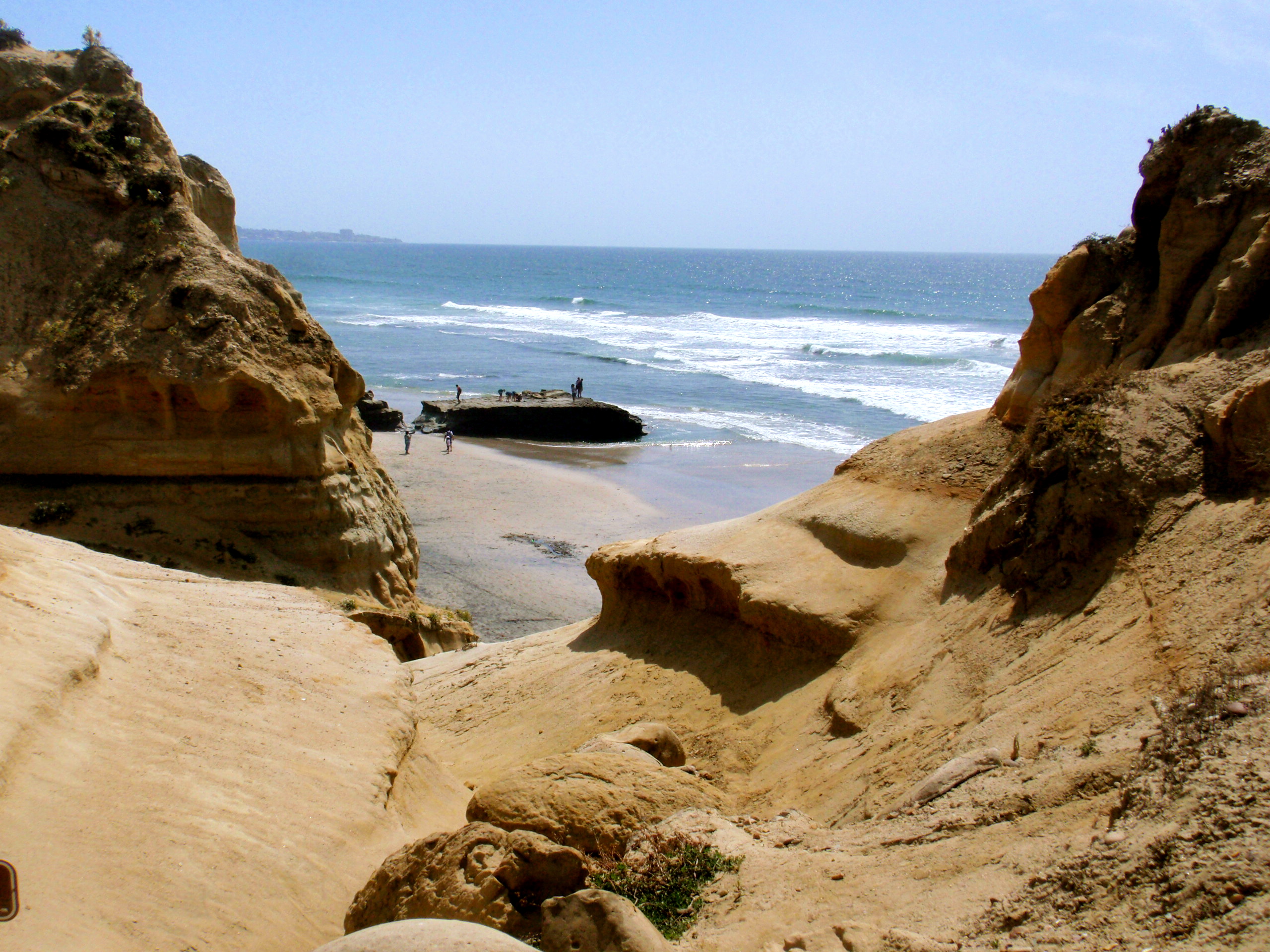
Eight miles of trails criss-cross the park, some hugging the sandstone cliffs, offering stunning 360º views.
Sandstone cliffs with views of Del Mar and Cardiff
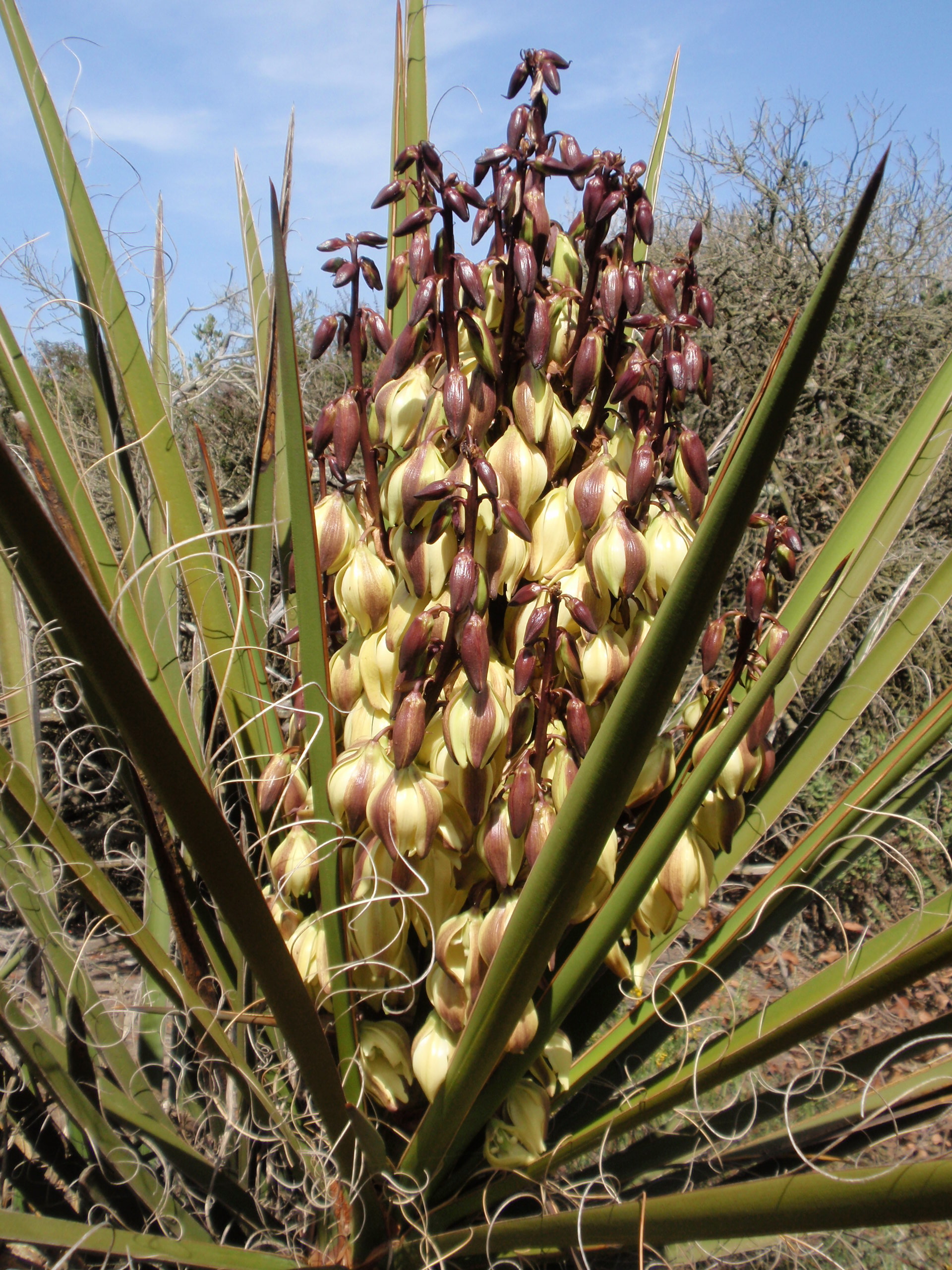
Other trails take you through chaparral, prickly pear cactus and Mohave yucca, just beginning to bloom. You can catch a glimpse of the famous Torrey Pines Golf Course through this shrubbery.
Flowering Mohave yucca
The Beach Trail descends 300 feet to Torrey Pines beach and lagoon, an area vital to migrating birds, with views of Flat Rock. South of this rock is San Diego’s “unofficial” nude beach, Black Beach.
View of Flat Rock on Torrey Pines beach
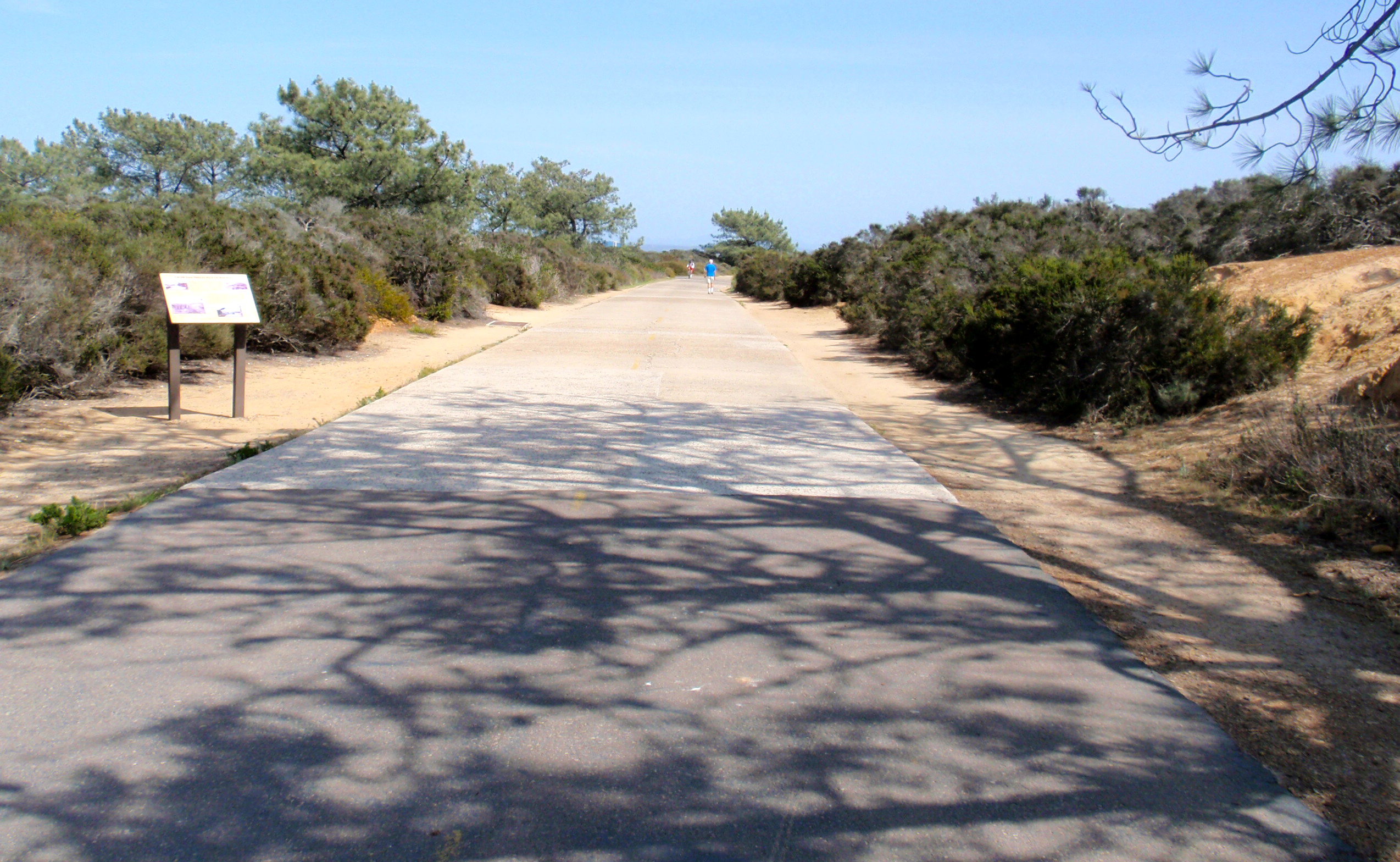
The Torrey Pines Park Road was once part of the main highway running between Los Angeles and San Diego. Originally a dirt road built in 1910, it was paved a few years later. Even paved, its steep grade posed a problem for the vehicles of that era. Because Model Ts used gravity to deliver gas to the engine that was set in front of the car, motorists had to climb the road in reverse! This road is now used by those wanting to enjoy the views while working up a sweat.
With the sound of the pounding surf and the salty smell of the ocean tantalizing the senses, you can forget that you were here for some exercise. If you are looking for a heart-pounding hike, this is probably not going to get you there but you definitely can’t beat the views!
If you liked this blog post, why not subscribe to my blog via feed reader or e-mail?













 Paint Your Landscape