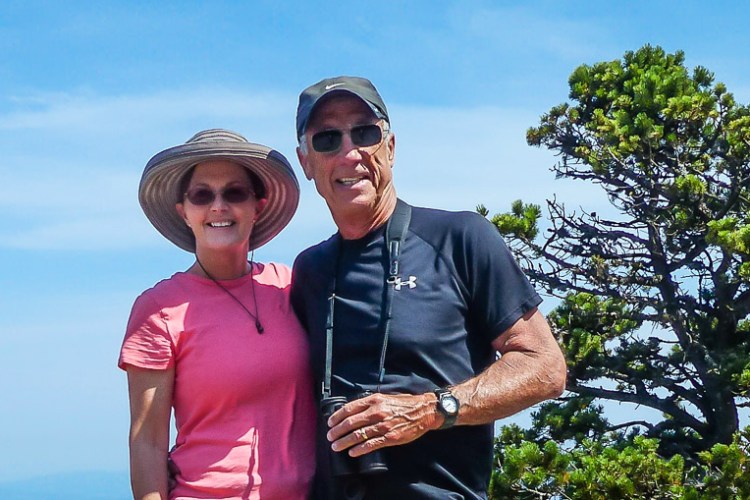
After lengthy careers maneuvering the treacherous waters of corporate America, Terry and I decided in August of 2011 that life was too important to take so seriously. We wrote what was to be our final resignation letters, stuffed our backpacks to maximum capacity, and headed south of the border for a Mexican adventure.Read more About Us
“I have no special talents. I am just passionately curious.” ~ Albert Einstein
Passion is that spark that creates the fire in our soul, allows our hearts to expand, and makes us feel vitally alive. As we move through life passion often evolves from a focus on career and accumulating money to finding our authentic self, peeling away the layers to find the real “me” that has been buried under the needs of others. Read more Pursuing Passion
“Physical fitness is not only one of the most important keys to a healthy body, it is the basis of dynamic and creative intellectual activity.” ~ John F. Kennedy Read more Let’s Get Healthy
After much anticipation we landed in Paris, spent after a very long night, with just our adrenaline to keep us moving. We hopped on the Easy Bus at Charles de Gaulle airport and, after Elan (our driver) traversed the side streets to avoid rush-hour traffic, we arrived at the apartment we had rented.
In five days we know we will barely scratch the surface here in the City of Lights, the most dense city in all of Europe, (with 20x’s more density than New York City) but we are planning to give it our best shot. Since we will be on the go so much I have decided to write “mini-posts” while in Europe, then go back and add more detail when we return to the states.
Our first two days in Paris began with a leisurely breakfast at a local boulangerie, where I was able to practice a little of the French language – emphasis on little. Once fortified we walked along the Seine River to tour Sainte-Chapelle, a royal Gothic-styled chapel, built around 1238, once the residence of the Kings of France. It houses some of the most extensive stained glass of the 13th century anywhere in the world.
Inside Sainte-Chapelle
Me, Frank & Margee with Sainte-Chapelle in the background
From there it was a short walk to Notre Dame (Our Lady of Paris), a medieval Catholic Cathedral. It is among the largest and well-known churches in the world. We had hoped to climb to the top of the tower but the lines were too long and we had much yet to see.
Inside the world-renown Notre Dame Cathedral
Notre Dame with a view of the Rose window
One of many wonderful sculptures telling a Biblical story at Notre Dame
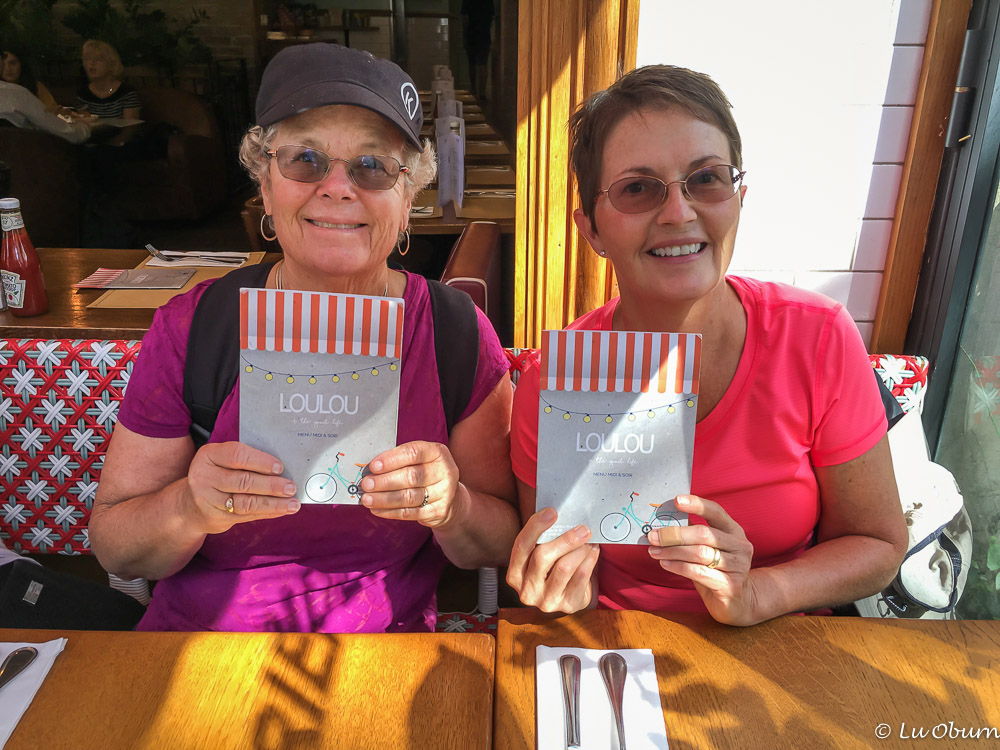
Lunch was in the Latin Quarter at LouLou’s, a must-top for this Lulu…délicieux.
Since we were enjoying the local fare so much, we agreed that walking was needed to burn off the calories so off we strolled to the Louvre Museum. Crossing over the Pont Neuf, the oldest standing bridge across the Seine, we stopped to take a few photos of some Locks of Love before continuing on our journey.
Locks of Love #1
Locks of Love #2
Although we had purchased a 4-day Museum Pass, which allowed us to skip some of the longest lines, once inside the Louvre it is impossible to avoid the crowds. You’ve got to just shoulder your way through the massive surge. We all agreed that for that reason alone, some of the smaller museums were more to our liking, but the architecture, the paintings, and sculptures were magnifique!
Terry and me outside the Louvre
Venus de Milo
The glass pyramid outside the Louvre
We rounded out our first day with an evening reservation at the Eiffel Tower where the views from above are breathtaking.
Margee & Frank at the Eiffel Tower
Sunset from atop the Eiffel Tower
Night view of the Eiffel
Day two took us to the Orsay Museum, which we all agreed was incredible. Build around 1900 and housed in an old railway station, the architecture and the clock towers are impressive. It holds the largest collection of impressionist and post-impressionist masterpieces in the world, including artists such as Monet, Degas, Van Gogh, Renoir, and Cézanne.
Cezanne
Silhouette of the clock tower at the Orsay
Whistler’s Mother by James Abbott
Orsay sculpture
Inside the Orsay
A walk to the Trocadéro for another view of the Eiffel Tower and a stroll through the Rue Cler market and day two was a success.
In less than two weeks we will be jetting our way to Europe for a two-month extravaganza through France and Italy. To say we are excited would be an understatement. We’ve been busily tying up all the loose ends before we leave so I decided recently to do a carry-on packing run, the only bag (along with a small purse) that I will be taking. We chose a carry-on without wheels and one that converts to a backpack, believing better on our backs than trying to wheel a bag over cobbled stones.
As I think about this upcoming trip, my mantra has been to “pack light, pack light, pack light”. I already know, given the limited space for clothing, that I will be ready to toss out everything I am bringing when I return to the states. A girl can only wear the same clothing for so long, right? 😉 Actually, I know that we can live out of our little bags for two months, as several years ago we traveled through Mexico for a year and headed south of the border with just a regular-size backpack strapped to our bodies, no vehicle, no place to call home.
I won’t bore you with all the details of what is going into my little black bag, but I would love to get packing tips or other travel tips from you avid travelers. Are there any unusual items that one should not forget or something that you brought along that just weighed you down? Is there something that caused an aha moment for you, something you told yourself you wouldn’t forget the next time you hopped a plane to an exotic place? I think I have the clothing needs wired, erring on the side of being a minimalist, as I know I can wash my wicking-wear clothes in my room or at a launderette.
I am bringing along a small MacBook and a camera, so I can download my photos, keeping track of where we are from day-to-day. I plan to continue the blog, as long as the Internet gods are with me, albeit on a much more scaled-down fashion until I return.
So, all you world travelers, come on, share your deep-dark secrets on how to make living out of a backpack complete, utter bliss. 🙂
I recently read a blog post written by Julianne, a woman I met several years ago in Yellowstone National Park, a woman I admire for her spirit, her strength, her connection with nature. She shares a blog, Writing the Wild, with two other friends, both women, both with strong voices and intensely personal relationships with wilderness, just like Julianne. It’s a blog that draws me in deeper with each new post I read. Julianne’s latest, Living in the Present, is deep and resonated with me immediately. I found myself reflecting upon her message for days, and in that contemplative space the kernels of a blog post started to sprout.
“The mountains are calling and I must go.” ~ John Muir
We recently returned from a trip up north, back to our winter home base in So. California. Although I knew we were heading back to complete details for an exciting trip we have planned this fall, I felt this sadness as I reflected upon the trip we had just finished, where nature and the wild imbued our every cell daily. I was not ready to step back into the modern-day trappings of excess and commercialism.
“Look deep into nature and you will understand everything better.” ~ Albert Einstein
It seems the more time I spend in nature, the more I have this reaction when I step off the trails. So I have asked myself, what draws us to nature, to the wild, even when it could potentially put us in harm’s way when we traverse the same land as predator species?
“I held my breath as we do sometimes to stop time when something wonderful has touched us…” ~ Mary Oliver
Yes, we take to the trails and the rivers for our source of exercise, but I believe it goes beyond this. Julianne certainly touched on it when she said that being in nature forces one to live in the moment, as it takes all our attention to navigate a flowing river in a kayak or avoid sliding off a mountainside on a steep trail.
“Wilderness is not a luxury but a necessity of the human spirit.” ~ Edward Abbey
Living in the moment in the wild takes us to a place where we begin to move at nature’s pace, instinctual, perhaps due to a base need to reconstruct our lives. Is it our soul’s longing to live free of the attachment we have developed to the various screens that have become an intrinsic part of our day-to-day existence, teeming with a set of perceptions on how well “liked” we are? Or are we trying to salvage that indigenous part of us that once was wild?
“It is not half so important to know as to feel.” ~ Rachel Carson
A famous study conducted by the University of Illinois, Chicago, found that we spend 25% less time out in nature than we did in the late 1980’s. If more of our society embraced nature and the wild, would we learn to live in harmony with our surroundings, be more at peace with ourselves and those around us? Would we realize that we need less to live a life of fulfillment?
“I feel like lying down by the side of the trail and remembering it all. The woods do that to you.” ~ Jack Kerouac
Nature is full of contrasts – rushed yet unhurried, quiet yet raucous, organized yet chaotic. Even with this diversity, there is an underpinning of calm, a sense of serenity that eludes so many of us. It is my hope each time I walk out of the wild that this sense of stillness will continue to reside in some deep recess of my soul, something I can draw from when day-to-day stresses arise.
“One way to open your eyes is to ask yourself, “What if I had never seen this before? What if I knew I would never see it again?” ~ Rachel Carson
“Nature never struggles to accomplish its purpose. All things in nature live in a state of total grace and bliss, completely connected to life itself.” I long to live this easy, effortless flow.
We have now returned home from our trip up north to prepare for our next adventure. While I practice learning key phrases in a different language (international trip perhaps?) I have decided to tackle a topic near and dear to my heart, that of vitamin/mineral supplementation, in particular vitamin D.
I have decided to write on this topic as I am one of those freaks who, instead of reading news articles ad nauseam, I pore through health and nutrition literature, topics for which I am most passionate. And with all the documentation out there, it can be mind-boggling. What I hope to do here is to open up a dialogue, and quite honestly, learn from your comments. So, here goes…
Disclaimer: I have no medical credentials to substantiate anything in this post; I’m just a passionate consumer. This is based on what I have read over many years and what resonates with me, which is the approach I take with most things in life.
Several years ago I read a book written by Dr. Sarfraz Zaidi, Power of Vitamin D, which for me was an aha moment. Since then I have read many articles on the subject. As I had lived in sunny Arizona for many years, I was shocked to read that this Southern California doctor discovered, after testing, that almost 90% of this patients were vitamin D deficient. Soon after I had my doctor test my level and found that I too was deficient. This started me on a course of vitamin D supplementation and a new approach to sun exposure.
Source: iStock.com
What I have learned in my readings is that there is evidence to support a relationship between vitamin D deficiency and “bone pain, osteoporosis, immune disorders, heart disease, high blood pressure, depression, diabetes, and cancer”. There are now over 800 references in the medical literature to support vitamin D’s effectiveness against cancer and many others that show vitamin D’s ability to fight infections and chronic inflammation.
If you buy into any of this literature, right now you may be wondering why your medical doctor has not told you about the risks of vitamin D deficiency. It may be because he/she may not know, as this is not covered in the medical schools’ curricula, which Dr. Zaidi says is often tailored to drug companies’ standards. It is not a drug so big pharma is not going to get behind it. In fact, vitamin D is not really a vitamin, but a steroid hormone instead.
I read an article a couple of years ago on Dr. Joseph Mercola’s website, where he states that “vitamin D deficiency is a pandemic in the United States, with 50% of the general population at risk”. Blood testing is the only way to be sure if you are vitamin D deficient.
If you prefer not to incur the cost of an office visit to have your doctor order a vitamin D blood test for you, there are several options for ordering in-home kits. Here are just a few of the outlets available:
The best source of vitamin D is sun exposure, as your skin creates it as a response to UV radiation. But if you can’t use the sun for your source, which may be dependent upon where you live or how you process vitamin D, then an oral supplement may be your next best bet.
Safe Sunlight Exposure
If you want to get your vitamin D from the sun, here are a few factors I have read for practicing safe sunlight exposure:
Time – the best time to expose yourself to the sun for processing vitamin D is between 10:00 am to 2:00 pm.
Skin pigmentation – fair-skinned people can max out their needed vitamin D production in as little as 10-20 minutes in the sun. Those with darker skin will need more sun than this.
Sensitive body parts – sunblock and/or hats should be used for the delicate skin of faces and necks. But, unlike what we have been told for years due to fear of skin cancer, a little UV radiation, by way of sun exposure, is most likely very good for us.
If you do opt for vitamin D supplements, which are inexpensive, studies show that taking this with vitamin K2 is very beneficial, as K2 helps move calcium into the areas of your body where it is needed, such as bones and teeth, and helps remove calcium from areas where we don’t want it, namely arteries and soft tissues.
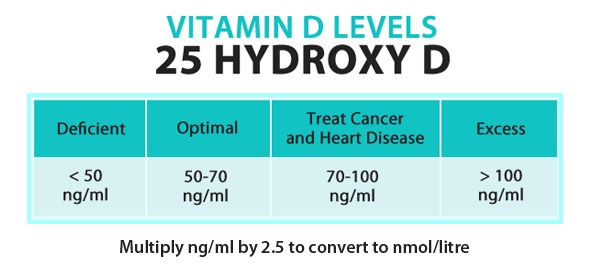
What are optimal levels of vitamin D?
Source: Dr. Mercola website
7 Signs You May Be Vitamin D Deficient
You have darker skin. ~ Those with darker skin may need as much as 10 times more sun exposure to produce the same amount of vitamin D as a fair-skinned person.
You feel “blue”. ~ Serotonin, the mood elevator hormone, rises with increased exposure to the sun.
You are 50+. ~ As we age our skin doesn’t make as much vitamin D in response to sun exposure.
You are overweight. ~ Vitamin D is fat soluble so it collects in fat cells. If you are overweight you are likely to need more vitamin D than a slimmer person.
Your bones ache. ~ Many who see their doctor for body aches and pains, accompanied by fatigue, may be diagnosed with fibromyalgia or chronic fatigue syndrome. For some, studies have found that when tested for vitamin D deficiency and treated with larger doses of vitamin D, their symptoms have resolved.
Head sweating. ~ This is one of the classic signs of vitamin D deficiency.
You have gut problems. ~ If your body lacks the ability to absorb fat properly, you may have a lower absorption of vitamin D as well. This may be true for conditions such as Crohn’s, celiac, and inflammatory bowel diseases.
Smartphone apps can track just about anything so I was not surprised that there is an app for tracking the UV radiation you’re getting in your area and how many units of vitamin D you are making. If you are interested, check out DMinder.
There are hundreds of articles on the subject of vitamin D, some in favor of sun exposure and supplementation and some concerned about toxicity. I would suggest googling vitamin D articles if you have an interest, and I would love to hear your comments, although please refrain from making this a political issue.
There is a dramatic stretch of highway that parallels the Continental Divide, melding together two stunning Canadian parks. This two-lane highway, stretching from the picturesque little village of Lake Louise in Banff National Park to the vibrant little town of Jasper in Jasper National Park, has been rated as one of the top drives in the world by Condé Nast Traveler, 144 miles of soaring rocky mountain peaks, ancient glacier ice fields, and immense sweeping valleys. I would not be classified a worldly traveler (more a wannabe) but I must agree that it is tops on my list.
This is more than a drive. It’s a journey through natural history, jaw-dropping landscapes, and more than 100 ancient glaciers. It is so much larger than my meager brain can wrap itself around. The best way to describe the beauty of the Icefields Parkway is through photos. Here are just a few of the dramatic sights seen along this winding stretch of road:
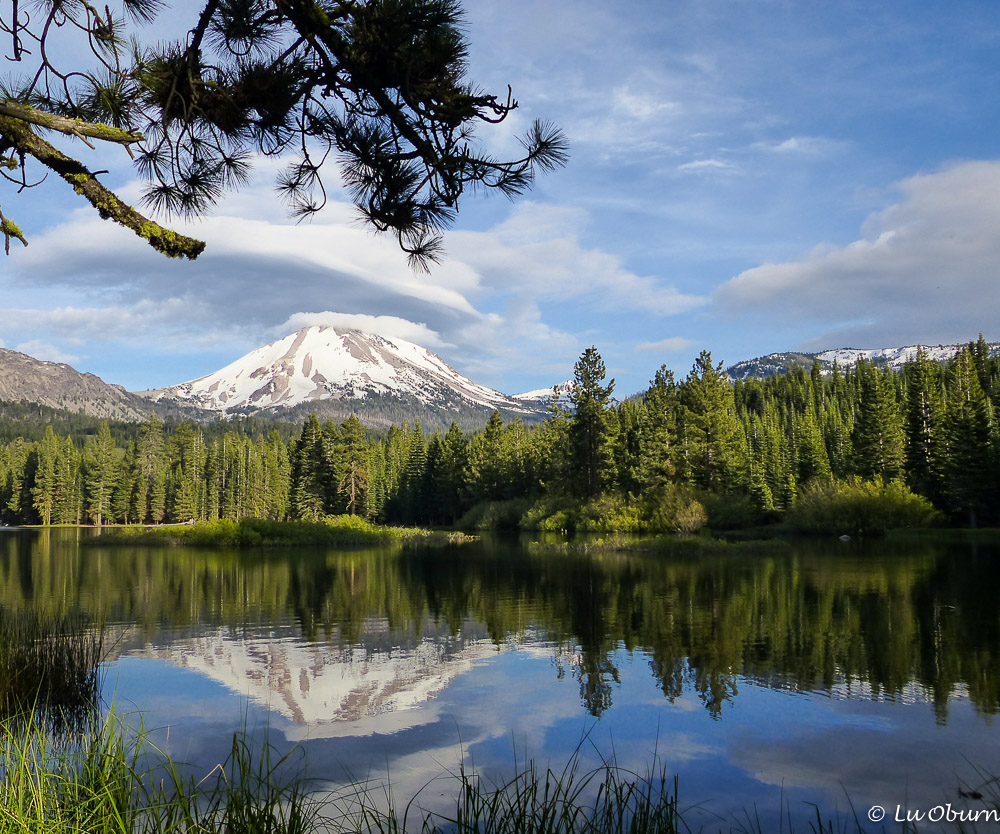
Herbert Lake, sitting under the peak of Mt. Tempe, was our first stop of the day after leaving Lake Louise. Its morning reflection was a great start to our day.
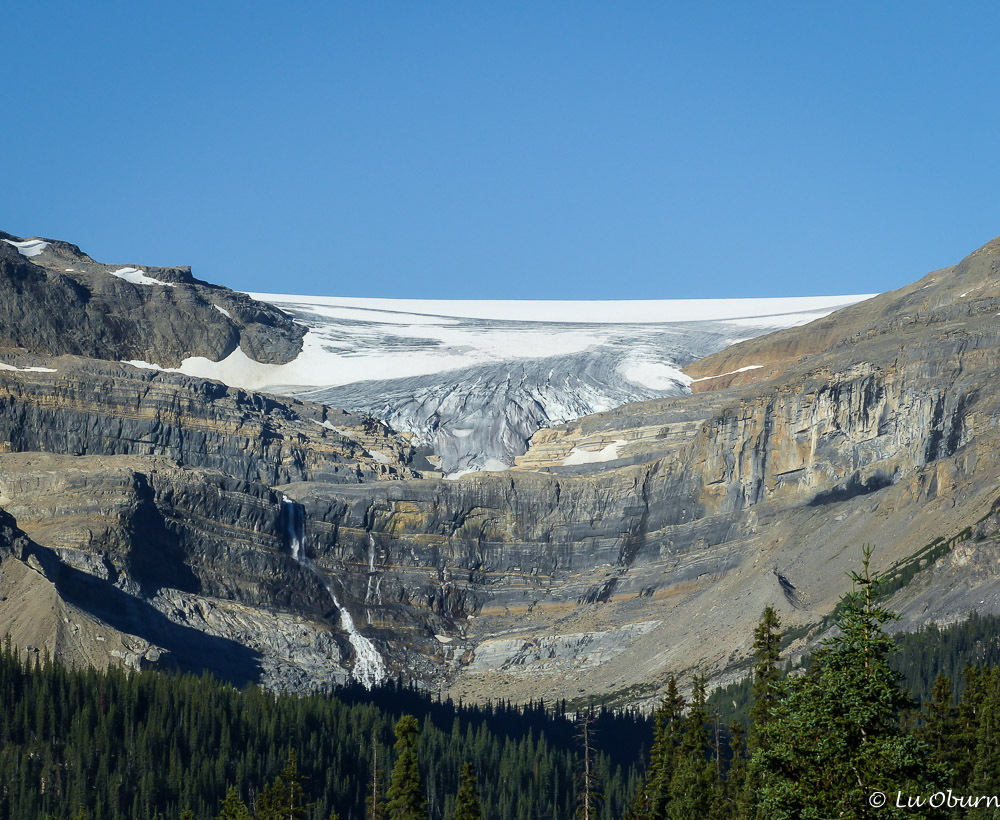
Bow Glacier and Bow Falls , one of the many striking glaciers along this beautiful stretch of highway.
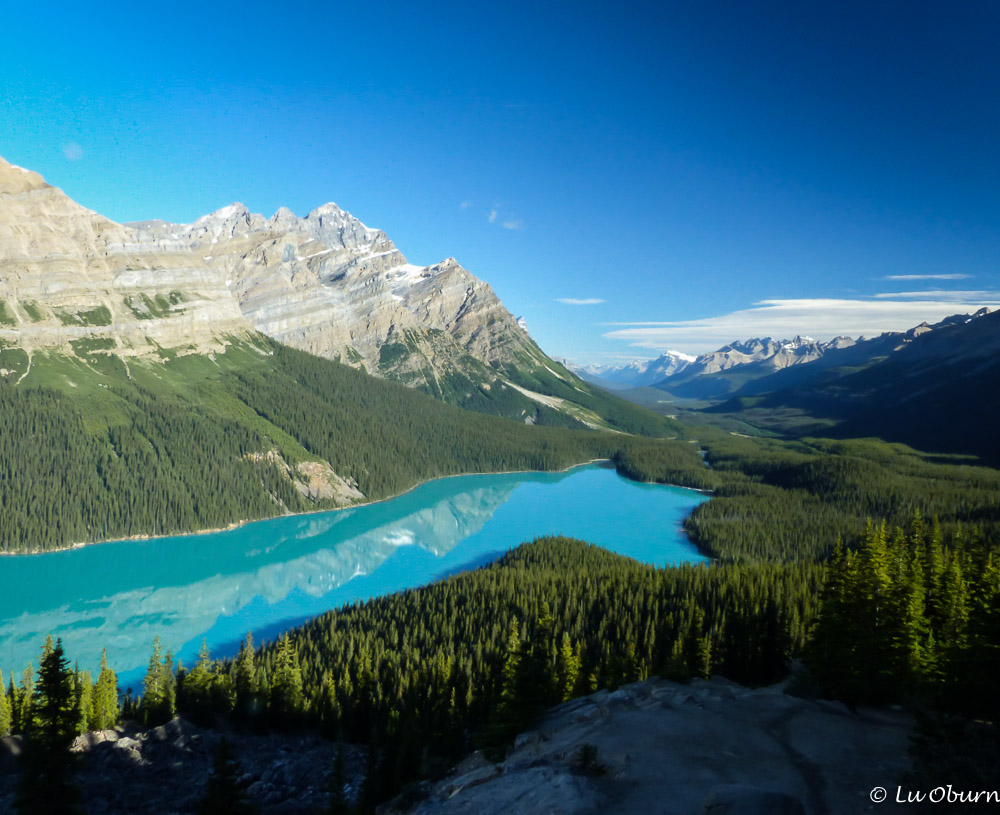
Peyto Lake, named for “Wild Bill” Peyto, one of the first game wardens in the park. The unusually bright blue water of the lake, created by glacial “rock flour”, which scatters the blue-green rays of light, coupled with the wide view of the Mistaya Valley, make this one of the most scenic sights along the parkway.
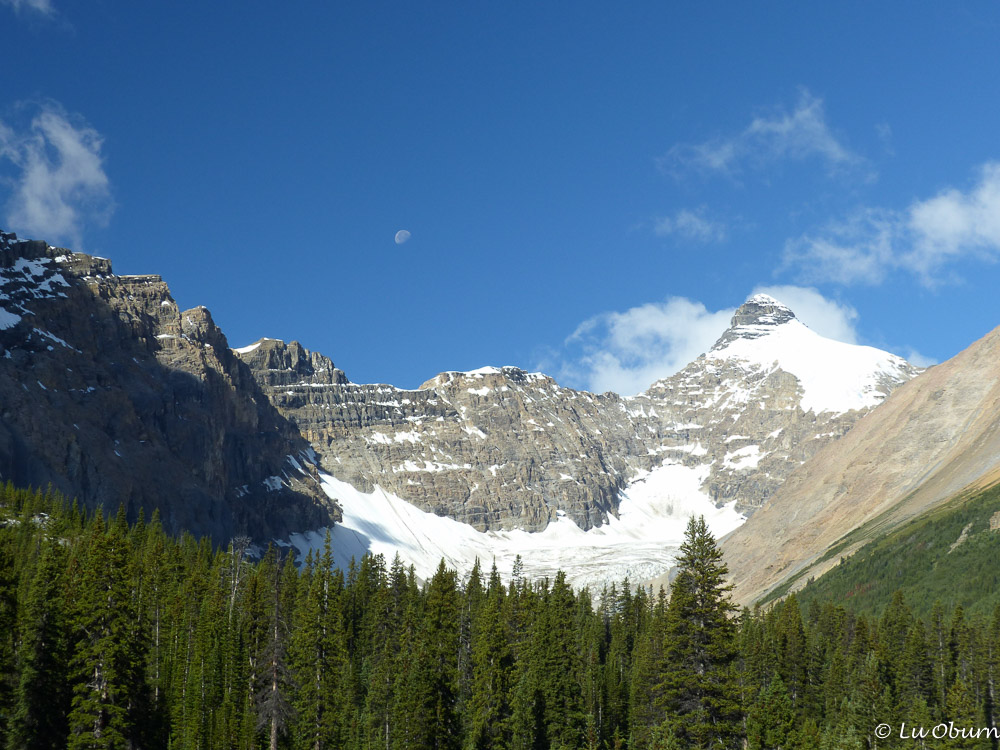
Another glacier seen from Hilda Pass.
And another from the Sunwapta Pass.
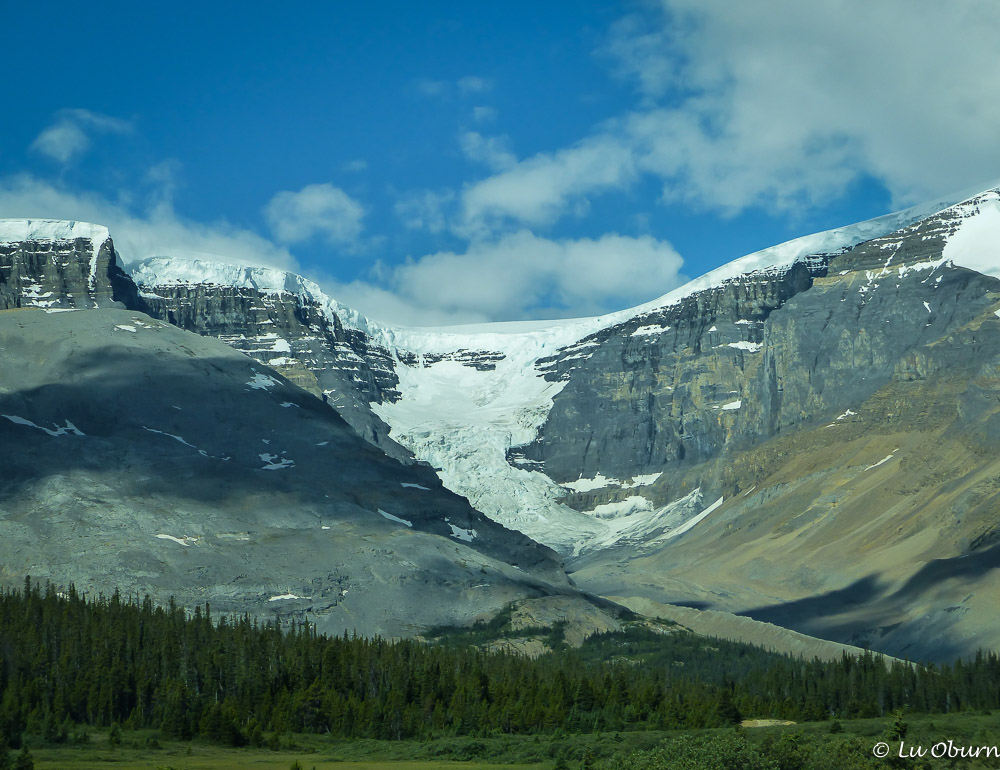
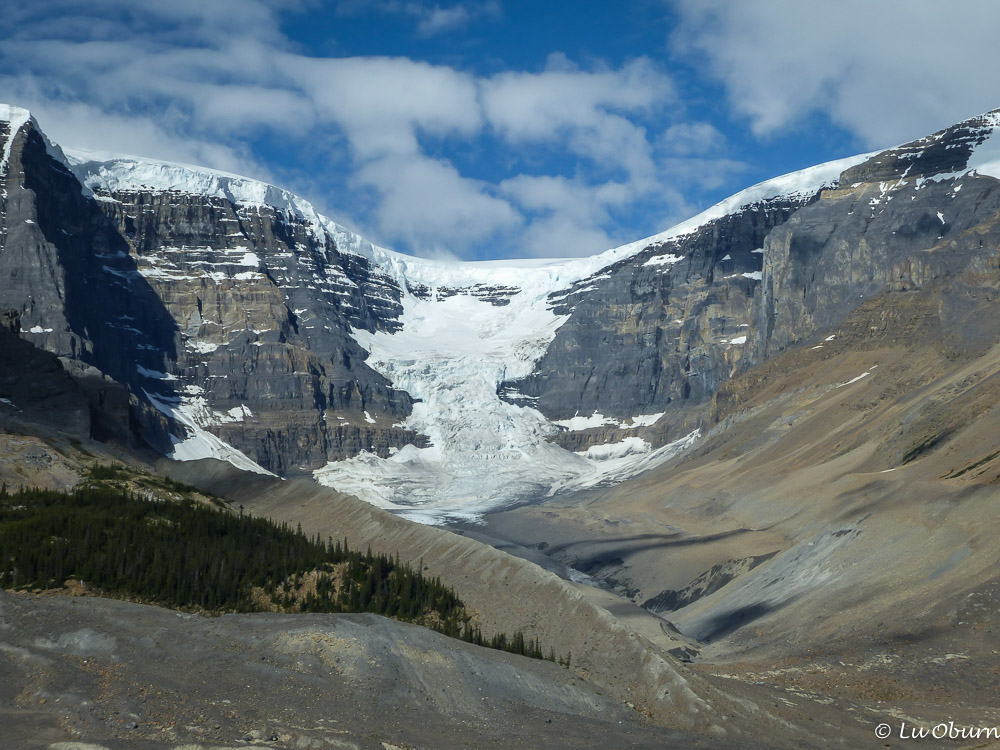
The Columbia Icefield, composed of eight glaciers and encompassing an area of about 200 miles, sits near the halfway mark on the Icefields Parkway. This ice mass is one of the largest south of the Arctic Circle and is one of the most reachable in North America. The Athabasca, Snowdome, and Stutfield Glaciers can be seen from the parkway.
The Columbia Icefield Centre, much like a large National Park Visitor Center, is where you can book the Columbia Icefield Glacier Adventure, a 90-minute excursion onto the Athabasca Glacier aboard a massive Ice Explorer. Tours on the Glacier Skywalk, a glass-floored observation walkway 918 feet above the spectacular Sunwapta Valley, can also be booked at the center.
Not unlike most other visitor centers, there is a 20-minute film that can be watched here. We experienced “Through Ice and Time”, the best film I have ever seen in a National Park visitor center.
Snowdome Glacier, part of the Columbia Icefields.
And the mother of them all, the Athabasca Glacier, largest in the Columbia Icefields, is the glacier the Ice Explorers drive visitors onto. In 1844 this massive glacier covered the area across the street at the Columbia Icefield Centre, where the parking lot now sits, another testament to how far these glaciers have retreated.
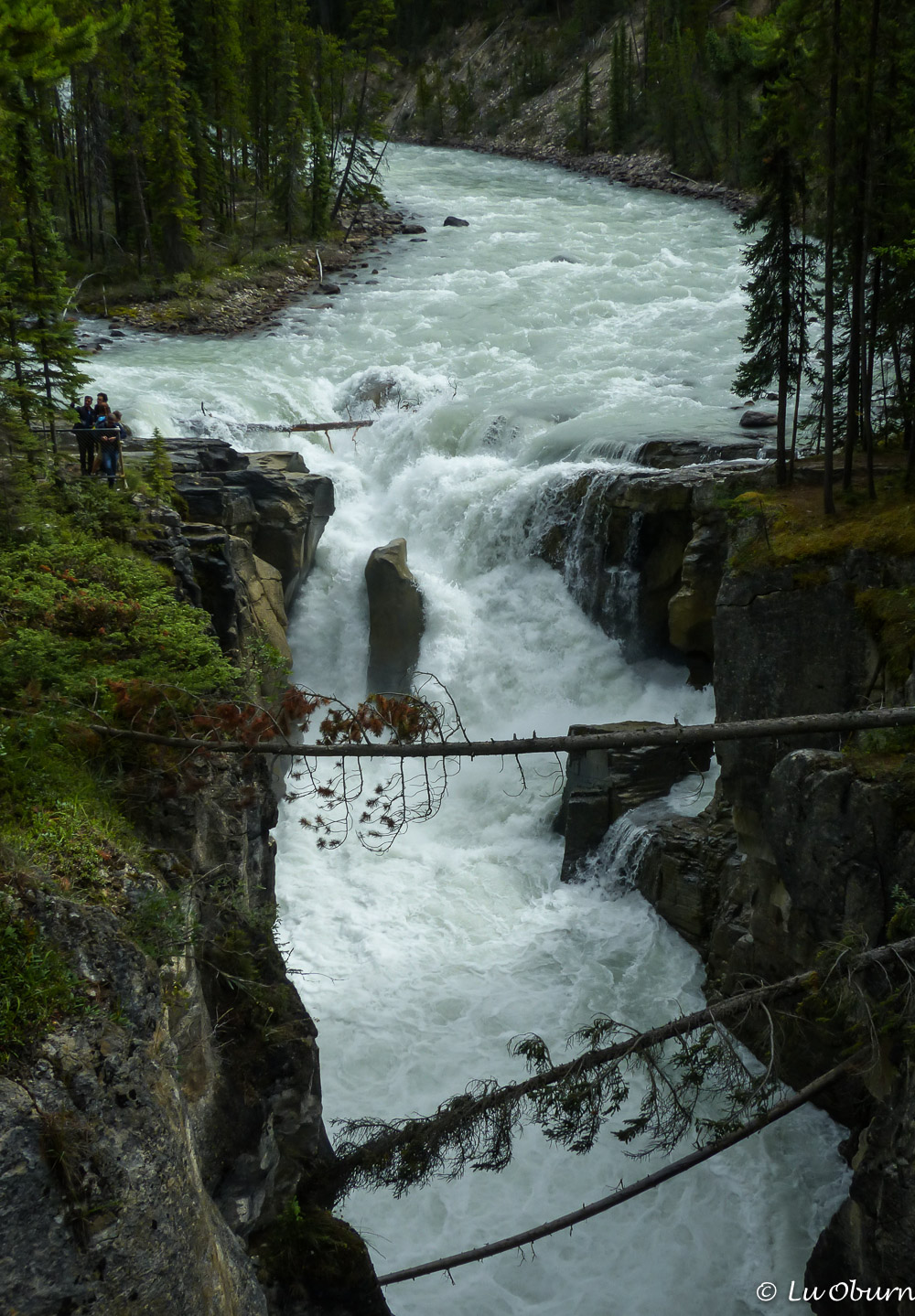
Thundering Sunwapta Falls, whose power can be felt and heard when you stand on the bridge above it.
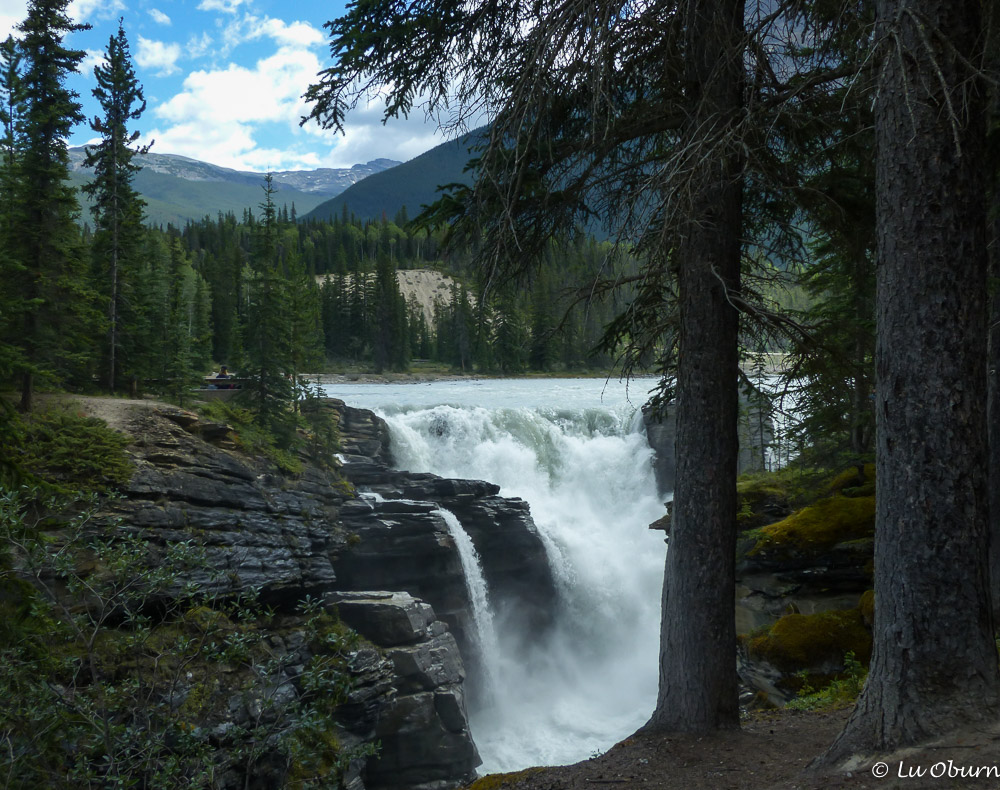
The massive power of the Athabasca Falls is created as the Athabasca River funnels into a narrow gorge.
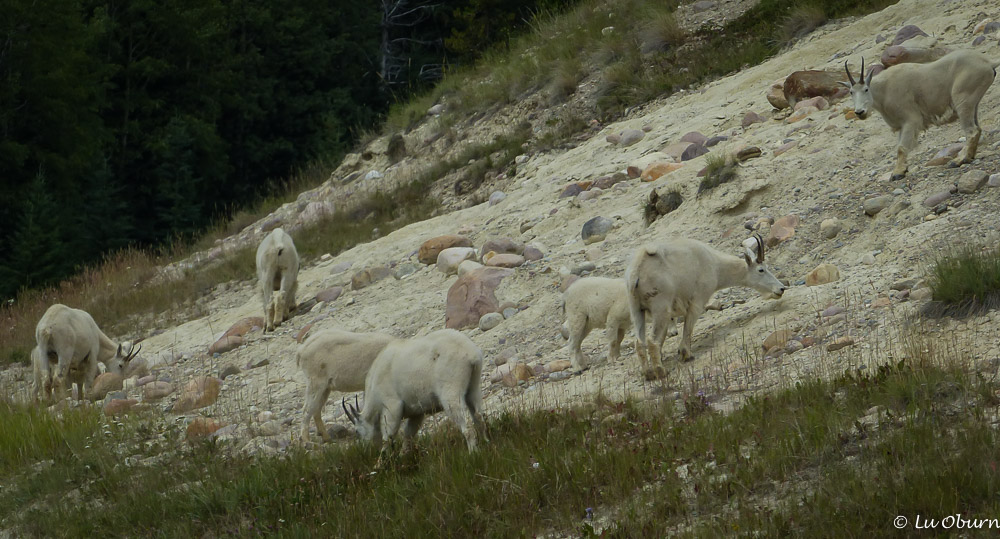
Mountain goats come down from the red cliffs of Mt. Kerkeslin to lick mineral deposits along the road.
A trip to the Canadian Rockies would be incomplete without experiencing this spectacular drive on the Icefields Parkway and the Columbia Icefields. As we drove the winding roads, I was remembering a post I had recently read by blogger friend Sue, who had recently biked this route with hubby Dave and a group of other cyclists. I bow down to you both. 🙂









 Paint Your Landscape