The Better Pompeii? ~ Ostia Antica, Rome Series, Part 3

A short metro and train ride from Rome takes you to the 4th-century B.C. ruins of Rome’s first colony, Ostia Antica.  Once a port city sitting at the mouth of the Tiber River, she served as a protector of Rome against any water invasion.  The main industry in Ostia was salt, taken from nearby salt flats, whose use was important in preserving meat in ancient times.

By the year 150 B.C., Ostia shifted from military watchdog to commercial port, becoming a key warehousing center for most of what was consumed in Rome.  As this transition occurred, Rome built a larger port where the city’s airport now stands, further changing the face of Ostia.

Women sat in the higher seats, typical of the gender division in Rome. 4,000 could gather in the theater. Used for religious, business, and entertainment events This was an elegant building in its day.
Ostia’s theater, used for religious, business, and entertainment events. Women sat in the higher seats, which spoke to the gender division in Rome.

At the beginning of the Dark Ages (around 500 A.D.) when Rome fell, the Tiber River changed course and Ostia Antica was abandoned.  This once thriving port of 60,000 became a malaria-infested swamp, buried by mud over time.  The silt that moved into the port most likely protected Ostia from scavengers and the ravages of time.  It also moved the port from the mouth of the river and today Ostia sits two miles from the sea.

This slideshow requires JavaScript.

A study of Ostia Antica shows a grittier side of Roman life (dating from 1st and 2nd century A.D.), although that is not evident in the magnificent frescoes and mosaics mostly intact still today.  The Square of the Guilds (Piazzale delle Corporazioni) has some of the most well-preserved mosaics throughout this 73 acre property.  It is a huge square lined with 60+ ship owner and traders’ offices, which was once the bustling center of Rome’s import-export business.

Ostia Antica did not enjoy the wealth seen in both Pompeii and Herculaneum, but rather represented a working-class community, with several multi-storied tenements (insulta) where the lower class lived.  These apartment complexes were usually cramped with no kitchens.  Heating and plumbing were non-existent and garbage was typically tossed out the windows.

Casa di Diana - typical multi-tiered tenement building
Casa di Diana – typical multi-tiered tenement building

The public baths were government-subsidized and functioned as both a business meeting place and a place to gather socially.  Roman engineers were radiant heat experts.  Water and air flowed through pipes under the floors and in the walls, heated by a huge furnace.  Just like a high-end spa, staffers attended to a bather’s every need, including the skimming of the water, as olive oil was used instead of soap for cleansing.  Three pools, a sweat room (laconicum) and rubdowns by a masseuse (tepidariae) were also available to the clientele.

Baths of Neptune showing a mosaic of Neptune and his wife Amphitrite.

Across the street from the baths were the public latrines (forica), where modesty was not an option.  Perhaps this was the time when friends had the chance to reconnect while literally rubbing elbows with each other.  A washable sponge on a stick was used instead of tissue and aqueducts brought in rushing water below each seat to do the flushing.  Thank goodness times have changed.

Ostia’s small museum, sitting on the back of the property, offers a look at some of the city’s finest statues, almost all 2nd and 3rd-century AD Roman pieces.

This slideshow requires JavaScript.

The beauty in a visit to Ostia Antica is that you will leave the crowds behind, unlike Pompeii and Herculaneum.

Next Up:  Vatican City

Artwork and Engineering Feats ~ Rome, Part 2

We continued our walk through ancient Rome, an era that lasted 1,000 years, from 500 B.C to 500 A.D.  Half of that time Rome was focused on expanding her government and the other half building a dominating empire.  In 500 A.D. Rome fell, and fell hard, due to corruption, invaders, and disease, dragging all of Europe into 1,000 years of darkness.  The city declined to a mere 20,000, leaving a crooked pope, crumbling ruins, and malaria-carrying mosquitos.  In the 1300’s even the popes said ‘enough’ and headed for France.
Beginning in the early 1500’s the popes decided it was time to rebuild Rome in order to attract new settlers.  They commissioned the best artists to decorate the churches and palaces, carve statues and build fountains.  We were fortunate to have the time to visit several of these artistic wonders.

On top of Capitoline Hill, overlooking the Forum, sits the oldest public museum in the world, with roots dating back to 1471.  The Capitoline Museums, consisting of two palaces, house some of Rome’s most famous statues and archeological finds.

The Etruscan Lupa capitolina is one of the most famous statues here.  It is the original bronze She-Wolf, a wild animal coupled with two hungry babies, Romulus and twin brother Remus.  According to Roman mythology, these two babes, children of Rhea Silvia and Mars, were credited with being the founders of Rome. They were orphaned as infants and raised by a she-wolf on top of Palatine Hill, one of Rome’s seven hills, overlooking the Forum.  It is a powerful symbol of perseverance for the city of Rome.

We decided to take one of Rick Steves’ self-guided tours, the Heart of Rome Walk, which carried us across the city to several popular sights.  Our first stop was Piazza Navona, a square which has been a center of Roman life since ancient times.

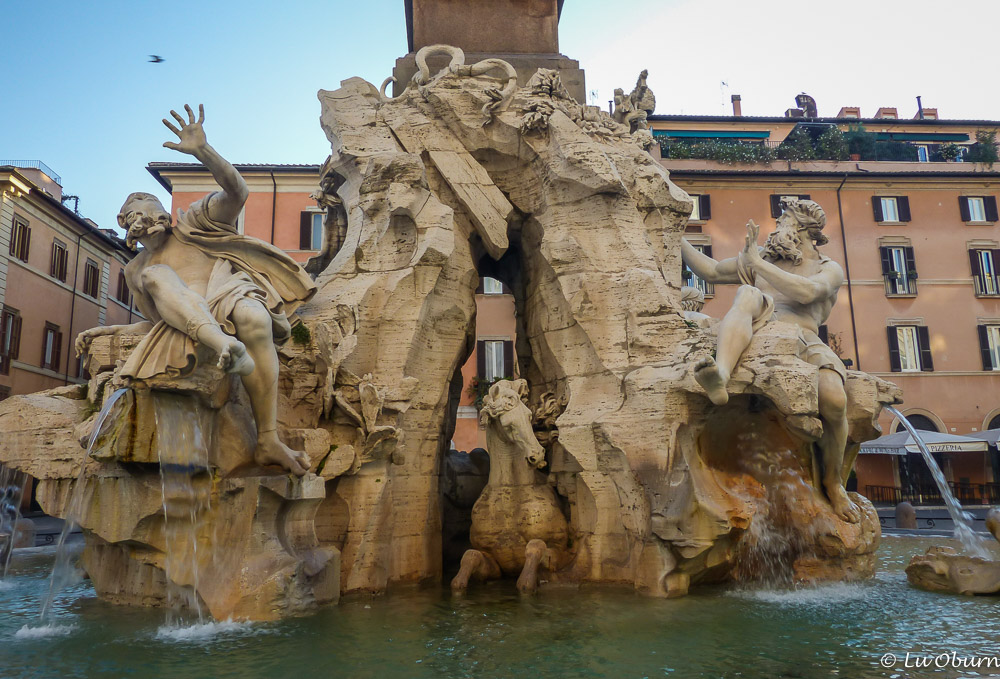
The main attraction at this piazza is the Four Rivers Fountain.  The pope, looking to clean up some of the seedier Rome neighborhoods, commissioned Bernini to build this fountain, with an obelisk rising from the center.  It represents gods of the four great rivers in four continents – the Nile in Africa, the Ganges in Asia, the Danube in Europe and the Río de la Plata, separating Uruguay and Argentina.

Our next stop was Campo de’ Fiori, where for centuries public executions were held.

This spot is where philosopher Giordano Bruno was burned at the stake for blasphemy in 1600.  Today it is a much more pleasant square and a major focus of Roman life.   Mornings it is transformed into a huge open-air market, while the evenings bring out a rowdier crowd, pub-style.

We continued our tour, stopping at the Trevi Fountain, the largest Baroque fountain in Rome, and one of the most famous in the world.

Built in 1762, it celebrates the reopening of several of the city’s great aqueducts. Neptune, god of the sea, is the central figure, with his trumpeter, Triton, blowing his conch shell, announcing their arrival.  It is impossible to photograph day or night without swarms of tourists surrounding it.

Our Heart of Rome Walk took us to the Spanish Steps, in Piazza di Spagna.  Named for the Spanish embassy to the Vatican, it’s been the hangout of Keats, Wagner, Goethe, and others.

English poet John Keats succumbed to tuberculosis at the age of 25 in the orange house to the right of the steps.  It is now a museum dedicated to his memory.  At the base of the steps is Bernini’s Sinking Boat Fountain, powered by an aqueduct.  It is a popular hangout at night.

Rome’s best preserved monument, the Pantheon, is also one of her greatest engineering feats.  Engineers still marvel at how ancient Romans built such a mathematically precise design without the use of computers or electricity.  Although I’m not an engineer I found the statistics to be quite fascinating.  The dome is as high as it is wide – 142 feet from side to side and from floor to the top of the dome.   The base of the dome is 23 feet thick, made of concrete mixed with travertine while the top is less than 5 feet thick, made of volcanic rock mixed with concrete.

The coffered ceiling offers reduced weight without compromising strength.  At the top of the oculus sits the Pantheon’s only light source, 30 feet across.  When the rains come, the 1,800-year old floor has holes in it and is angled towards the edges to drain off the water.  This floor still has 80% of the original stones.  It is inconceivable to me that this engineering design was completed in 27 B.C.  Due to fires the Pantheon we see today was completely rebuilt in A.D 120.

This Rome temple, dedicated to the gods, may look like an ordinary building from the outside, but perhaps is one of the most important in art history.  It’s dome has inspired the Florence cathedral dome, Michelangelo’s dome of St. Peter’s Basilica, and the U.S. Capitol in Washington D.C.  It is the only of Rome’s ancient buildings that has seen continued use.  The building, sunken below street level, shows how Rome has been lifted up over 20 centuries of rubble.

Perhaps the most unusual stop we made in Rome was to the Capuchin Crypt, a catacomb beneath the church of Santa Maria della Concezione dei Cappuccini.  It contains bones of 3,700 Capuchin friars, artistically displayed, not meant to be ghoulish but rather a silent reminder of our own mortality.  Click here for crypt photos as they are prohibited during your visit.

Next Up: Ostia Antica

Ruthless, Chaotic Rome ~ Part 1

Beware, a history lesson awaits. You have been forewarned.

Continuing our Italian journey, we hopped on the Circumversuviana train (a bit of a rattle trap) to Naples, then connected with the high-speed ItaliaRail to our final destination, Rome.  I had ordered our Roma Passes and scheduled pick-up at the train station upon our arrival.  If you intend to spend a few days in Rome and want free admission and/or discounts at some of the more popular sites, this pass is a must.  And perhaps the best feature of the Roma Pass is that it allows you to move to the front of the line instead of waiting with the throngs of tourists.

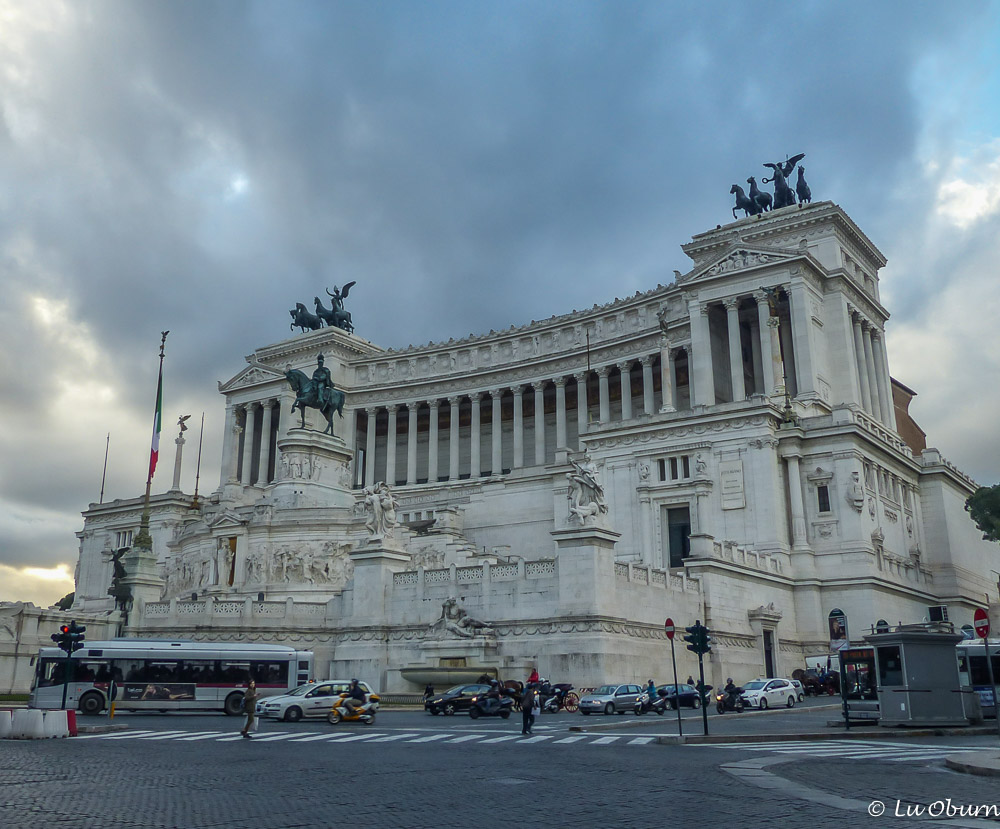
The massive, spectacular Victor Emmanuel Monument

We road-weary travelers were wondering how much energy we would have for our last full week in Italy, after almost two months of perpetual motion through France and Italy.  But as the taxi driver carried us across Rome to our apartment, all my worry dissipated like a wispy fog as the city and her history unfolded before me.  I became a wide-eyed child as we passed ancient ruins entwined with modern buildings and monuments.  I couldn’t wait to get started.

I had chosen an apartment outside the center of the city in Trastevere (trahs-TAY-veh-ray), Rome’s bohemian neighborhood, and some would say her most charming.  We were thrilled to find a beautiful apartment awaiting us and have the tram just outside our door.  It was the perfect location to explore this magnificent city.

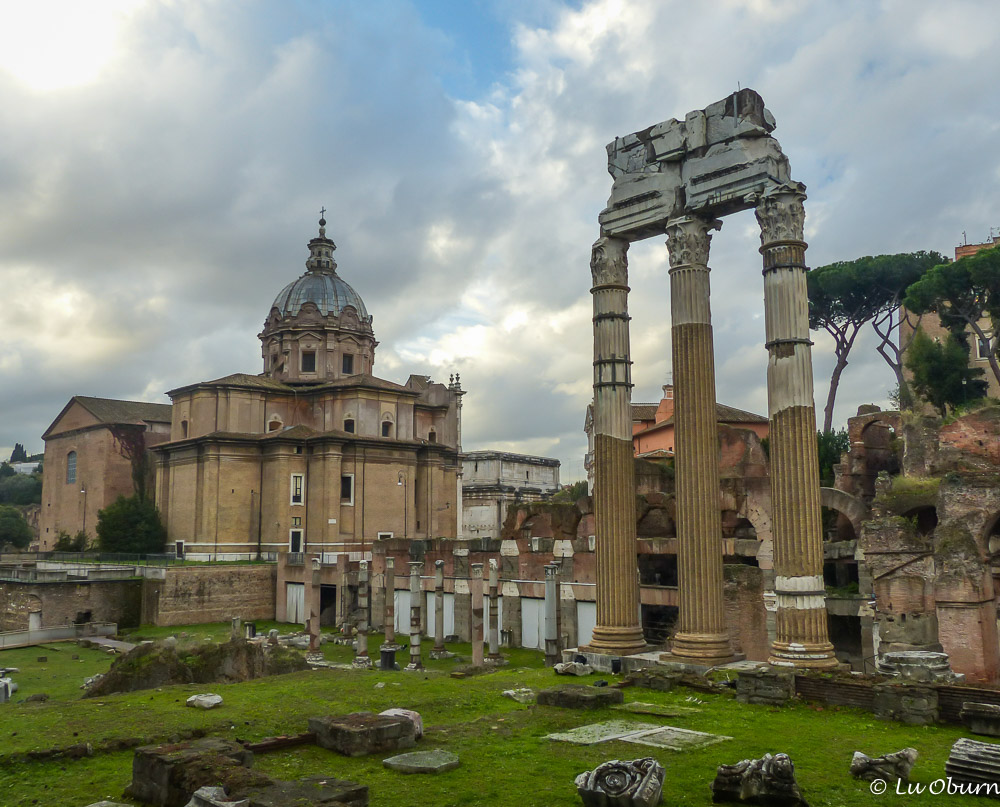
Caesar Forum
Caesar Forum

Rome is ruthless and grandiose, an imposing chaotic urban maze.  I loved her many layers.  But let’s be real, isn’t Rome really Caesar, gladiators, chariots, wild animals, and trumpets blaring?  With that lingering thought in mind we stepped back in time to A.D. 79, to the core of ancient Rome, the Colosseum.

The Colosseum was where Rome’s thirst for violence was quenched, where men and wild animals alike fought to the death in unimaginable ways.  Killing was a spectator sport back then and on any given day 50,000 roaring fans could be seen giving a thumbs-up or down to the blood lust in the amphitheater below.

Looking at her bones, the Colosseum is an amazing engineering feat, with 3.5 million cubic feet of travertine stacked into the shape of an arch, sans mortar.  It took four straight years of daily work and 200 ox-drawn wagons traveling back and forth from Tivoli to bring the stone to Rome.  Once the travertine was stacked, a keystone was wedged into the top to keep the stones from falling.

This grand amphitheater saw four centuries of grisly use.  When the gladiator games were banned in A.D. 435 the Colosseum sat eerily silent, with just the haunting echoes of the wretched cries of man and animal carried on the wind.  Today only one-third of this historic building remains.  Earthquakes consumed some of her, but most of the stone was carted off for use in other buildings across the city.  When you look down into the Colosseum today you see where the gladiators and wild animals were kept. Atop these underground passages a wooden floor was placed, sprinkled with sand, which became the killing field.

We remained in ancient Rome as we stepped away from the Colosseum to see two impressive arches, the Arch of Constantine and the Arch of Titus.

The Arch of Constantine marks an important turning point in history, the coup led by Emperor Constantine in A.D. 312, which resulted in the legalization of Christianity.

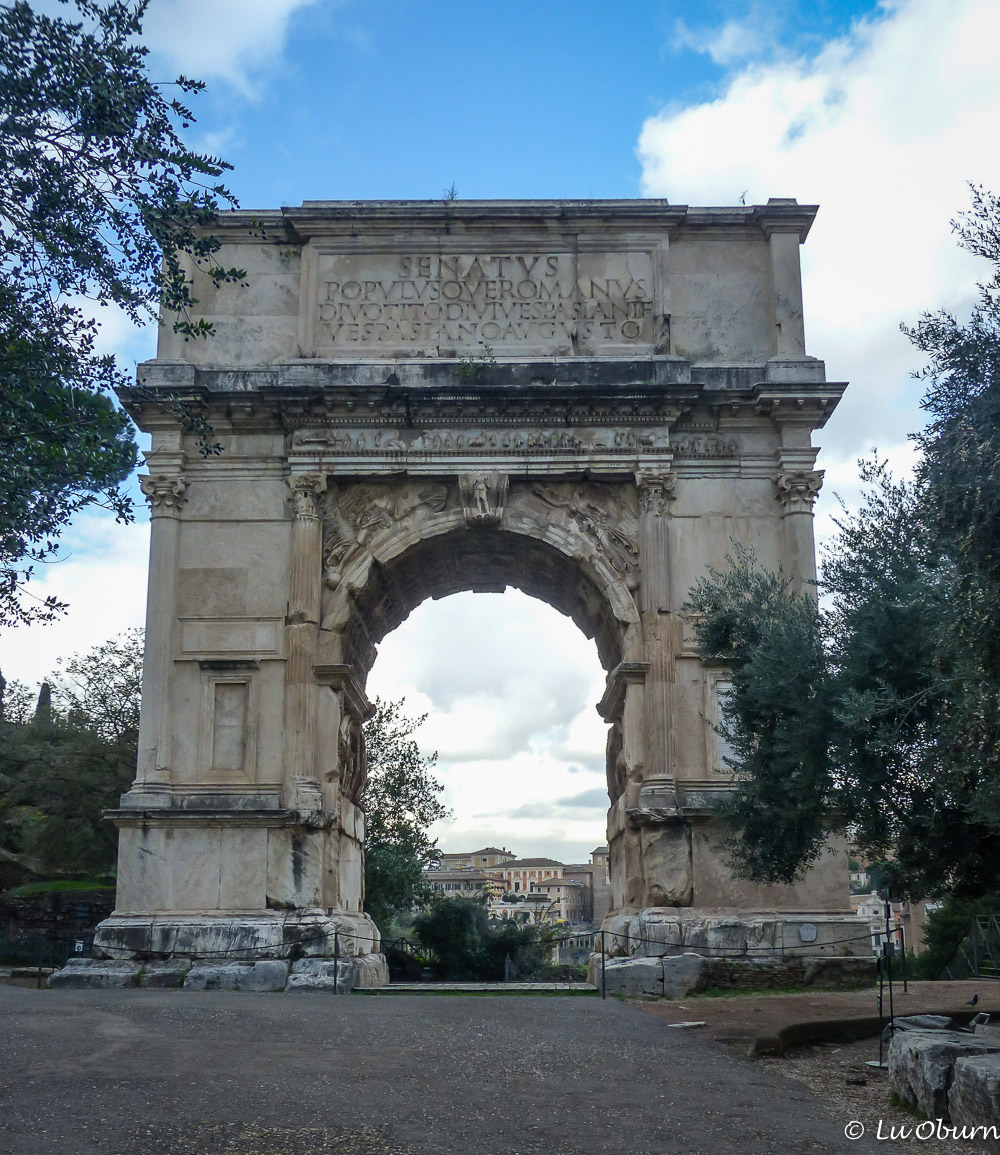
The Arch of Titus honors the military accomplishments of Titus and stands at the head of the Forum.  It has been the inspiration for many arches to follow, including the Arc de Triomphe in Paris.  The Via Sacra (Sacred Way), once Rome’s main street, leads up to the arch.

Walking through the Arch of Titus, we found ourselves in Rome’s political, religious, and commercial center, the acclaimed Forum.  Anything important that took place in ancient Rome happened here.  It is said to be the most revered meeting place in all the world, throughout history.  Today the crumbling ruins of many of the oldest and most important buildings of ancient Rome can still be seen on this sacred spot.

The Temple of Castor and Pollux is the most photographed site in the Forum.  Built in the 5th century B.C., it is one of Rome’s oldest temples.  This is where the senators met and its front steps served as a platform for free speech.   This shrine was raised to celebrate victory over the Etruscan king, Tarquin, who had once oppressed all who lived here.

The Temple of Antoninus and Faustina was dedicated to Emperor Antoninus Pius and wife Faustina the Elder by Marcus Aurelius.

This is the plaque that commemorates the man who exemplified the greatness of Rome more than anyone else – Julius Caesar.  On this spot he  was cremated after being stabbed 23 times by political conspirators and his adopted son – ‘Et tu, Brute?”.

Entrance to the Temple of Saturn, the Forum’s oldest temple, erected in 497 B.C.

The Arch of Septimius Severus, with reliefs that celebrate the African-born emperor’s battles in Mesopotamia.

This unusual structure, even older than the Temple of Saturn, was named Umbilicus Urbis (Navel of the City).  It was considered the center of the universe and all distances in the empire were measured from here.

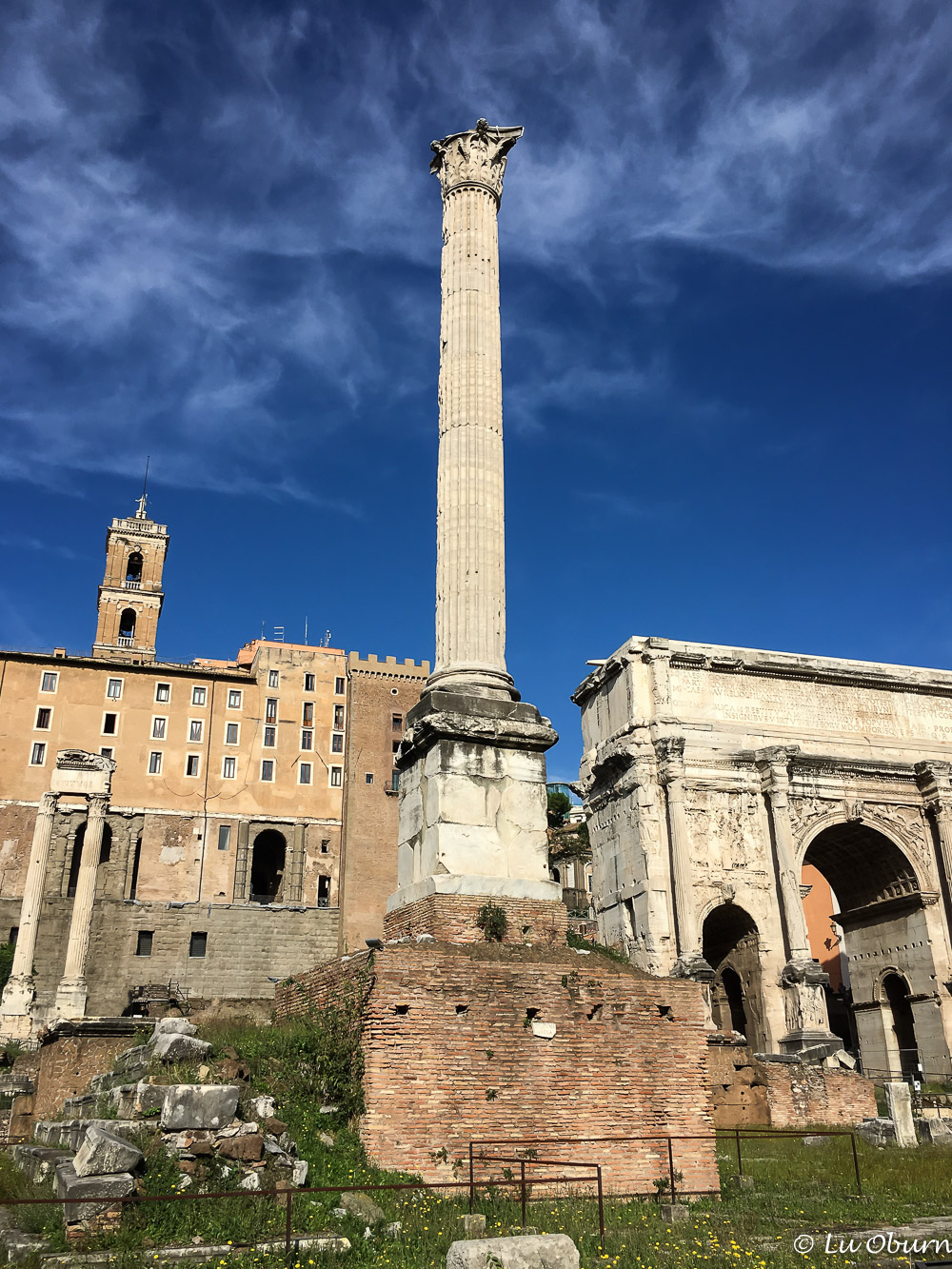
The Column of Phocas celebrates the pagan Pantheon’s transformation to a Christian church.  It was the symbolic nail in ancient Rome’s coffin.

Next Up:  Artwork and Engineering Masterpieces of Rome

Volcanic Onslaught ~ Pompeii and Herculaneum

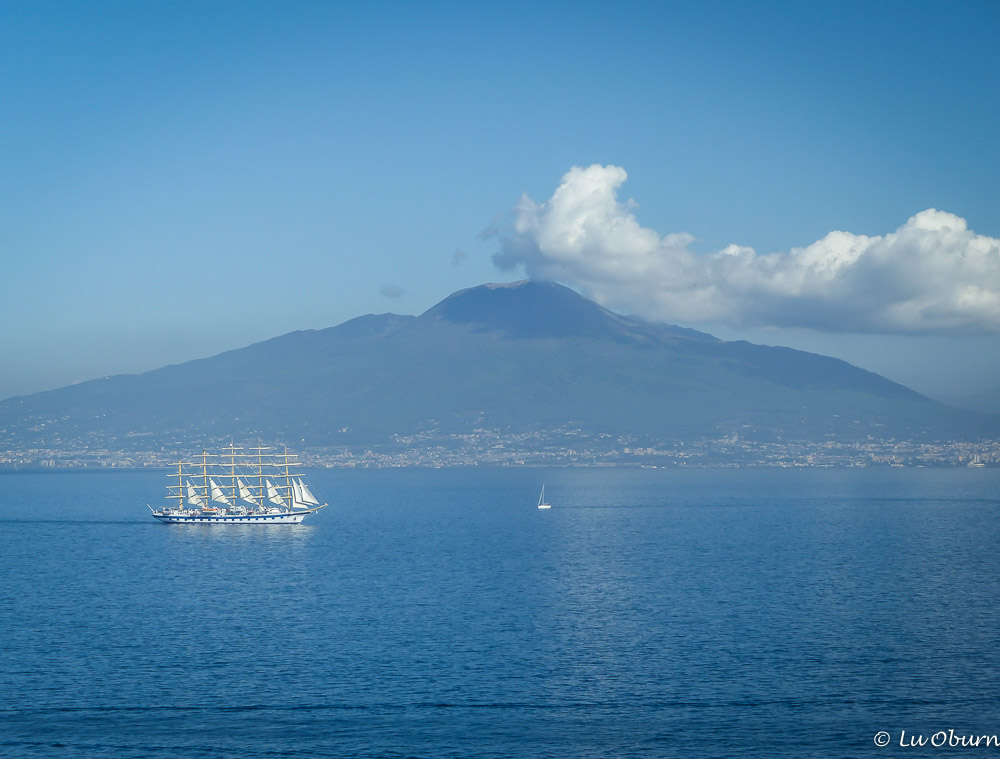
As we stood on our terrace in Sorrento, looking across the Bay of Naples, billowy clouds suspended in a cerulean sky draped a majestic peak.  It’s hard to imagine that such a serene backdrop was once the setting of a volcanic onslaught so massive that it is classified as one of the worst eruptions in all of human history.

The volcano that wrought such fury is that of Mt. Vesuvius, still considered to be one of the most dangerous volcanoes in the world.  She is hundreds of thousands of years old and has erupted more than 50 times, but the most famous of her outbursts was that of August, A.D. 79, when she stopped two cities, Pompeii and Herculaneum (Ercolano in Italian), soundly in their tracks, quickly and decisively frozen in time.

A visit to Pompeii and Herculaneum is like taking a journey back in time to see what life in ancient Rome was like. As the archeologists began their meticulous unearthing work in 1748, they found two cities still very much intact, especially Herculaneum.

Pompeii, founded in 600 B.C., was once a thriving commercial port of about 20,000 residents.  This was a middle-class community, an example of quintessential Roman life.  Streets would have been lined with shopping stalls jammed with customers.  Chariots rivaled shoppers for street space.  Rich and poor rubbed elbows as grand homes stood alongside simple abodes. Pompeii was rowdy, raw, the place for action and shopping, with more than 40 bakeries, 30 brothels and 130 bars, restaurants and lodgings.  In contrast, nearby Herculaneum was a more dignified place to live, with traffic-free streets, lavish homes and better drainage.

August 24, A.D. 79, a fateful day in history, Mt. Vesuvius erupted, raining hot ash down over Pompeii,  burying the city under 30 feet of volcanic soot.  One witness wrote that the volcanic dust “poured across the land like a flood”. Of her 20,000 people, 2,000 stayed to ride out the “storm” and 2,000 perished.  

No one had any idea they were living literally right under a volcano, as Vesuvius had slept for over 1,200 years.  Imagine the confusion, then the horror as small rocks and volcanic dust collapsed roofs and crushed those who chose not to flee.

Herculaneum was initially spared, thanks to the direction of the wind, but about 12 hours after the explosion began, she was slammed by a deluge of superheated ash and hot gases that came roaring off the volcano.  Eventually Herculaneum was buried under 60 feet of ash, which hardened into tuff, perfectly “freezing” the city until 1748.

Archeologists initially wondered why there were so few victims found at Herculaneum.  But during their excavations in 1981, hundreds of skeletons were unearthed in the boat storage area, a sign that some of her 4,000 residents attempted to escape by sea and were overtaken by fumes and ash.  Chilling reminders of this can still be seen today.

This slideshow requires JavaScript.

Some experts believe that, although Mt. Vesuvius has stood quietly since 1944, another similar eruption is inevitable, due at any time.  This would be catastrophic as almost 3,000,000 people live within 20 miles of her crater.  For now she sits silently on the horizon, smoldering.

For those who are interested in seeing how this fateful day may have played out, an interesting re-enactment can be found here.

Next Up:  Rome

The Grand Balcony Between Sky and Sea ~ Amalfi Coast, Italy

“You may have the universe if I may have Italy.” ~ Giuseppe Verdi

We headed to the Rome airport from Tuscany, where we were set to part ways with Winston, our leased vehicle.  He had served us well, but after doing a little reading, we all felt it was time for someone else to be doing the driving for the rest of our journey.  Given there is only one overland passage on the Amalfi Coast, the 25-mile Strada Statale 163, a winding, narrow road of 1,000 bends, this seemed like the perfect place to cut our ties with Winston.  Sorry old chap. 😦

Initially I wasn’t sure that I wanted to spend time on the Amalfi Coast, but since many consider this stretch of coastline to be Italy’s most scenic, I acquiesced.  After wandering through the hill towns of Tuscany, five sun-kissed days ogling soaring rock faces, pastel-brushed villages tumbling to the sea, forested hillsides, and the azure waters of the Mediterranean sounded rather enchanting.

Artists have been drawn here for centuries, from the 14th-century writer Giovanni Boccaccio, the 19th- century composer Richard Wagner, to the 20th-century playwright Tennessee Williams.  In spite of its glitz and glamour there is a rural side here also.  Farmers still work small plots of steeply terraced land to eek out a living and their wives make cheese.  All different sizes and shapes of lemons are grown, some that become part of the famous digestif, limoncello, a blending of lemon rinds, alcohol, sugar and water…quite tasty.

View to the sea from Piazza Tasso, Sorrento's main square
View to the sea from Piazza Tasso, Sorrento’s main square

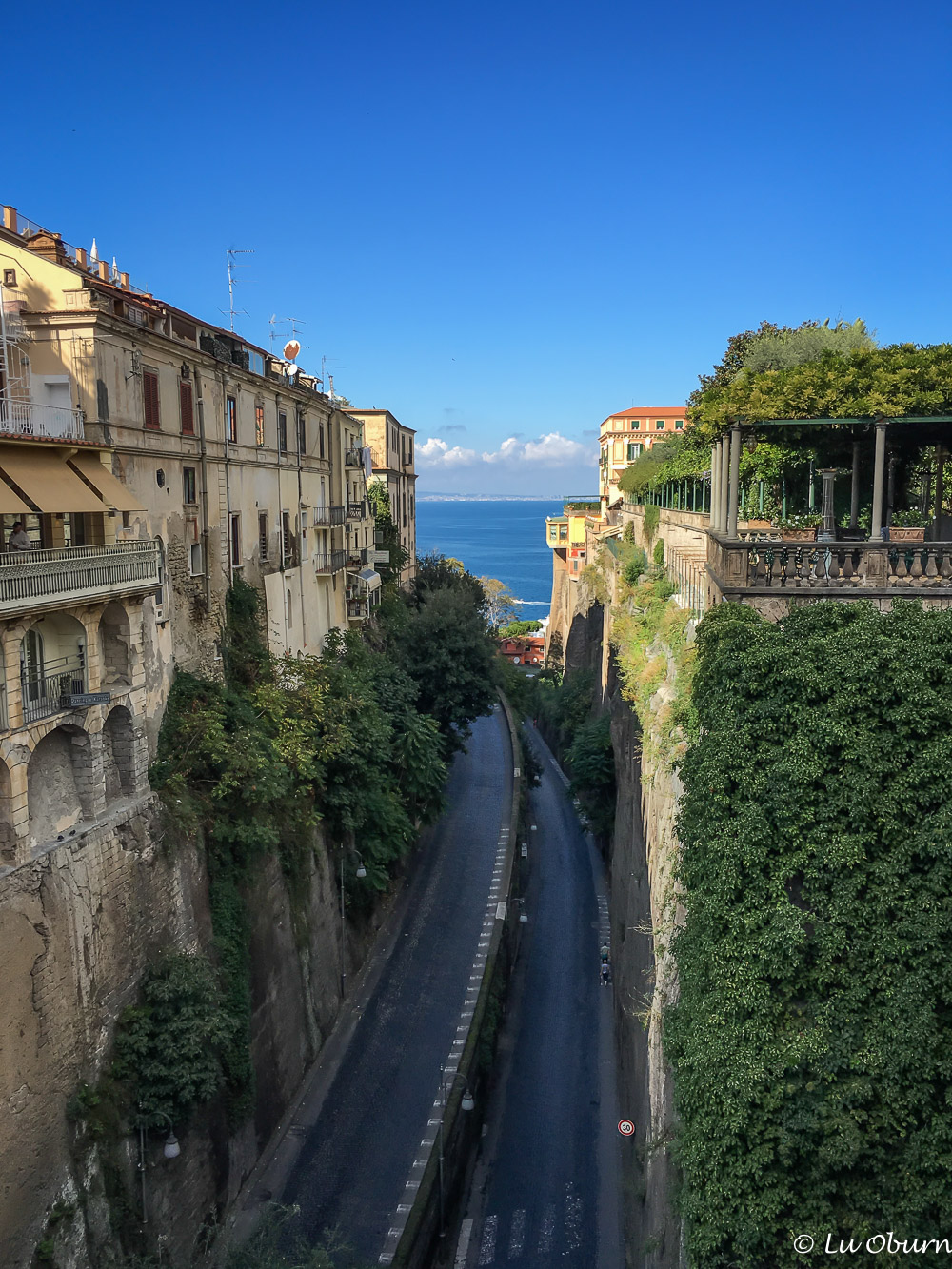
We chose a hotel in Sorrento for our base, a funky little inn perched atop a cliff, with sweeping vistas of the sea and Mt. Vesuvius.  The entire town is clifftop, looking down on its two marinas, filled with narrow alleys lined with tiny shops and restaurants, and tenants living above.  A 15-minute walk got us into the heart of Sorrento, where we spent most days exploring and sampling the local fare.

Here’s a glimpse of our time spent on the Amalfi Coast:

1)  Sorrento 

This slideshow requires JavaScript.

Sitting on a clifftop, balancing above the Mediterranean, Sorrento is an attractive place to spend several days. This town of 20,000 doubles in size during the summer, and was still quite active during our visit in October.  The main drag changes depending on the time, allowing vehicles to move through, then becomes a pedestrian walkway later in the day.  And just off this main drag is a street that goes back centuries before Christ…hard to get my head around such history.

“Sorrento’s name may have come from the Greek word for “siren”, the legendary half-bird, half-woman who sang an intoxicating lullaby.  According to Homer, the sirens lived on an island near here.  No one had ever sailed by the sirens without succumbing to their incredible musical charms…and to death.  But Homer’s hero Ulysses was determined to hear the song.  He put wax in his oarsmen’s ears and had himself lashed to the mast of his ship.  Oh, it was nice.  The sirens, thinking they had lost their powers, threw themselves into the sea, and the place became safe to inhabit.” ~ story told in Rick Steves’ guidebook

This same Rick Steves’ book suggested taking a day tour of Positano, Amalfi, and Ravello with Mondo Tours.  It was great letting someone else worry about losing a side mirror trying to pass other vehicles on this winding, seriously narrow stretch of road that hangs off a cliff face like a grand balcony.  But you exchange stress-free driving with little time in villages, making for a whirlwind day and finding out you may have missed the very best some of these villages has to offer.

2)  Positano

In days gone by, Positano was famous for its fleet of ships and heroic sailors, but a tsunami in 1343 and Middle Age pirate raids zapped its power and wealth.  It flourished again in the 1700’s and in the 20th century Positano became a haven for artists and writers wishing to escape the ravages of Communist Russia and Nazi Germany. Today this village is a mass of cafes and women’s boutiques, with a broad beach at her base.

It’s been almost impossible for Positano’s residents to get a building permit for the past 25 years, resulting in endless staircases that have become a way of life for her 4,000 residents.  There is only one street that allows motorized vehicles, so this village has been spared the influx of big bus tourist mobs.

3)  Amalfi

This town of 5,000 had its heyday back in the 10th and 11th centuries, when it was a major maritime republic, rivaling Venice and Genoa.  The tsunami that struck in 1343 almost wiped her off the map, and today Amalfi relies on tourism.   Her waterfront continues to be the coast’s biggest transport hub.  Amalfi’s most important sight is the Duomo, begun around 1000 A.D., and is certainly worthy of a tour.  The beautiful bronze doors, as old as the cathedral, were cast in Constantinople in the year 1066.

4)  Ravello

Sitting on her lofty perch 1,000 feet above the sea, Ravello is considered one of the most romantic small towns in southern Italy, attracting celebrities for generations.  Those who have fallen under her charms and called Ravello home are Gore Vidal, Richard Wagner, D. H. Lawrence, M. C. Escher, Henry Wadsworth Longfellow, and Greta Garbo.  Visitors come here to visit her two magnificent gardens and estates.  Unfortunately we had time for little except lunch and a quick walk through town.  And I learned just last night from friends that Ravello’s flatware and beautiful hand-painted dinnerware were not to be missed.  Darn! 😦

Next Up:  A Cataclysmic Eruption – Pompeii and Herculaneum