Unfortunately most of our time spent in the Outer Banks was a bust weather-wise, bringing blustery winds and cold rains. Planned bike rides and walks on the beach were scrapped most days, so instead we turned our attention to visiting the lightkeepers of the Outer Banks, those lone sentinels with piercing gaze, standing guard over the dangerous channels and shoals, always at the ready to guide mariners to safety.
The entire stretch of coastline along the Outer Banks has been nicknamed the “Graveyard of the Atlantic”, given the 1000+ ships that have succumbed to a watery grave here since record keeping began in 1526. The cold waters of the Labrador Current crash into the warmer waters of the Gulf Stream, resulting in severe weather, strong currents and thick fog.
We visited five towering lighthouses along the coastline, although many would say only four actually stand within the Outer Banks’ boundaries. The southernmost light station at Cape Lookout resides in the Core Banks, immediately south of the Outer Banks, although there is much discussion about exactly where the Outer Banks begin and end. Regardless, we found each of these stately brick lighthouses to be fascinating, each with their own unique designs and light patterns to act as location markers for seagoing vessels.
1) Currituck Beach Lighthouse
 Currituck Beach Lighthouse is the northernmost lighthouse, in Corolla, NC. Prior to constructing this light station, there was an 80-mile navigational void along this stretch of land where many vessels languished. Standing 158 feet tall, this unusual unpainted brick beacon began flashing its 1st-order Fresnel lens on December 1, 1875. Its light rotates in 20 second increments and can be seen 18 miles out to sea. The lighthouse’s 220 steps are open to the public for climbing, giving a wonderful panoramic view of the Currituck Sound and the Atlantic Ocean.
2) Bodie Island Lighthouse
 Bodie Island Lighthouse (pronounced ‘body’) stands just south of Nags Head and is the third beacon built along this stretch of coastline. The first was abandoned due to a poor foundation and the second obliterated by Confederate troops. The present-day structure was completed in 1872 and stands in an atypical setting of tall pines and marshland. Standing 150 feet tall, it is said to be the architectural twin of Currituck Beach, but is not open to the public for climbing. Bodie carries the familiar black and white horizontal stripes common to many lighthouses, casting its 1st-order Fresnel lens 19 miles over the ocean.
3) Cape Hatteras Lighthouse
 Known as “America’s Lighthouse”, Cape Hatteras is the tallest brick lighthouse in the country, standing 208 feet tall. Its familiar black and white spiral-striped tower guards one of the most dangerous stretches of the Outer Banks, 12 miles of shifting sandbars sitting off Cape Hatteras, known as the Diamond Shoals. The present-day beacon was completed in December 1870 and today uses two 1000-watt lamps to guide mariners, throwing its light 20 miles out to sea.
In 1999 the Cape Hatteras Lighthouse was moved inland one-half mile to save it from the ravages of the intruding Atlantic. It was cut from its base, lifted onto steel beams and transported via railroad tracks to its current location. The interior 269 steps are open to the public; however, we determined its beauty was best seen from afar as we watched a large bus full of pre-teens standing in line to tackle the climb. 😉
4) Ocracoke Lighthouse
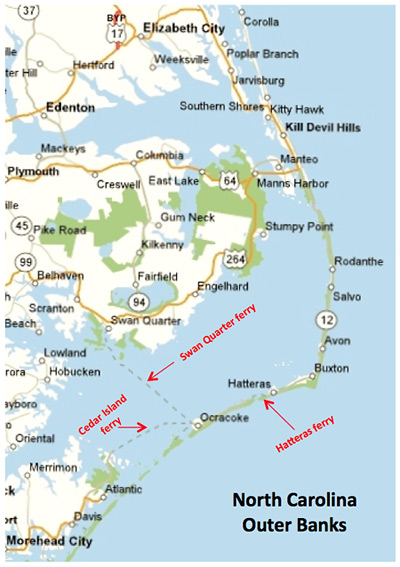
 Ocracoke Lighthouse is North Carolina’s oldest operating lighthouse. The present-day structure, built in 1822, is the third, with the first two being replaced due to shifting inlet sands. Standing 75 feet tall, it shines its constant fixed beam 14 miles out to sea. It is not open to the public for climbing and if you want to see her, you must access the free ferry over to Ocracoke Island. Fair warning, be prepared to wait in long lines to get onto the ferry. We waited 2 1/2 hours and peak season was not yet upon us.
5) Cape Lookout Lighthouse
 Cape Lookout Lighthouse, whose structure is very similar to that of Bodie and Currituck, stands 163 feet in height, with 207 interior spiraling steps that can be traversed during summer months. Not unlike Ocracoke, it must be accessed by small ferry from Harker’s Island, and if you are lucky on the ride over, you may spot the wild ponies of Shackleford Banks.
As is true of most of the beacons in the Outer Banks, the present-day lighthouse is not the first. The original structure was not tall enough to spot before many navigators ran into the Lookout Shoals, nicknamed the “Horrible Headland”. Today’s beacon reaches 20 miles out to sea thanks to two 1000-watt electric bulbs. An underwater cable running from Harker’s Island supplies electricity to the lighthouse.
What makes Cape Lookout truly unique is her black and white diamond pattern, unlike any other in the Outer Banks. The black diamonds face north/south, while the white face east/west, a great daytime navigational aid.
Our time in the Outer Banks has ended and we now point our rig towards our nation’s capitol, specifically Greenbelt, MD, where we will be camp host volunteers for the summer at Greenbelt Park.


We look forward to new adventures and already know we have a treat waiting for us when we arrive. More to come on that. 🙂






 Paint Your Landscape