After a few weeks of preparation, it was finally time to support my first field seminar, Intro to Wolf Management and Ecology. Since the reintroduction of wolves to Yellowstone in 1995, debates relative to this alluring creature have been tireless and complex. Wolf watchers in the park are enamored by them, ranchers and hunters not so much.
Sunrise at Slough Creek, site of an active wolf den.
I had heard several park employee discussions on the topic of reintroduction of the wolf, namely Doug Smith, project leader for the Wolf Restoration Project, since our arrival to the park. He has studied wolves for the past 20+ years and still brings the same passion to the topic as he did as a Yellowstone freshman. I was anxious to hear some fresh views on this subject from our class instructor, Jon Trapp. Beyond embracing many of the views presented by Doug, Jon also spoke on the topic of wolf denning, subject of his master’s thesis.
Our classroom time took us through the past couple of decades since reintroduction, how many of the wolves have been collared and tracked, the family dynamics of how they hunt together, and what happens when an alpha member of the pack is killed. It was most informative and supporting this field seminar added another dimension to my time at the Buffalo Ranch.
Field time at the Slough Creek den
Wolves get a bad rap, some of it deserved, as they do kill some livestock. No rancher wants to work hard to grow their herd, only to have a predator take from him. The good news is that when this happens, the rancher is compensated for his loss.
Hunters who share the sentiment that the only good wolf is a dead wolf feel that the elk population has been jeopardized by the reintroduction of the wolf. It is true that the mainstay of the Yellowstone wolf’s diet is elk; however, statistics have shown that many more elk are taken down by cougars than wolves. I learned that 85-95% of the time when hunting an elk, the wolf is not successful, and their elk hunting is compensatory, killing weaker elk who were most likely going to die anyway.
Instructor Jon Trapp balanced over an abandoned wolf den
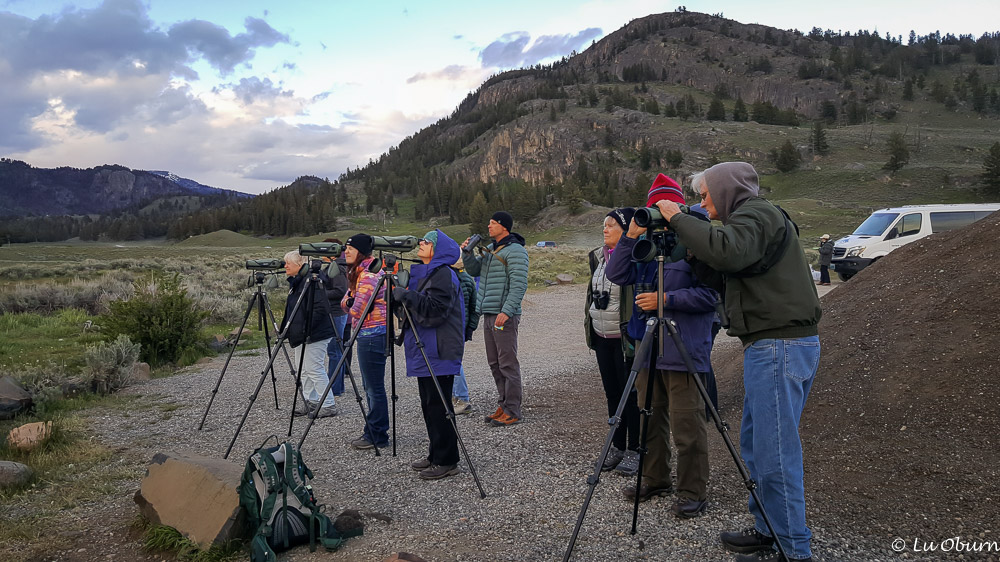
Our field studies were the most exciting, taking us to an area of the park where we could view an active wolf den using spotting scopes. Watching the pups emerge from the den, tumbling over one another, frolicking in the sunlight, delighted us all. Jon also took us to one of the first acclimation pens, Rose Creek, where we read the story of the first alpha female to the reintroduced to the park. On another outing we inspected an abandoned wolf den.
Rose Creek acclimation pen where the first of the wolves were reintroduced
Our class reading the story of alpha wolf #9 at the Rose Creek acclimation pen
Class photo
With the wolf’s return to the world’s first national park, Yellowstone has regained its balance of historic mammals and is now described as the largest intact ecosystem in the temperate world. We now see this region as it was before the Europeans arrived.
Biologists and scientists spend significant time in the field tracking the wolves of Yellowstone, but in the end what matters most is that we carved out another little piece of wildness with their reintroduction. We need these wild spaces, their coarseness, erratic ebbs and flows, the magic and mystery.
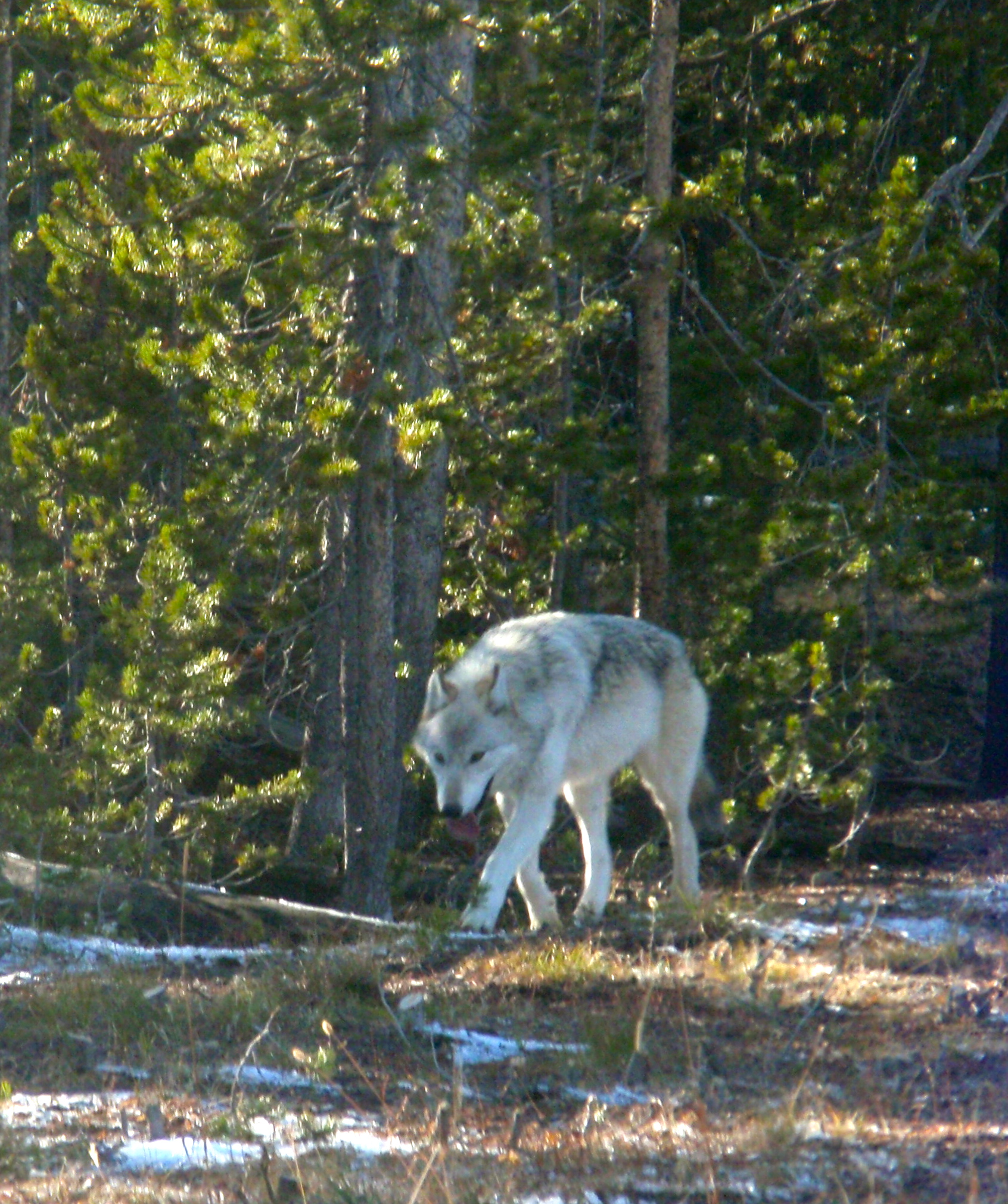
Photo of the white wolf from September 2010, recently shot and killed within Yellowstone NP.
Disclaimer: The views expressed here are my own and do not necessarily represent the views of Yellowstone Forever.
Planning for our summer began in earnest several months ago but we just arrived at our destination, Yellowstone National Park, a few weeks ago and what a whirlwind it has been.
Giving back by way of volunteering is a passion of ours and this year we have elected (and been chosen) to be program volunteers for Yellowstone Forever. Formerly known as Yellowstone Association, a merger in October 2016 between the Association and the Yellowstone Park Foundation created Yellowstone Forever, the educational and philanthropic partner of the park. We will be supporting the naturalists who conduct the Field Seminars and soaking up every bit of knowledge we can along the way. Their subject list is diverse, ranging from wildlife, birding, photography, geology, sketching, hiking, Native American studies, backpacking, fly-fishing, and an entire new Naturalist Series. It is going to be an active and educational summer, one in which we feel fortunate to participate.
Training for our Yellowstone summer adventure spanned a couple of weeks and covered a broad spectrum of activities; e.g. orientation, bus driver training, an intensive two-day wilderness first aid class, course preparation, and camp duty…whew!
When we finally arrived at our summer home, the Lamar Buffalo Ranch, we hit the ground running with a dedicated group who travel from near and far to ready the campus for the upcoming summer season. From top to bottom we scrubbed and scoured the bunk house, bath houses, and cabins, in anticipation of a busy summer. If it sounds like a lot of prep, it is, but the care taken by Yellowstone Forever to ensure happy field seminar participants has resulted in numerous returnees year after year to consume the knowledge eagerly shared by the engaging naturalists who conduct the classes.
This slideshow requires JavaScript.
Yes, it has been a whirlwind few weeks, tiring yet exhilarating. Although far from being expert program volunteers, we both have one field seminar under our belts, “Intro to Wolf Management and Ecology” and “Bears, Bones, Signs, and Stories”.
As I sit on the back porch of our bunkhouse looking out over the heart of the Lamar Valley, known as the “Serengeti of North America”, I listen to the resounding thunder rolling across the landscape. Countless bison can be seen grazing, while their young “red dog” calves frolic. I am humbled by the wonder of this magical landscape. I have no doubt that my Yellowstone Forever summer will change me in ways I cannot foresee.
Rumi said:
“There is a voice that doesn’t use words. Listen.”
I believe that voice can be found in the wilderness, in places like Yellowstone National Park. I plan to spend plenty of time listening. As time and the internet permits, I hope to share what I have learned.
Hope you are all having a great start to your summer!
Disclaimer: The views expressed here are my own and do not necessarily represent the views of Yellowstone Forever.
The Cinque Terre (Five Lands), a six-mile stretch of coastline along the Italian Riviera, seductively draws tourists, her allure building every year. Hanging off the cliff sides, this grouping of five villages, the coastline that hugs them, and the surrounding hillsides all coalesce to form the Cinque Terre National Park, a UNESCO World Heritage Site. Leave your vehicle at your hotel, if you came in one as we did, and join the tourists who use her walking paths, trains, shuttles, and boats to move from village to village. At least these tourists seem more laid-back than those we had seen in other large cities.
Although Cinque Terre has been “discovered”, there remains an air of authenticity here. The enchantment of the Cinque Terre is found in the colorful houses and shops, appearing to be stacked one on top of another, running down the ravines and hillsides to the shore. Her real charm is in the lack of corporate development. There is something provocative about the locals refusing to give in to the trappings of the modern world. Their philosophy of living a good life is through religious devotion, family ties, hard work, and lots of wine and laughter. Throughout the centuries these hardy locals have terraced the hillsides, building houses, planting vineyards, olive groves, and family gardens, tending and harvesting them.
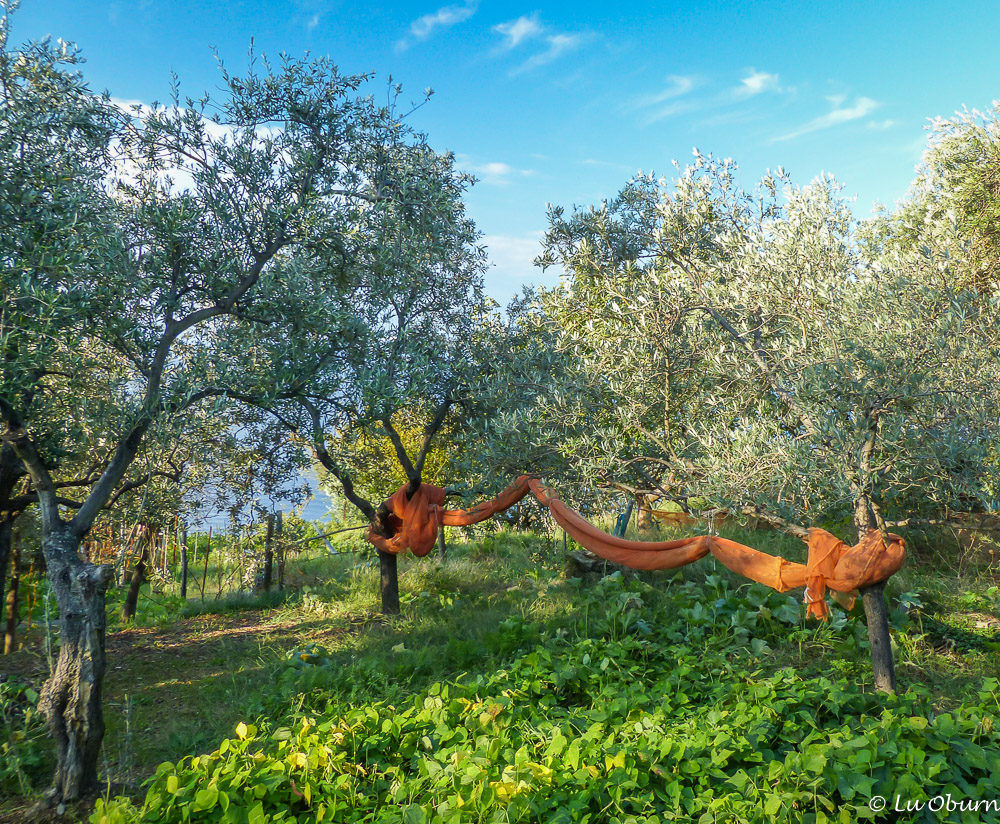
Nets tied up under olive groves awaiting a new harvest.
We had hoped to be spontaneous about sleeping arrangements here but the more we read of the Cinque Terre, even in the shoulder months of September and October, the more we thought an advance hotel reservation may be in order. Knowing we might be crowd weary at day’s end, I chose a hotel above the Cinque Terre, in the small village of Volastra. We couldn’t have been more pleased with Hotel Il Saraceno and her proprietress, Antonella. Arriving late afternoon when restaurants were closed, we walked to the market for local fare of cheeses, salami, bread, antipasto, and wine. The terrace back at the hotel became our banquet table and Antonella contributed wine glasses for the affair. Waking to cappuccino and a wonderful breakfast spread each morning and coming back to a quiet little hotel above the bustling villages each night made this the perfect respite.
We had planned to hike the Sentiero Azzurro (Azure Trail) when we arrived, a trail that connects all five villages. Unfortunately sections have been closed for repairs since the devastating floods and mudslides of October 2011 and are yet to reopen. We hiked all that was available and enjoyed the views from each section. Purchasing the Cinque Terre Multi-Service Card, which included the use of walking trails within the National Park, as well as the train and shuttles, completed the logistics for navigating from village to village, and it paid for itself quickly.
Volastra to Manarola hike – much steeper than it looks
The final steps on the Volastra to Corniglia hike.
Taking the high trail through vineyards from Volastra to Corniglia.
We opted to tackle the stairs first on our way from Monterosso to Vernazza.
This local was selling fresh-squeezed OJ on the trail from Monterosso to Vernazza.
Given Cinque Terre’s location on the Mediterranean, seafood is plentiful here. Acciughe ( ah-CHOO-gay), aka anchovies, is a local specialty and not the salty version we know of in the states. These are fresh from the sea, cooked in various dishes. I enjoyed a layered casserole of whole anchovies, potatoes, tomatoes, white wine, oil, and herbs…very tasty!
The villages each have their own unique qualities so each draws its own special crowd. From north to south, here are the “five lands” of the Cinque Terre:
1) Monterosso al Mare
Lunch of mixed seafood stew at Ristorante Belvedere
Street scene
St Francis stands watch
Enjoying the views of Monterosso beach
Inside St John the Baptist church
This is the oldest of the five villages, founded in A.D. 643, when locals moved from the hills to the coast to escape barbarians. It is the only town built on flat land, has both an old town and new town, separated by a tunnel, and is the only village with a proper beach. It was one of two villages hit the hardest by the floods of 2011.
2) Vernazza
Doria Castle, now a park, was once the town’s watchtower during the pirate days and a Nazi lookout during WWII.
Colorful fishing boats bob in the harbor.
Atop Doria Castle
Church tower overlooks the harbor
Terraced hillsides above the village
Founded around the year 1000, it has the closest thing to a natural harbor and this is where the action is in town. We spent much of our time in this quaint village down at the harbor, watching old men puttering with their fishing boats and students sketching and watercoloring, as we enjoyed sunny days, picnic lunches of friggitoria (bite-sized seafood piled into a paper cone), and gelato (of course). Many feel Vernazza is the jewel of the Cinque Terre.
This jolly fisherman loved having his photo taken.
Watercolor class at the harbor.
Lovely view of harbor from trail above
Starting lessons at an early age
Fishing boats cover the harbor waters.
Vernazza was hit the hardest on October 25, 2011, when 22″ of rain fell, burying much of the town under ten feet of mud. With the affluence brought on by tourism, some locals had abandoned their land, leaving vineyards unworked and stone walls crumbling, all which slid into the village, adding to the devastation – a tough lesson for the residents.
3) Corniglia
A stop for fresh-squeezed lemonade at a local cafe
Inside Church of San Pietro
Village square
The quiet middle village, Corniglia is the only town not on the water, although steps lead down to a rocky cove. Some say that vases of wine found at Pompeii were those made in this peaceful little village. Wine is still the life blood today.
4) Manarola
Sense of authenticity even in the mannequins. 😉
Street view
Colorful boats line the walkway
Lots of kitties wander the streets.
Harbor as seen from the point
Tucked in a ravine, mellow Manarola has a little harbor at its base. It’s hillsides, blanketed with vineyards, have more grapes than any other village. Great photos can be taken of the colorful village and harbor from a point on the peninsula. Our first hike was from Volastra down to Manarola, a steep descent through olive groves and vineyards, with gorgeous views of the Mediterranean.
5) Riomaggiore
Hillside jumble of buildings
It’s wash day!
Beautiful murals speak of what life was like in Riomaggiore.
Largest of the five villages, Riomaggiore was built in the 8th century by Greek settlers fleeing persecution in Byzantium. It is the laid-back working man’s town, with colorful murals honoring the workers who built the 300 million cubic feet of stone walls, made without mortar, that runs through Cinque Terre.
I had read that Cinque Terre has a way of mesmerizing those who visit, with many planning to leave but still here. We had much yet to see in Italy so we made our escape after a fantastic 4-day visit.
There is a dramatic stretch of highway that parallels the Continental Divide, melding together two stunning Canadian parks. This two-lane highway, stretching from the picturesque little village of Lake Louise in Banff National Park to the vibrant little town of Jasper in Jasper National Park, has been rated as one of the top drives in the world by Condé Nast Traveler, 144 miles of soaring rocky mountain peaks, ancient glacier ice fields, and immense sweeping valleys. I would not be classified a worldly traveler (more a wannabe) but I must agree that it is tops on my list.
This is more than a drive. It’s a journey through natural history, jaw-dropping landscapes, and more than 100 ancient glaciers. It is so much larger than my meager brain can wrap itself around. The best way to describe the beauty of the Icefields Parkway is through photos. Here are just a few of the dramatic sights seen along this winding stretch of road:
Herbert Lake, sitting under the peak of Mt. Tempe, was our first stop of the day after leaving Lake Louise. Its morning reflection was a great start to our day.
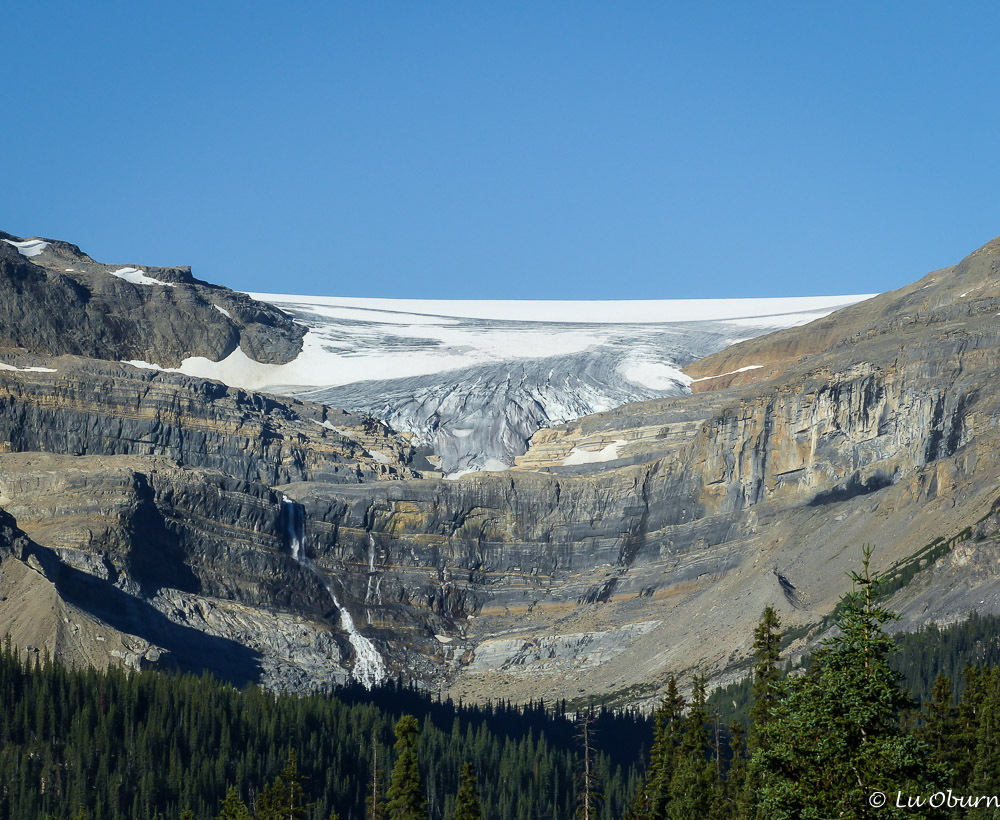
Bow Glacier and Bow Falls , one of the many striking glaciers along this beautiful stretch of highway.
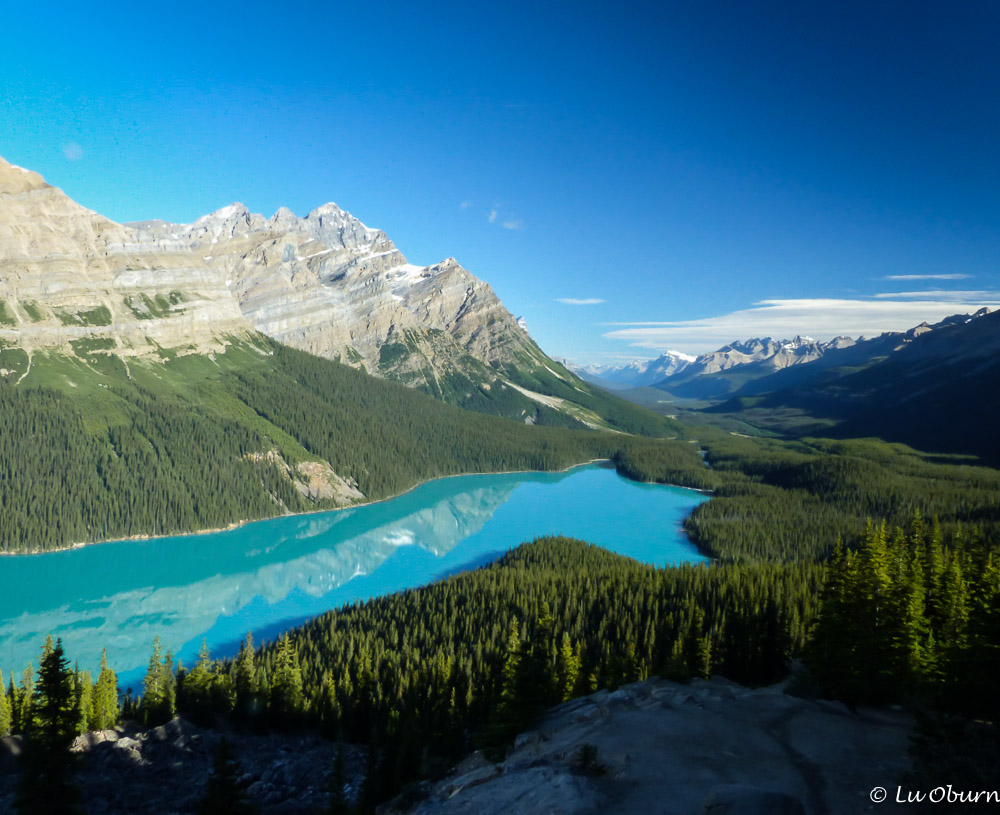
Peyto Lake, named for “Wild Bill” Peyto, one of the first game wardens in the park. The unusually bright blue water of the lake, created by glacial “rock flour”, which scatters the blue-green rays of light, coupled with the wide view of the Mistaya Valley, make this one of the most scenic sights along the parkway.
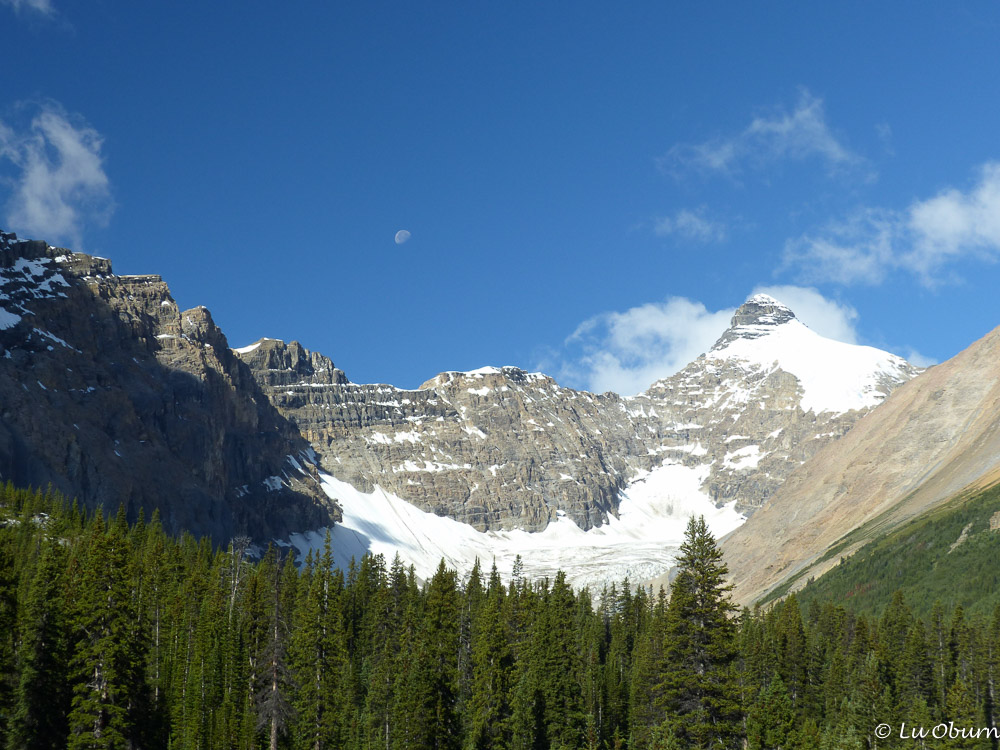
Another glacier seen from Hilda Pass.
And another from the Sunwapta Pass.
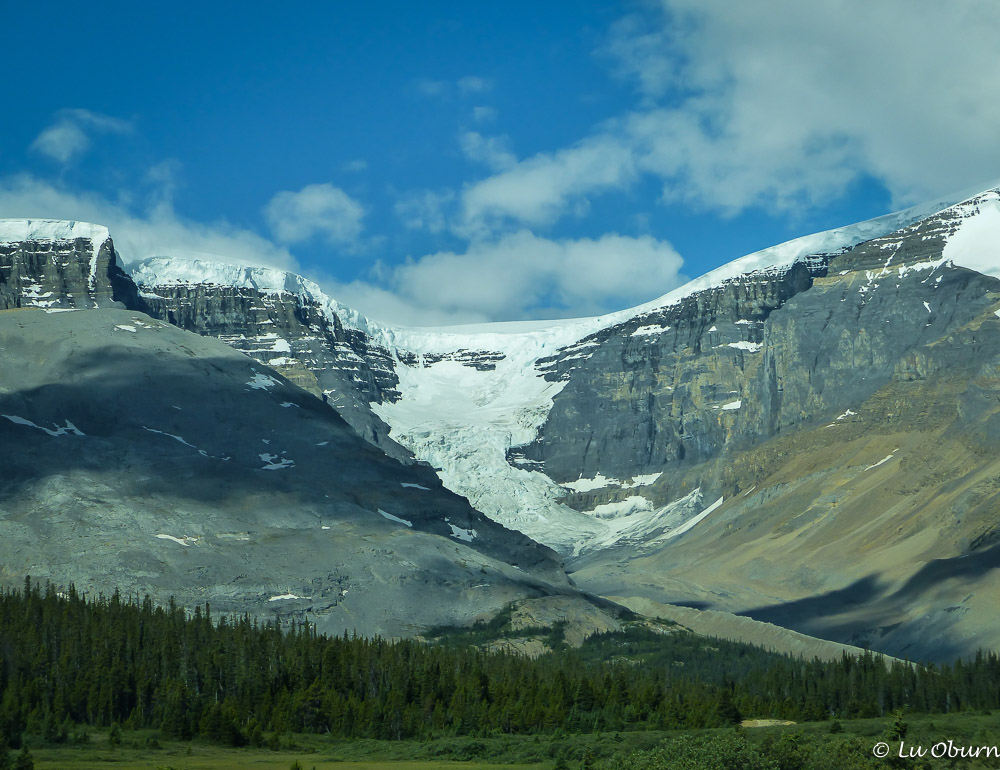
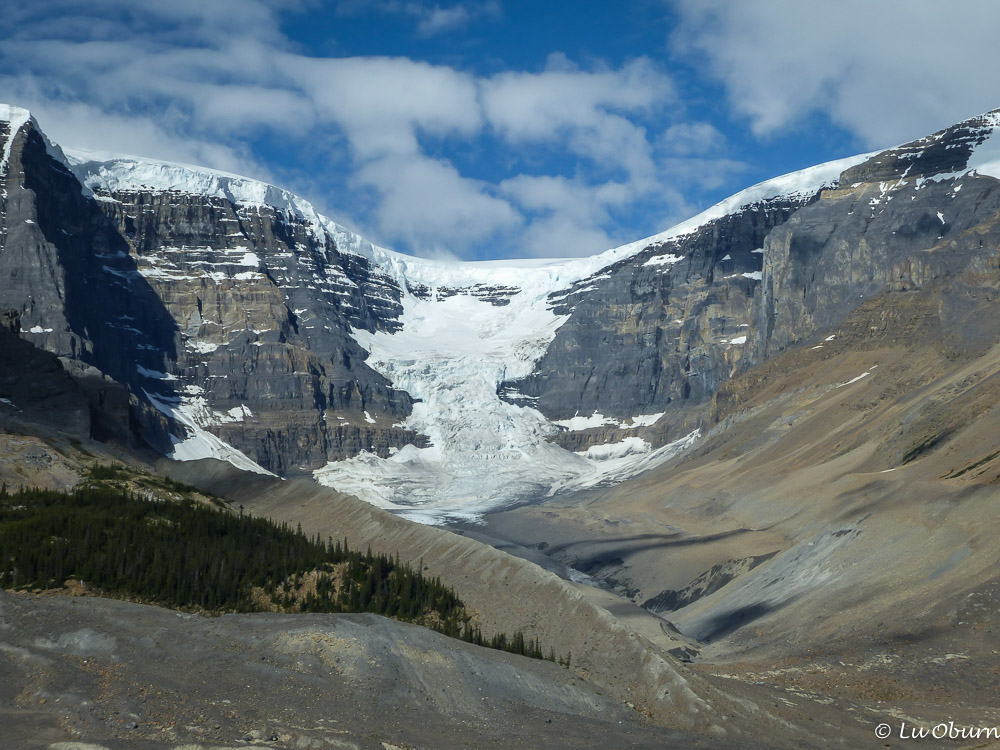
The Columbia Icefield, composed of eight glaciers and encompassing an area of about 200 miles, sits near the halfway mark on the Icefields Parkway. This ice mass is one of the largest south of the Arctic Circle and is one of the most reachable in North America. The Athabasca, Snowdome, and Stutfield Glaciers can be seen from the parkway.
The Columbia Icefield Centre, much like a large National Park Visitor Center, is where you can book the Columbia Icefield Glacier Adventure, a 90-minute excursion onto the Athabasca Glacier aboard a massive Ice Explorer. Tours on the Glacier Skywalk, a glass-floored observation walkway 918 feet above the spectacular Sunwapta Valley, can also be booked at the center.
Not unlike most other visitor centers, there is a 20-minute film that can be watched here. We experienced “Through Ice and Time”, the best film I have ever seen in a National Park visitor center.
Snowdome Glacier, part of the Columbia Icefields.
And the mother of them all, the Athabasca Glacier, largest in the Columbia Icefields, is the glacier the Ice Explorers drive visitors onto. In 1844 this massive glacier covered the area across the street at the Columbia Icefield Centre, where the parking lot now sits, another testament to how far these glaciers have retreated.
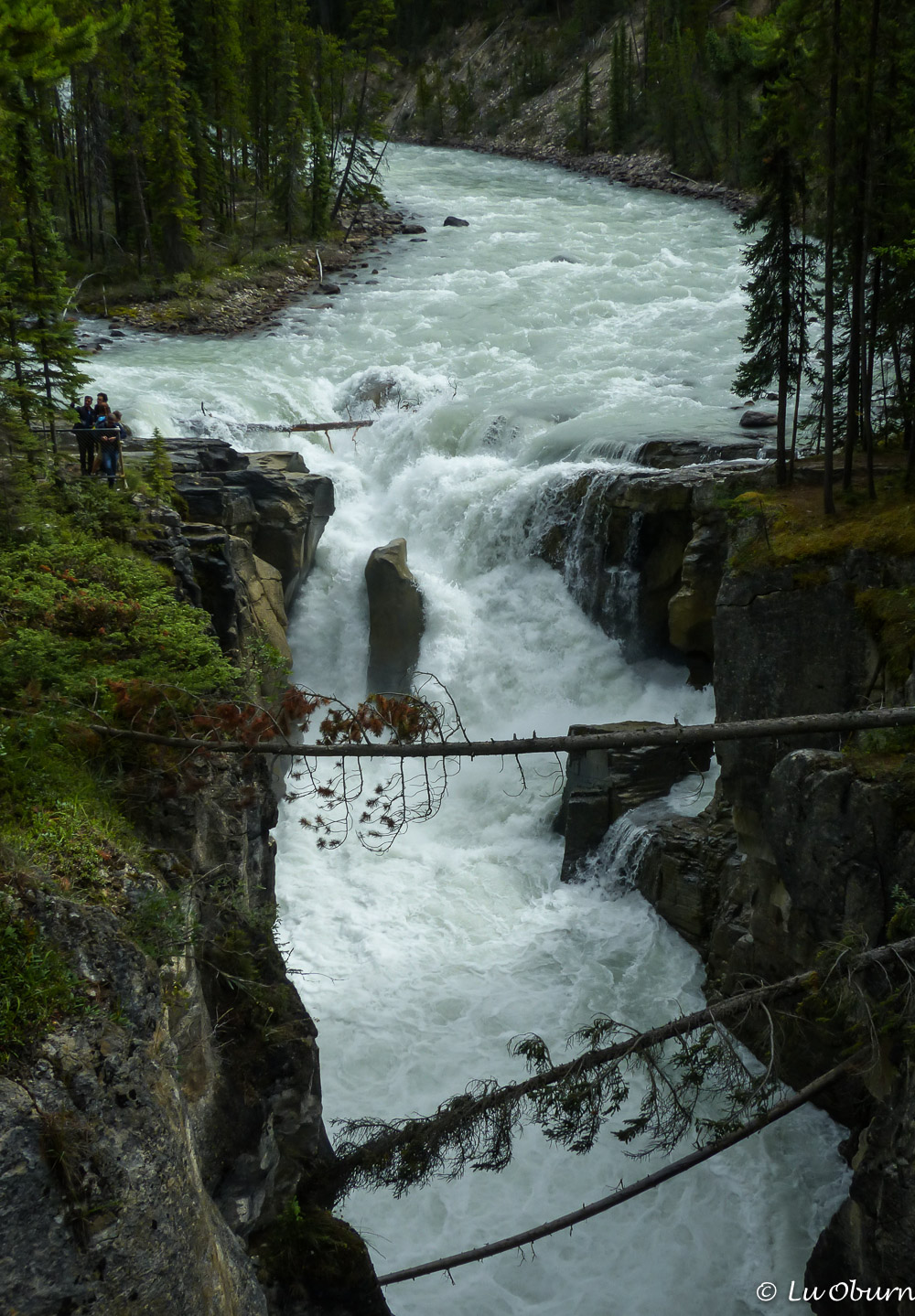
Thundering Sunwapta Falls, whose power can be felt and heard when you stand on the bridge above it.
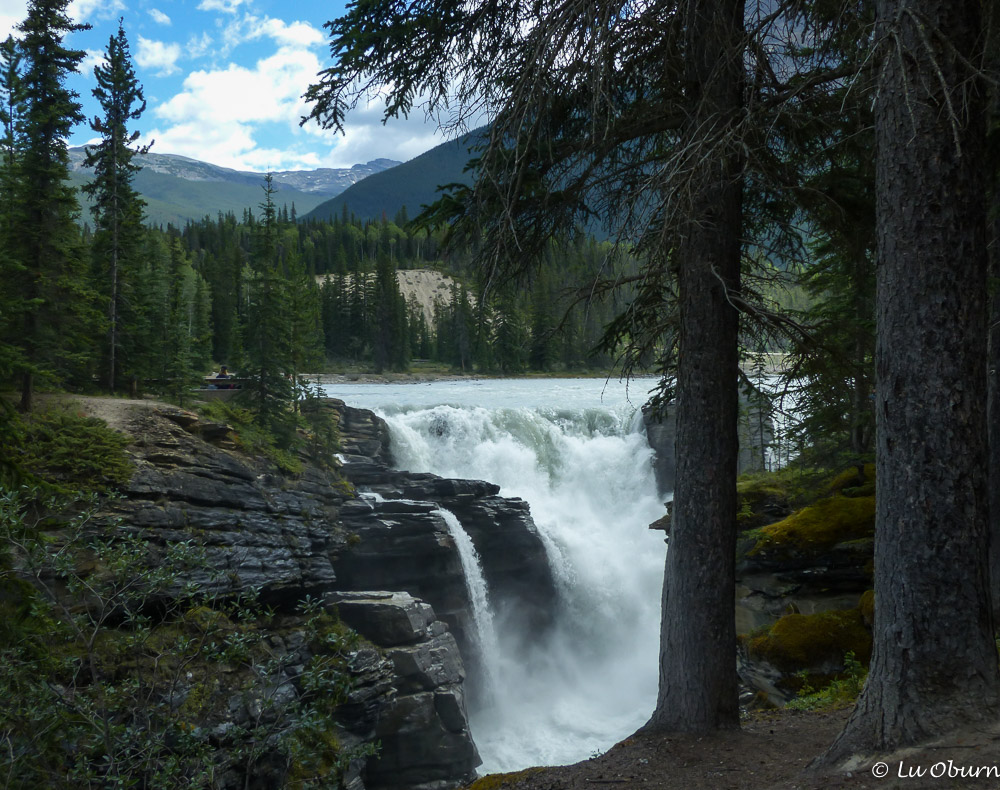
The massive power of the Athabasca Falls is created as the Athabasca River funnels into a narrow gorge.
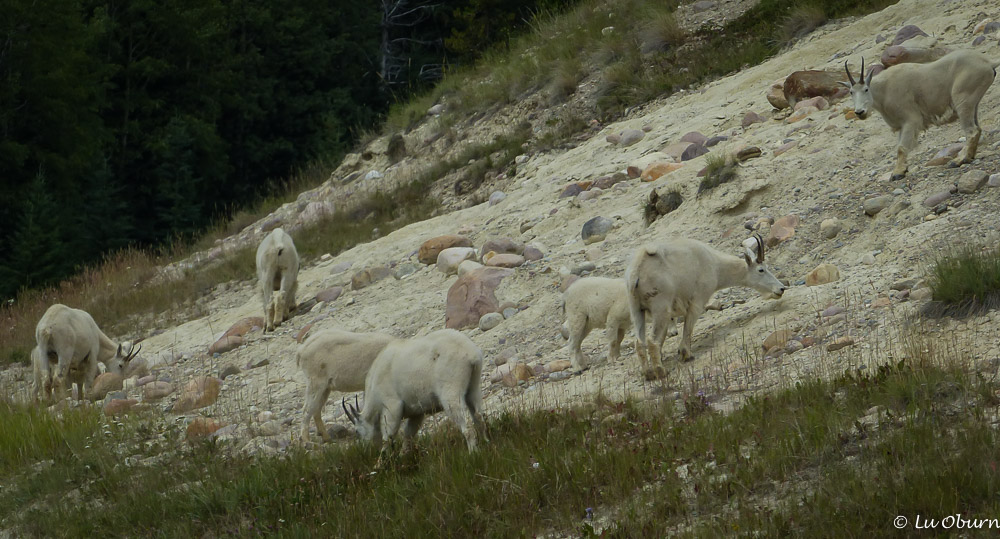
Mountain goats come down from the red cliffs of Mt. Kerkeslin to lick mineral deposits along the road.
A trip to the Canadian Rockies would be incomplete without experiencing this spectacular drive on the Icefields Parkway and the Columbia Icefields. As we drove the winding roads, I was remembering a post I had recently read by blogger friend Sue, who had recently biked this route with hubby Dave and a group of other cyclists. I bow down to you both. 🙂
While visiting friends in Cochrane, Alberta, we had to make the difficult decision of how to spread out our limited time in Canada. I recall when we lived in Yellowstone shaking our heads each time a visitor came into the park with a few short hours to spend. We wondered if it was worth the time to visit when so much would be missed. Here we were faced with a similar decision, during peak tourist season, and I found myself as excited as those first-time Yellowstone visitors, wanting to see it all. We were so close to many national parks so of course I wanted a taste of as much as possible, rationalizing that we could always return for more.
Our first stop was Banff National Park, in the Alberta province, where we pitched our tent for three nights at Lake Louise campground. What began as a 16 square mile hot springs reserve is now 4125 square miles of unparalleled mountain terrain, Canada’s first National Park, home to seven National Historic Sites. Banff, along with Jasper, Yoho, and Kootenay National Parks is recognized as part of the Canadian Rocky Mountain Parks UNESCO World Heritage Sites.
Ok bear, here I come!
I thought our western mountains were breathtaking, but Canada really takes it up a notch with their Rockies, a beautiful melding of heaven and earth. There is an unspoiled “wild-ness” here, thanks to the ice-age glaciers acting as landscape sculptors, creating the rugged mountain ranges and gouging out the valley into a deep basin.
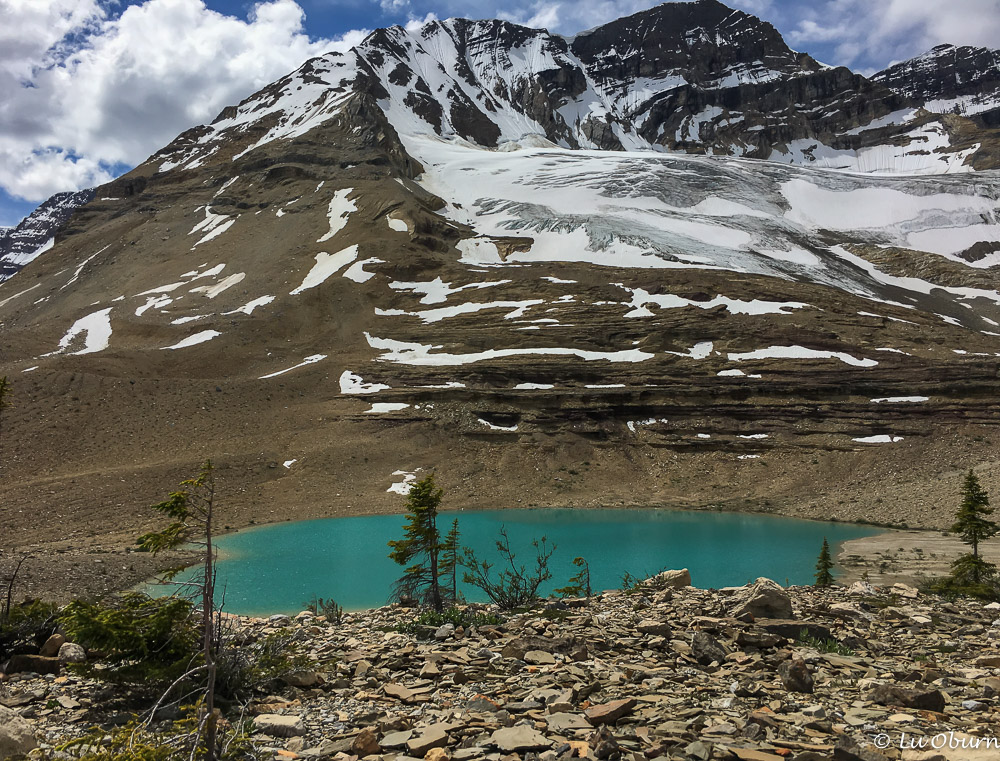
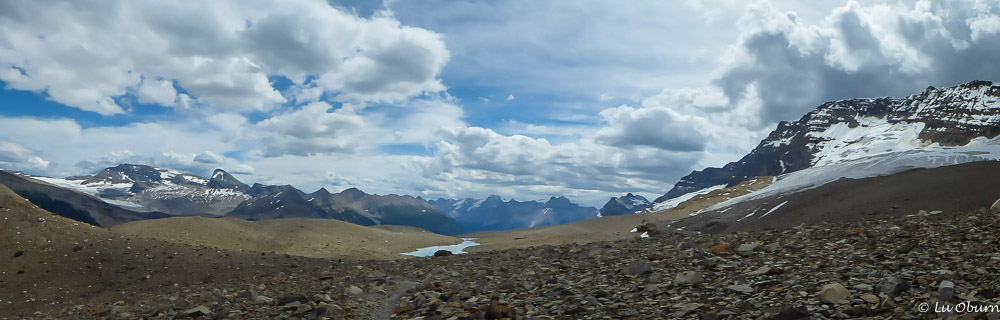
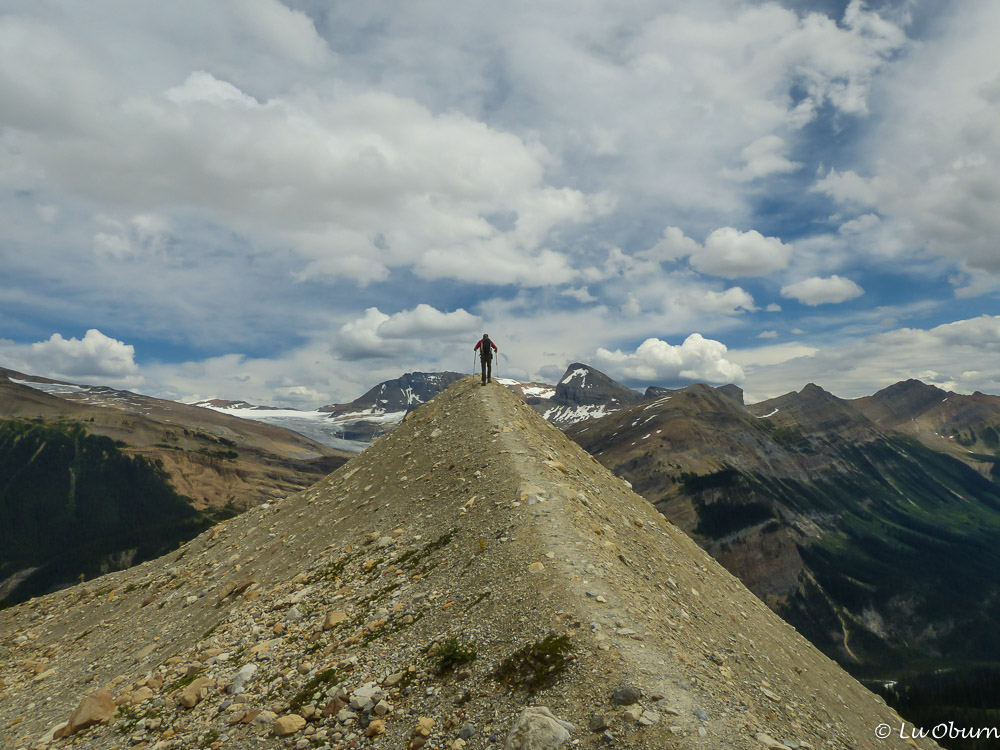
Spectacular glaciers and turquoise lakes above treeline on the Iceline Trail
The glaciers that covered the Canadian Rockies have vastly retreated but have left behind vivid memories found flowing in the turquoise and jade green waters, unusual gorges and canyons, and unique rock formations.
The next morning we set out for the much smaller Yoho National Park, in the province of British Columbia, and the second Canadian National Park. The unusual name for this park is a Cree expression meaning awe and wonder, which was exactly what we were feeling throughout our first hike in a Canadian park.
Although the smallest of the four parks that form the Canadian Rocky Mountain Parks UNESCO World Heritage Sites, it holds some of the oldest and most significant shale fossil beds in the world, as well as 36 peaks soaring above 10,000 feet. It packs a punch!
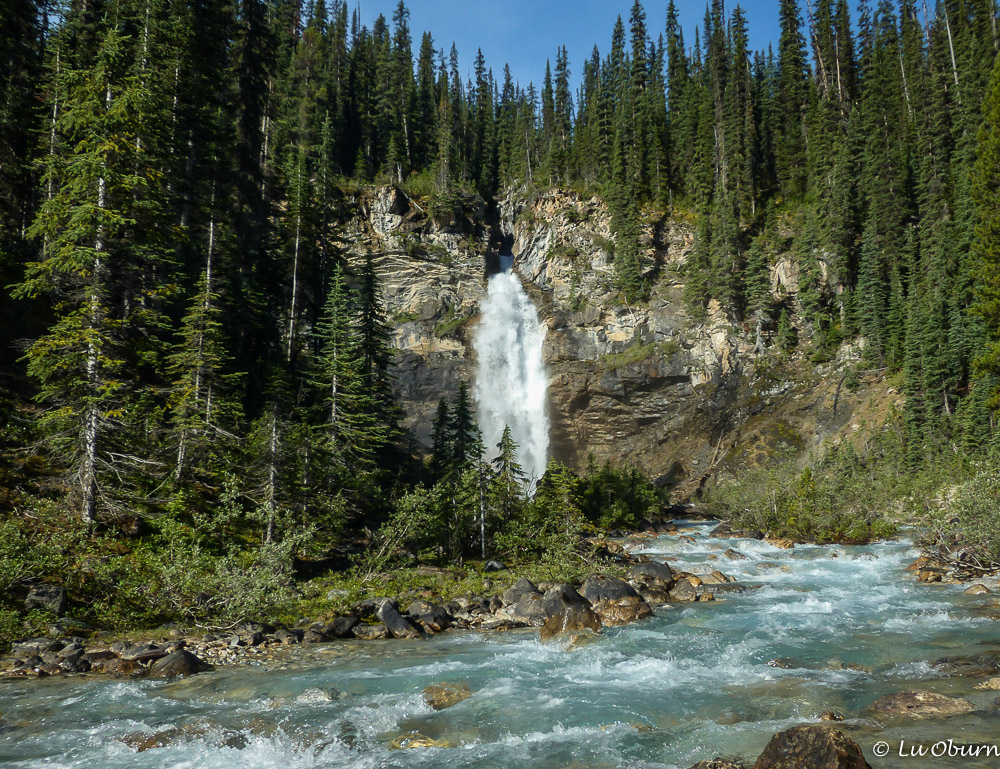
Takakkaw Falls – 830 foot drop in one stretch and 1260 foot drop in total, among the highest in Canada
Since we had time for only one hike in Yoho, we chose a memorable hike, the Iceline Trail. There are several ways to tackle this hike, out and back, a shorter loop and the big loop. Guess which one I chose? 😉
Terry climbs to get a better view of Takakkaw Falls
The Iceline Trail via Little Yoho (the big loop) is 13-miles, with many of those above treeline. It’s roughly 3000′ of elevation gain made for a challenging hike, but the 360º views of glaciers, flowing streams, and one of the tallest waterfalls in all of Canada made it worth the effort.
One of the infamous red chairs found after completing the Iceline Trail.
The next day we decided to scale back our hiking and chose to hike the Lake Agnes Trail in Banff National Park to a European-style tea house, the highest tea house in all of Canada. It is probably the most “civilized” way to see the Rockies. The trail is 4-miles round-trip, with a 1300 foot elevation gain, just enough for me after our previous day’s trek.
Lake Agnes tea house
And a visit to Banff is not complete without visiting the most iconic site in the park, the emerald waters of Lake Louise, where millions come every year to bask in her beauty. It is the most famous glacial lake in the Canadian Rockies, named for Princess Louise Caroline Alberta, daughter to Queen Victoria.
The iconic Lake Louise
The world-famous Fairmont Chateau Lake Louise sits on the edge of the lake, striking an impressive pose. And it looked like millions were there on the day we visited and none spoke our native tongue.
Fairmont Chateau Lake Louise
Enough though we visited during peak season and had little time to explore, we wouldn’t have passed on getting a glimpse into these two spectacular Canadian parks, and we will definitely be back. I am already reading about Banff in the winter – snowmobiles, dog sleds, cross-country skiing, sleigh rides. Sounds like fun, doesn’t it? Hubby is not convinced. 😉











 Paint Your Landscape