Artistry Forged by Fire and Ice ~ Yellowstone Forever Field Seminar Series, Part 1

I have said time and again that this past summer was stimulating and educational for us, but I know as a blogger that my passions may not match yours so if geology isn’t your thing, feel free to look at the pretty pictures instead.  I say this as someone who gave geology a mere passing nod until I supported a couple of naturalist courses on the subject.  Now I am spellbound and will never look at Yellowstone the same, nor anywhere else for that matter, where geologic forces come together to create majestic peaks, valleys, and canyons.

I can’t say which of the Yellowstone Forever field seminars I supported was my favorite, but without a doubt I can say that the instructor who led the Thermal Biology and Geology course this summer, Joshua Theurer, is extremely bright, passionate about Yellowstone, and can hold a student’s attention like the most seasoned of instructors.  I was fully engaged in both his field seminars I supported and look forward to participating in more of his classes in the future.

Steamboat Geyser, world’s tallest active geyser, whose last major eruption occurred in Sept. 2014
Cistern Spring, which drains when Steamboat Geyser erupts. This spring grows more in one year than most do over 100 years – 1/16″.

Joshua’s “Observing Thermal Geology and Biology” course, which followed on the heels of Virginia’s “Landscape Geology” class (also wonderful), was fortuitous for me (or so I thought), giving me a leg-up, as it were…hardly. This is a complex subject, and we were required to complete an exercise before the end of the course, in order to receive credit for this naturalist class.  I could go on and on about everything I learned but instead will touch on some of the highlights, so as not to put anyone to sleep.

Imagine, if you will, the earth as an egg:

  • The outer layer of the earth, the crust, is analogous to the shell of the egg.  It is ~ 25 miles thick.  Yellowstone has a much thinner crust than average, as little as three miles thick in places.
  • The mantle, which makes up the bulk of the earth and moves in enormous convection cells, is like the egg white.  It averages about 3000 miles in thickness.
  • The core of the earth, resembling the egg yolk, is composed mostly of metals and acts as a nuclear reactor, our primary heat source.

There are about two dozen hot spots on earth, with Yellowstone being one of the largest.  The theory is that a hot spot originates at the core of the earth and doesn’t move.  The continental plates move across them.

Given the 10,000+ hydrothermal features in Yellowstone, one would assume a significant magma chamber below the park, deep in the mantle of the earth, and you would be right.  In 2011 the University of Utah’s research concluded that this chamber was at least 400 miles thick and this was all they could determine as their equipment went no further.  In 2015 they discovered a “mantle plume” of roughly 1000 miles below the original magma chamber, a reservoir 4.5 times larger than their initial discovery!  We now believe there is enough magma below Yellowstone to fill the Grand Canyon 11 times.  Although this sounds ominous, given Yellowstone is classified as a “supervolcano”, scientists don’t expect a major eruption is in the park’s near future, and feel that there would be weeks, if not months, of increased seismic activity prior to such an eruption.

Echinus Geyser, the largest acidic geyser in the world, and one of the most popular in Yellowstone.

Day one our course took us to one to the hottest and most rapidly changing thermal areas in all of Yellowstone – Norris Geyser Basin.  Mechanically it functions like other geyser basins but is far more complex, due to the converging of three fault lines beneath it.
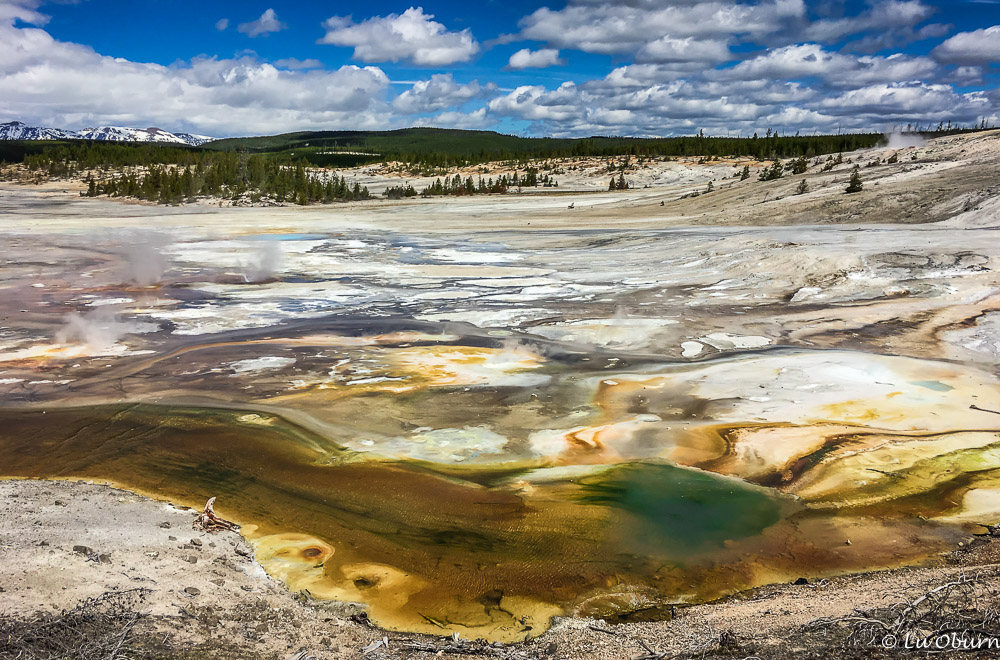
Porcelain Basin resides within Norris and was so named for the milky color of the mineral deposits found here.

There are four types of thermal features found within the park:

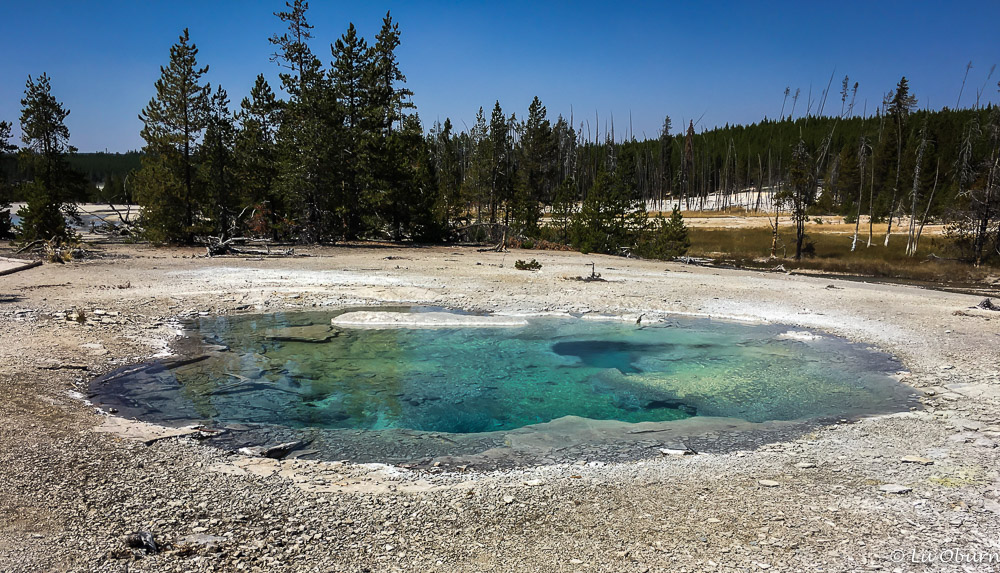
  1. Hot springs – most common and have no constrictions.  Water continually circulates, preventing the water from reaching a temperature needed to produce an eruption.  The deeper the blue color, the hotter the water.  Deep blue signifies temps of at least 159º F.
  2. Geyser – around 500 in the park.  These features erupt when the gas bubbles’ surface area is so great that the water is lifted outside the reservoir.
  3. Mudpot – most acidic, with a pH of 2 or less and a limited water supply.  Gases convert rock to clay.
  4. Fumarole – known as a steam vent, and is the hottest hydrothermal feature in the park.  Water is converted to steam even before it reaches the surface, and is usually announced with a loud hissing sound.  Temperatures can reach to 280º F.  Norris’ hillsides are dotted with these steam vents.

Hot springs, geysers, and fumaroles can be found within the Norris Geyser Basin.  I am not aware of any mudpots within Norris, but some can be found just a few miles south at Artists’ Paintpots.  The varying colors found within these thermal features are due to special microbes, called thermophiles, that make their home here, and the off-putting smell (think rotten eggs) is due to the elevated levels of sulfuric acid and hydrogen sulfide gas found in the thermal features.
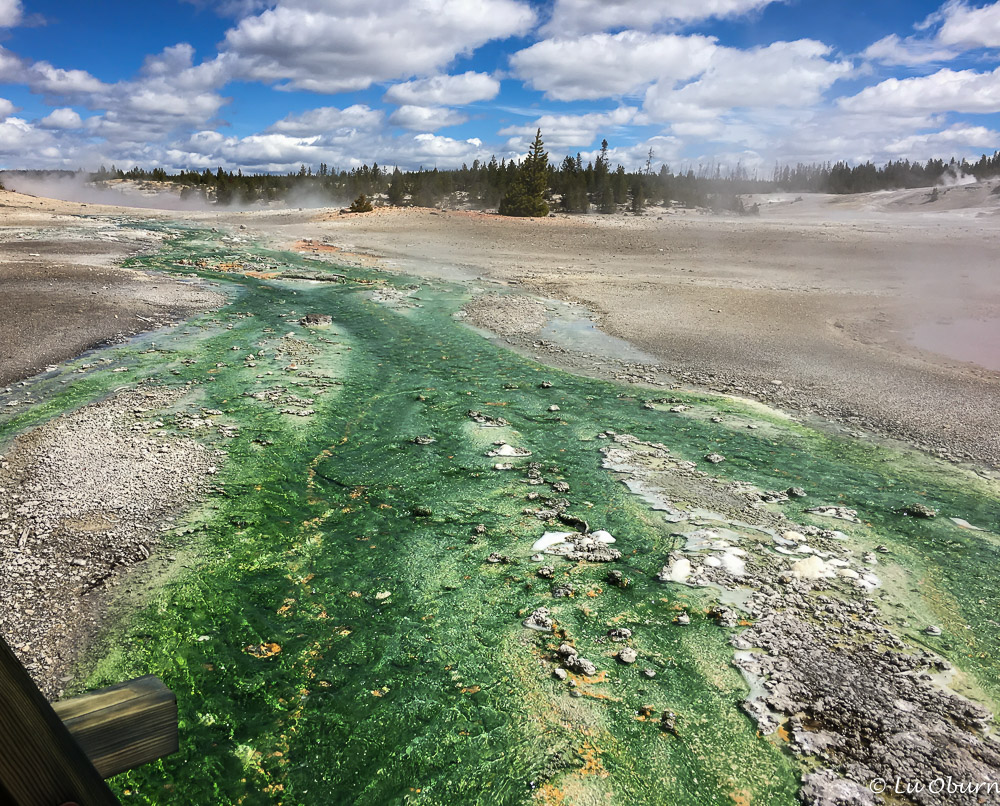
Thermophilic algae, known as “Cyanidium” create the bright-green color seen in this area of the Porcelain Basin in Norris.  Temperatures here average about 120º F, with a pH of 3-4.  This organism can be found nowhere else in the park.
Crater Spring

And one of my favorites…

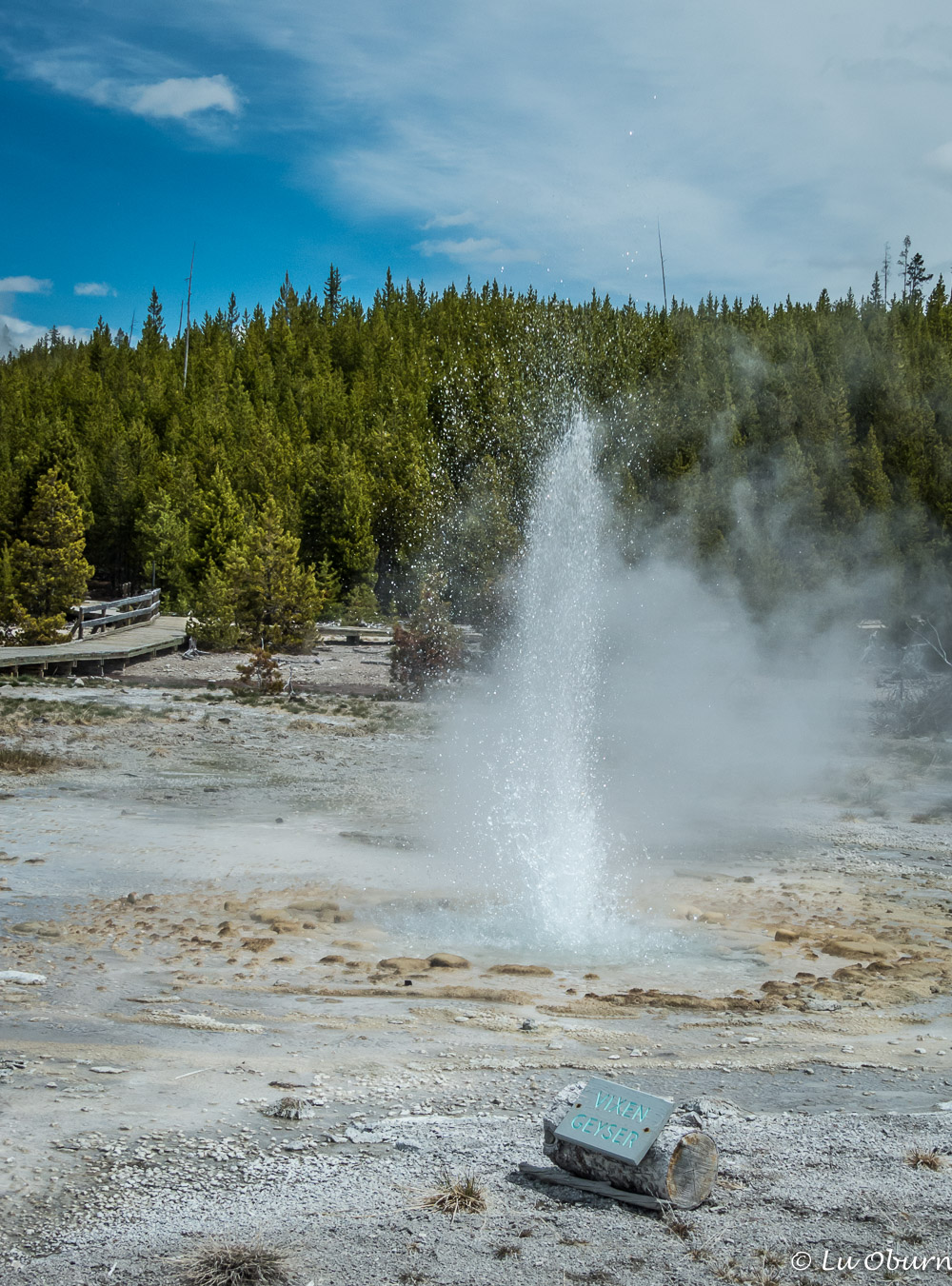
Vixen Geyser, a sassy little gal, who is very active.

Disclaimer:  The views expressed here are my own and do not necessarily represent the views of Yellowstone Forever.  

Next Up:  Day 2 of Thermal Biology, where travertine abounds.

SaveSave

SaveSave

SaveSave

SaveSave

SaveSave

SaveSave

SaveSave

SaveSave

SaveSave

SaveSave

SaveSave

SaveSave

SaveSave

SaveSave

Travel is…

 “We travel, initially, to lose ourselves; and we travel, next to find ourselves. We travel to open our hearts and eyes and learn more about the world than our newspapers will accommodate. We travel to bring what little we can, in our ignorance and knowledge, to those parts of the globe whose riches are differently dispersed. And we travel, in essence, to become young fools again- to slow time down and get taken in, and fall in love once more.”  ~  Pico Iyer

We have returned home from our time on the road, where dreams of sinking into my comfy bed have once again become reality.  The last couple of weeks have been a flurry of activity, setting up my kitchen once again, including getting some ferments bubbling on my countertop, coordinating annual doctor visits, re-establishing a weight-training regiment (thanks to having a gym in our little community), and largely just getting back into a “normal rhythm”.

Time and again my thoughts return back to our summer in Yellowstone National Park, and then move beyond.  I find myself absorbed in what travel can do for us, beyond the stunning landscapes, to what it can do for our minds, our bodies, and our souls.  Whether travel serves as a walk in nature, a drive to a mind-blowing landscape, or a long plane ride to an exotic destination, there is ample evidence supporting the health benefits of travel.

Here are my top 10 thoughts on what travel is for me.

1/  Travel is humbling.

“Traveling tends to magnify all human emotions.” — Peter Hoeg

As I look out over a vast canyon or windswept mountain or stare up at a night sky, I feel small, yet mighty.  I feel more alive than any experience I could ever have sitting in front of a computer or television screen.  Travel opens not only my eyes, but my heart.

2/  Travel is a way to create meaningful relationships.

We are forever grateful for those we have met during our RV travels, many we know will be lifelong friends, all who have been sprinkled with the same wanderlust as have we.  And writing a travel blog has connected me with so many across this beautiful globe, many I will never meet, but who have ingrained themselves in my heart.

3/  Travel is challenging.

It forces us to endure long airport security lines, many hours of bus travel as we bump along a lonely highway, or painfully long airline flights to foreign lands.  Jet lag can zap energy, cause headaches, make one feel disoriented. But if we take a deep breath, are gentle with ourselves, and move beyond these initial challenges, we see the wide world that is open to us.  What frazzles our nerves can also expand our level of patience.  It’s called character building baby!

4/  Travel is an avenue for discovering who we are and who we want to be.

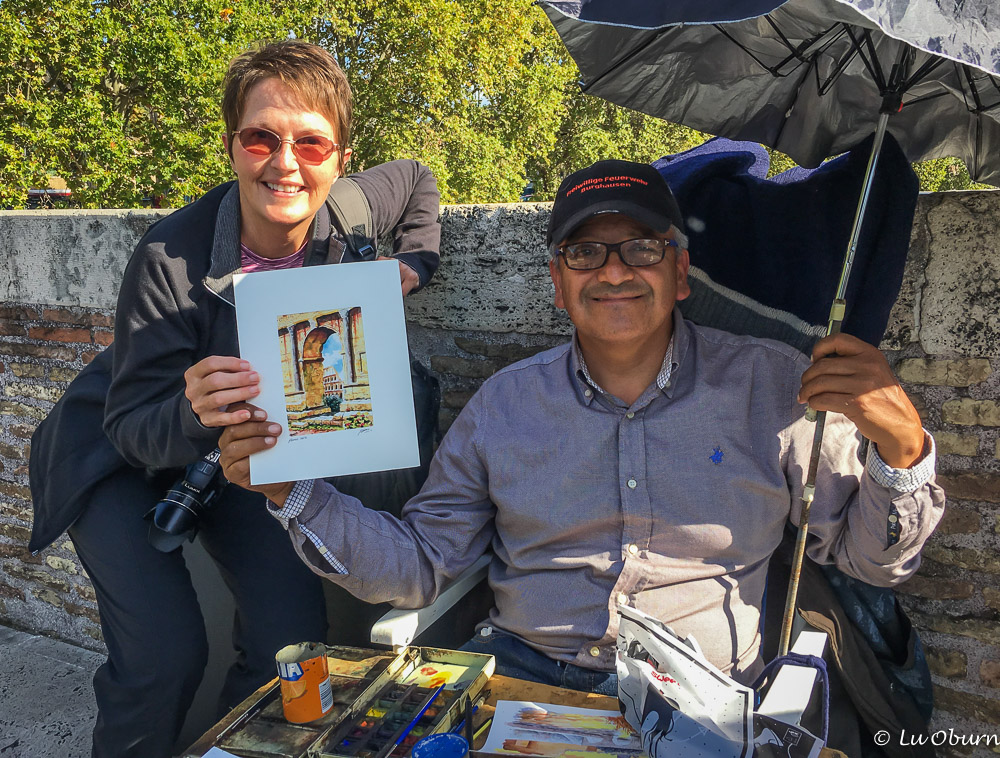
This gentle artist in Rome, Italy indulged us with a photo. How could I resist one of his paintings?

I know that I am much more open-minded than I was before my nomadic ways began.  Stepping beyond my country’s borders has given me a brand-new perspective on how I want to look at the world.  Taking a break from my norm allows me time to reflect upon my personal journey through this life.  Travel has restored my faith in humanity and broadened my world views as I have seen good reflected in the eyes of strangers.  Travel encourages philanthropy as we discover new causes and ways to assist those suffering in this world.

5/  Travel is a means for detoxing from the negative effects of social media and news feeds.

The power of the internet seen in Cirque Terre, Italy.

Although we all seem to live in the world of social media to one extent or another, disconnecting, at least for a time, is healthy for both our bodies and our minds, and can be quite liberating.  Our summer in Yellowstone forced us away from phones and computers and found us immersed in a world of  like-minded people excited about learning more about the natural world.  We met so many people we are now proud to call friends and reconnected with friends not seen for many years.  We will be eternally grateful for our time at the Lamar Buffalo Ranch and hope to do it all again soon.

6/  Travel is educational.

Whether you are hiking across an open meadow, zip-lining through the forest canopies of Costa Rica, participating in a cooking class in some foreign land, or walking the streets of a city new to you, there is always something new to learn, something exciting to embrace.  Travel is a magnificent teacher and hopefully, makes us more interesting.

7/  Travel is empowering and a confidence builder.

Travel forces us to step outside our comfort zone, as we navigate new territories, try a new activity that scares us to death, strive to learn a new language or embrace new customs.  If we don’t shrink away from these challenges, we might discover a feeling of empowerment arising.  And even if we learn only a few new words or phrases in another’s language, there is evidence to show that learning a foreign language strengthens our brains, not to mention the mental clarity that nature provides.

8/  Travel is a great story teller.

…and creates rich, lasting memories.

9/   Travel is a soul feeder.

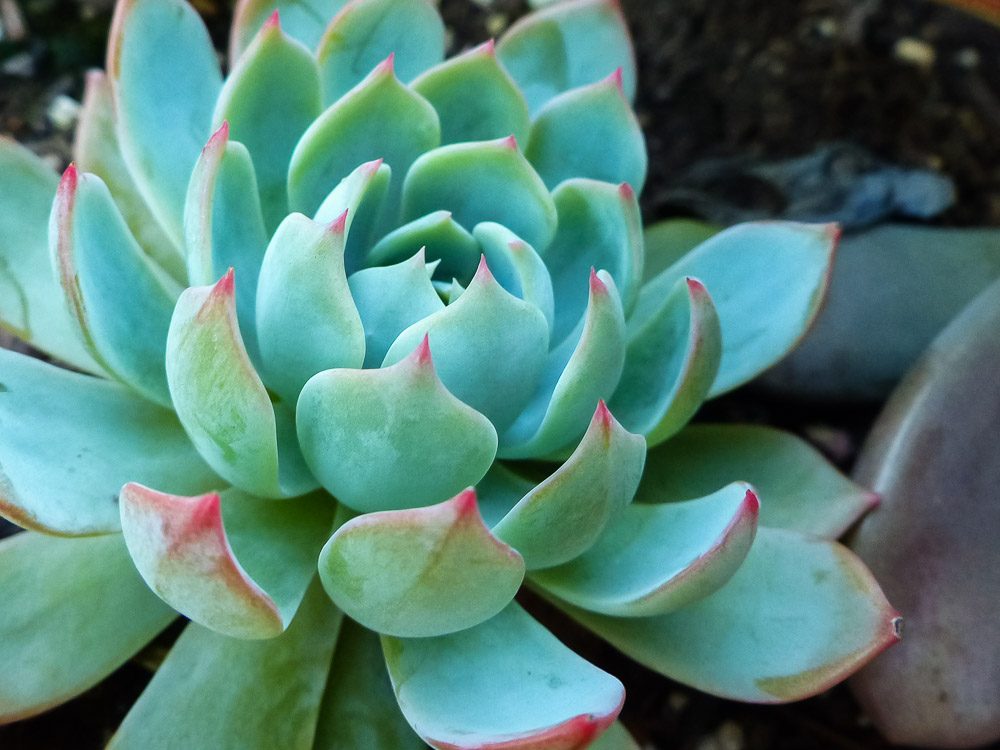
Two ninas with a gift for me ~ Ajijic, Mexico

Need I say more?

10/  Travel is the ultimate happiness fairy!

Research shows that people who are anticipating an experience; e.g. a vacation, are much happier than those who are waiting for things, like that new iPhone.

Our lives have been forever enriched by our travels, friends met along the way, and the experiences encapsulated in our hearts.  We are already planning our next adventure.

How has travel changed you?

“Veni, vidi, amavi” ~ I came, I saw, I loved.  ~  Anonymous

SaveSave

SaveSave

SaveSave

SaveSave

SaveSave

SaveSave

SaveSave

SaveSave

SaveSave

SaveSave

SaveSave

SaveSave

SaveSave

SaveSave

SaveSave

SaveSave

SaveSave

SaveSave

SaveSave

River Otters of Yellowstone ~ Yellowstone Forever Field Seminar Series

When I think of cute and cuddly mammals, both in kid and adult form, what comes to mind is the gregarious, charismatic river otter, which may be elusive but can be found in Yellowstone National Park.

I was preparing to support the river otter field seminar but I wasn’t confident we would actually see any otters.  It wasn’t that pessimism was rearing its ugly head, more that few otters had been spotted this summer.

There was a photography course running simultaneously with the river otter course and as the photographers were leaving for the field, I jokingly gave one of the instructors his marching order for the day – find river otters. His reply, “Since we are going to a lake, I guess we won’t be finding any river otters.” Ok buddy, I’m not that naïve.

Otter tracks…could sightings be in our future?

The otter class left for the field as well, hiking down to the Lamar River to scout for otters but, in lieu of the actual mammal, what greeted us was a fresh stonefly hatch. No matter how tightly I buttoned my shirt, those fat, juicy flies found their way in…lovely!  Although we found no otters that morning, we did find evidence they had been there recently – prints down by the shore, as well as denning signs and latrines.  We headed back to the ranch feeling one step closer to finding the real deal.

When the photography class returned later that morning they were gloating as they showed us photos of river otters at Trout Lake, just east of the ranch, where the cutthroat trout were spawning.  Our plan was to head there after dinner, hoping dusk would find these little cuties still romping around the lake.

Hiking around Trout Lake near dusk was lovely but devoid of otters so we headed over the hill to Buck Lake, where we found an otter trail but none in sight.  Thinking our day was going to be a bust, we hiked back over to Trout Lake and as we crested the hill we saw a mammal swimming across the lake and soon found not one but four otters on a fallen log, near the inlet where the cutthroat were spawning.  We spent two gleeful hours busily snapping photos of their antics – fishing, eating, and playing.  Nothing more would have needed to happen during this seminar and it would have been labeled a success.

Just a few stats on these little charmers:

  • The species found in Yellowstone National Park is the North American river otter.  They are a member of the weasel, badger, and marten family.
  • Mostly crepuscular, they can be best spotted at dusk or dawn.
  • They grow to an adult length of 3.5 to 4 feet and weigh from 11 – 33 lbs.
  • Long, stiff facial whiskers can detect prey, even underwater.
  • They close their ears and nostrils when swimming underwater, allowing them to easily stay under for 2-3 minutes.
  • They have large, fully webbed feet and a tail that serves as a rudder.
  • Females breed in the spring and the egg floats freely in the womb until winter, when it attaches to the uterine wall.
  • Typically 2-3 pups are birthed per litter.

We turned up ‘otterless’ the next two days but there was plenty of sign (scat) to collect, to clean and view under the microscopes, telling us on what these little guys were eating.  We were more than content with that. 🙂

Yellowstone river otters can most easily be seen in the winter, when their dark fur readily stands out against the white snow.  They do not hibernate like other park mammals, so can be seen slip sliding across the ice and snow.

If you are interested in learning more about the educational programs offered by Yellowstone Forever, go to www.yellowstone.org and check them out.  You won’t be disappointed.

Disclaimer:  The views expressed here are my own and do not necessarily represent the views of Yellowstone Forever.  

SaveSave

SaveSave

SaveSave

SaveSave