After lengthy careers maneuvering the treacherous waters of corporate America, Terry and I decided in August of 2011 that life was too important to take so seriously. We wrote what was to be our final resignation letters, stuffed our backpacks to maximum capacity, and headed south of the border for a Mexican adventure.Read more About Us
“I have no special talents. I am just passionately curious.” ~ Albert Einstein
Passion is that spark that creates the fire in our soul, allows our hearts to expand, and makes us feel vitally alive. As we move through life passion often evolves from a focus on career and accumulating money to finding our authentic self, peeling away the layers to find the real “me” that has been buried under the needs of others. Read more Pursuing Passion
“Physical fitness is not only one of the most important keys to a healthy body, it is the basis of dynamic and creative intellectual activity.” ~ John F. Kennedy Read more Let’s Get Healthy
Not all travel destinations feel the same, some resonating more than others, whether in your home country or abroad. Some destinations will surprise us, with treasures found beyond tripadvisor reviews, while others, even after all our research, will fall short of the mark.
“Lo siento, Salta, ¡no estamos tan interesados en ti!”
Sorry Salta, we’re just not that into you!
Looking back, I’m not sure what we were expecting from Salta, the stop before our final Chilean destination, but it just didn’t do it for us. Perhaps it was because Salta came on the heels of Mendoza, a city that captivated us.
Salta, relatively the same size as Mendoza, has been described as the most visited colonial city by tourists in northwest Argentina. As we sped away from the bus station in our taxi, it looked nothing like the lovely city we had just left, feeling more like a tired, worn sister to Mendoza. Gone were the lovely storefronts and cobbled walks, replaced with crumbling facades, peeling paint, and trash in the gutters. Many streets were blocked off, causing our cabbie some anxiety, which he expressed from his open window, to anyone who would listen. The city was noisy, dirty, crowded, chaotic, and everyone around me seemed to smoke, none of which was a positive start to our visit. Ironically, we had the best hotel stay of our entire trip here and the best view of the city from our 7th-floor room.
Best view of Salta from our hotel window.
And in fairness, we discovered many more attractive neighborhoods once away from the bus station.
San Bernardo Convent, oldest building in Salta
Salta Basilica on the main square
Interior of San Francisco church
Statue of General Martin Miguel de Guemes, who defended Argentina from the Spanish.
Each day we walked the city streets, looking to feel something more, something that would grab us and draw us in. One little gem, food-related of course, was discovered at La Tacita restaurant, where the most delicious empanadas and humitas (think tamales) can be found, along with the most engaging owner, Porfidio. His little family restaurant and tasty creations raised the likeability meter of Salta for us. We also discovered a lovely vegan restaurant, Chirimoya.
Porfidio, proud owner of “La Tacita” restaurant.
Choclo humitas and empanadas at La Tacita…delicious!
Our open-air window seat at La Tacita.
Salta is an interesting juxtaposition, with shop owners washing down walls and sidewalks in front of their businesses alongside people tossing wrappers and cigarette butts into the streets and little tikes dropping their britches and peeing into the gutters. No one seemed to bat an eye, except me, whose eyes were a bit bugged-out before our stay ended.
Not all was a loss however, as our lack of interest in exploring more of the city allowed me to play catch-up on processing photos and gave us time to research and book tours for our next stop.
Street view outside La Tacita, one of the prettier streets in the city.
Salta’s birthday celebrated by local students
Celebration!
Interesting street art
This statue stood in the park across the street from our hotel.
This cutie longingly looking at the outside world.
We left Salta via a double-decker bus, this time with front-row seats on the upper level. No more overnight rides (yay), just interesting scenery to entertain us. The landscape slowly changed from lush green to high desert, with saguaro-like cacti dotting the hillsides.
The road seemed to fold in on itself many times as we slowly crept up the mountain, traveling from ~ 4,200 feet up to 13,430 feet (4,170 meters). The effects of altitude greeted many of us as we stepped off the bus at Chilean immigration. We crept further up the mountain before we made our final descent, topping off at 15,820 feet. All I kept thinking was “I’ve got to find me some coca leaves”.
Hard to believe large buses make this trek.
We have arrived at the Salt Flats.
Salt production, a big operation in this part of the world.
Next Up: Our final destination (and one of our most spellbinding) – San Pedro de Atacama
After six weeks, and with Malbec on our minds, we were ready to trade the wild Patagonia winds for a warmer climate. To make this change all the more enticing, a mixture of rain and snow was falling as we said adios to Bariloche. We loved our time there, but we were ready to soak up some rays in Mendoza. Perhaps the only thing I wasn’t looking forward to was another long bus ride, this time leaving at 1:00 pm and arriving the next morning at 9:00 am. The scenery of snow-capped mountains and the ever-changing hues of the Limay River made the trip palatable.
The hotel we booked, Hotel Raices Aconcagua, is a lovely hotel in the heart of Mendoza. Plaza Independencia, which the city is centered around, is nearby, with four small plazas located two blocks off each of its corners. Something unique to Mendoza is the exposed stone trenches that run alongside many streets, irrigating the graceful trees lining the sidewalks. I can only imagine there have been a few injuries from people tumbling into those trenches in the darkness of night.
Plaza Independencia
Great Middle-Eastern restaurant
Beautiful monument that has sadly been defiled.
Walking around Mendoza, feeling the glorious warmth, we were reminded of a European city, particularly the Trastevere neighborhood in Rome, with paved pedestrian walkways and beautiful boutique storefronts, although Mendoza is a much younger city than Rome. Having suffered a devastating earthquake in 1861 that claimed over 5,000 lives, it hasn’t been that long ago that Mendoza was rebuilt, this time with wider streets and sidewalks, large green spaces, and urban designs that better tolerate seismic activity.
Although we knew that there was much more to be seen in Mendoza than through the bottom of a wineglass, we decided that our first tour would be a winery/biking adventure. As Mendoza is considered one of the “Great Wine Capitals” in the world, we were anxious to taste some of the wines for which she is famous.
There were many options to consider when biking out to the wineries, but in the end we opted for a self-guided bike tour, wanting the flexibility. We took the local bus out to the small town of Maipu, then went to Maipu Bike Company, recommended to us. They provided a map of the wineries, recommendations and cost of tastings, and booked a guided tour/tasting at one of the more popular wineries. We were also invited back later in the day for happy hour. Not sure this lightweight would need more wine but we kept that open as an option.
The bikes, although a bit dated, were functional, and we were given helmets. The only challenging section of road was after we left the safety of the designated bike path, which dwindled to a narrow road that had to be traversed with the motorized traffic. We made the decision to vacate the pavement when traffic started to crowd the roadway, as I had read a tripadvisor review the night before that was a bit scary. When traffic subsided, we pedaled to our next stop and arrived at each of our destinations safely.
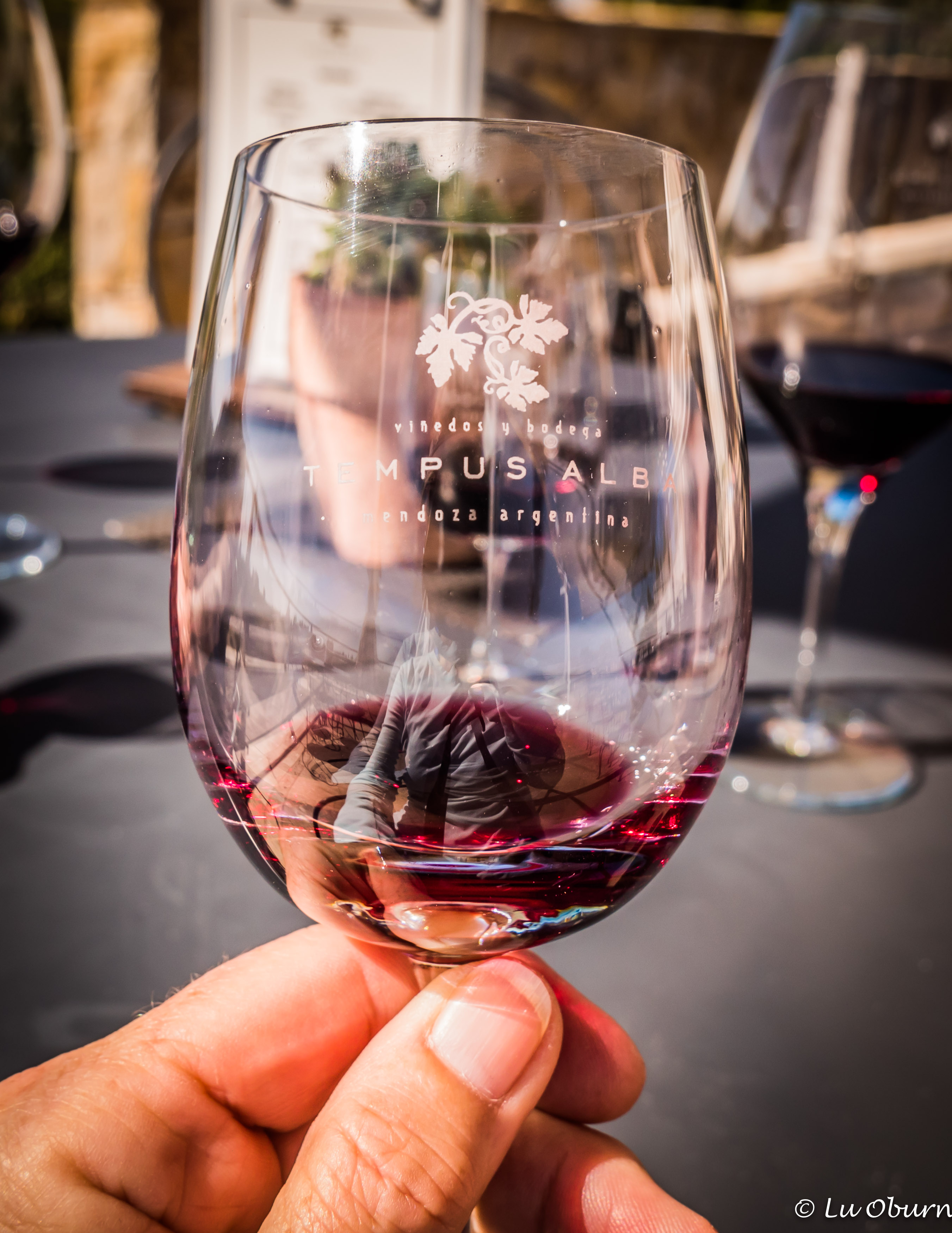
Our first stop was Tempus Alba Winery, where we did a self-guided tour and finished with a relaxing wine tasting. We were pleased to have the patio to ourselves, overlooking the vineyard, a wonderful way to start our day. And we walked out with a bottle of their Malbec for another day.
Mevi Winery
Interesting little shop for tasting olive oils, condiments, & liquors.
Mevi Winery was our second stop, a boutique winery, where we did a tasting and enjoyed lunch on their patio.
Entre Olivos was our stop for olive oil tastings, condiments, and liquors. We brought home a jar of stone-ground mustard with Chardonnay…very tasty.
Trapiche here we come!
Our tour guide at Trapiche. Note the egg-shaped concrete wine vessels in the background.
On the deck overlooking the olive grove.
Lots of youngsters on our tour.
Lots of yummy wines offered up at Trapiche.
Trapiche, one of the largest and most popular wineries, was our final stop of the day. We did a guided tour, accompanied by several tastings, all very good. We took an alternate route back to Maipu Bikes, with much less traffic, and found that yes, we did want to participate in a quick happy hour next door.
Very rudimentary but it works for a happy hour, and the homemade wine was pretty good too!
This was a great way to see some of the wineries at our own pace.
I had read about an Andes Photo Safari tour that would get us into the mountains, give us some history of Mendoza, and almost guarantee us some wildlife viewing. It seemed like a wonderful way to get away from the city and give us a healthy dose of nature. Timothée, our tour guide, picked us up at our hotel, where we learned that we would have a private tour…yes!
Our day started in the protected Reserva Natural Villavicencio, where I was assured that I would see guanacos, a member of the camelid family, native to South America. To date I had only seen them from afar, so I was counting on Timothée, and he delivered guanacos, as well as rhea, a distant relative to the ostrich, seen from a distance, while condors circled far overhead.
My first guanaco sighting!
A baby guanaco, known as a chulengo.
They blend into the landscape so well. Good for them but tough to photograph.
A South American gray fox graced us with his presence, walking up to the truck. Timothée wouldn’t allow us to get out as this little guy had most likely been habituated to humans and was looking for food. I had to practically get in Timothée’s lap to get the shot, as the fox was on his side of the truck.
Views of the Andes and Aconcagua, the highest peak outside of Asia, could be seen throughout the day. Standing at ~7000 meters (22,837 feet), it is the tallest peak in the Southern Hemisphere and sits completely within Argentina, 70 miles from Mendoza.
Aconcagua Peak, the tallest in the Southern Hemisphere.
Known as the Route of the Year (365 Curves) – note the dotted line on the map.
Shooting into the sun doesn’t make for great photos but it does show the winding road we took up the mountain.
We continued climbing to Paramillos, up to 10,300 feet on the 365 Curves, also called Route of the Year, or Caracoles De Villavicencio. At Paramillos we stopped to visit the old Jesuit mining settlement and the ancient colonial road, built in the 16th-century, which led through the mountains to Chile. It was the only road available at the time for José de San Martín, one of Argentina and Peru’s primary liberators from the Spanish Empire.
Entrance to the old Jesuit mine.
Terry & Timothee inspecting the old mining operation
Such a great tour guide!
After a brief history lesson we headed to Cerro 7 Colores and hiked around the colorful hills, whose colors were enhanced by various minerals in the soil.
Lunch was an authentic kid goat barbecue at Parrillada El Rancho Restaurant in Uspallata. We had not seen so much meat, and so many varieties in one sitting, brought to our table on a cast-iron grill, kept warm throughout the meal. A nice bottle of Malbec appeared, compliments of our tour guide, whose wife works at one of the Uco Valley wineries. Without the meat we would have had a full meal, with empanadas, salad and appetizers. I wonder if the locals eat this much at every meal.
This is a great tour for anyone wanting to experience the beautiful mountains surrounding Mendoza.
General San Martín Park was on our agenda for the following day, to work off some of the calories we had consumed. It is a 970-acre park within the city, giving us plenty of space to stretch our legs.
Beautiful tree-draped streets
Terraza JardinMirador, a rooftop garden at the Mendoza City Hall, was to be our last activity in Mendoza. Not expecting too much but hoping for some exercise and a few city views, we were both pleasantly surprised.
With one last overnight bus trip to look forward to (ugh), we turned our sights to Salta. Although the bus system throughout Argentina and Chile has been top-notch, I may not want to get on another bus for a long time after this adventure!
Another travel day, another bus ride, the best way to be transported from one beautiful landscape to another in Patagonia. Once again we would find ourselves crossing from Chile to Argentina, adding another stamp to our well-used passports.
The double-decker bus that took us over the Andes, then got grounded at Argentina border control.
As we crossed the Andes, the weather changed from brilliant blue skies to a wintry wonderland but as we dropped back down towards Argentina the blue skies returned. Upon arriving at the border control point, we found ourselves sitting in a closed bus, with no explanation about why we weren’t heading into the immigration office. After a lengthy time we learned that the power was off in the office. Our choices: (a) wait for an oil tanker to fill their empty generator or (b) determine the protocol for clearing people through immigration manually. Since no oil tanker appeared to be coming, someone decided after a two-hour wait that we didn’t look like hardened criminals transporting drugs. They ignored our bags, stamped our passports, and we were on our way.
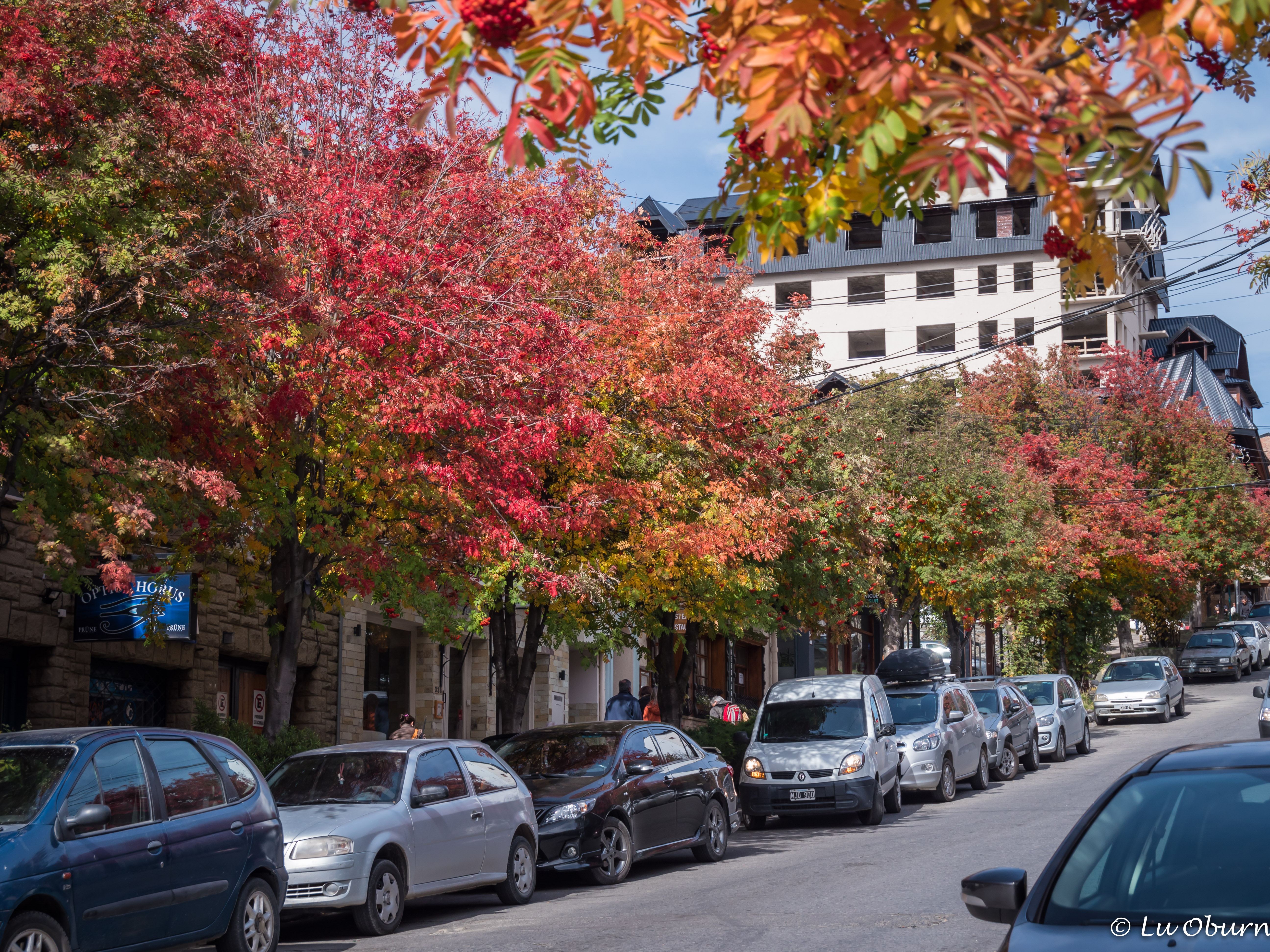
Autumn has arrived in Bariloche!
As we got closer to our destination, the sun came out and big billowy clouds hung low over the deep azure lakes we passed, an inviting scene. But when we stepped off the bus in Bariloche, it felt like winter had arrived, as temps had dipped into the 30’s…brrrr! Cooler temps would be in the forecast our entire visit, although we did have many sunny days.
Our taxi driver deposited us at Hotel Milan, where Pablo, an engaging staff member, directed me to a pharmacy, as I realized I wasn’t going to shake this sinus ‘thing’ on my own. I gave my symptoms to the pharmacist (no doctor visit required) and was given throat lozenges and antibiotics, the latter which I abhor, but I reluctantly admitted I needed in order to kick this thing.
Since it was late in the day we decided to settle into our room and relax. I was now beginning to sound like the barking sea lions I had photographed on Isla Marta earlier in our trip and Terry worried that my refusal to lay low would result in my first-hand knowledge of a Bariloche medical clinic. He said it was either that or he might have to go searching for a priest who could perform an exorcism, as he had never heard, in all our years together, anything like the sound coming out of me. 🤪
It’s hard to keep a good woman down (haha), so the next day I was ready to learn why so many tourists were drawn to this lakeside city. I had read that Bariloche is known for its decadent chocolates and its microbreweries and I intended to take full advantage of both, certain I would need both to heal. 😉
San Carlos de Bariloche Cathedral
Wrought iron sculpture on the cathedral grounds.
San Carlos de Bariloche, better known as Bariloche, lies in the foothills of the Andes, on the southeastern shore of Nahuel Huapi Lake, located within the park of the same name, Nahuel Huapi National Park, Argentina’s first. Bariloche, in the indigenous Mapuche language, means “people from behind the mountain”.
During much of the 19th-century, this area had a stronger connection to Chile than Argentina. It was the work of Francisco Moreno, aka Perito Moreno, a prominent explorer and academic, along with the military campaign “Conquest of the Desert”, to claim Bariloche for Argentina. This campaign’s intent was to show Argentine dominance over Patagonia, which was then inhabited by indigenous peoples. In the 1881 border treaty between Chile and Argentina, the indigenous Nahuel Huapi decided to be recognized as an Argentine province.
Historic statue in Centro Civico
Names of those who disappeared during the last dictatorship.
Pedro wants a photo taken with you, or perhaps that’s his owner’s wish.
If Patagonia were to ever become independent, San Carlos de Bariloche could be its logical capital, as it is the Lake District’s largest city, and the gateway city to Nahuel Huapi National Park, the Mapuche name meaning “tiger island”.
Alpine-styled Bariloche has grown from a cattle-trading center to an international tourist destination, with skiing in the winter and sun-bathing in the summer, which has boosted its population considerably, to 122,700 present-day.
Interesting architecture in the indoor shopping mall.
It is so tempting to bring home lots of souvenirs from this trip.
A tired guard dog behind the plate-glass window of a t-shirt shop.
In the 1990’s Bariloche made a name for itself when international headlines broadcast that this thriving tourist city was a “haven for Nazi war criminals, such as the former protection squadron SS Hauptsturmführer Erich Priebke and SS Officer Reinhard Kopps, known in Argentina as Juan Maler.” Priebke had been the director of the German School of Bariloche for many years. Fortunately for Bariloche, these headlines have not seemed to diminish their tourist trade.
For us, the only way to see the Nahuel Huapi and Lanín National Parks was by rental car, which we did during a day trek. We had read about the Ruta de los Siete Lagos(Route of the Seven Lakes) so decided this would be a good way to experience the parks and see some of the lovely towns along the way.
Terry posing at Lago Espejo
Lago Correntoso
Lago Villarino
Lago Machonico
Ranger station inside Nahuel Huapi National Park
Both Nahuel Huapi and Lanin National Parks encompass arid steppe, alpine forests, and volcanic summits, with deep-blue finger lakes dotting the landscape. Nahuel Huapi connects Chile and Argentina via a series of scenic roads and waterways and Monte Tronador, a gigantic dormant volcano, straddles both nations.
Villa La Angostura, a small town lying on the north shore of Lago Nahuel Huapi, begins the route, a lovely setting with many restaurants and upscale boutique shops. San Martín de Los Andes, 260 km from Bariloche, was our final destination. Barely a century old, it has become one of the Lake District’s most fashionable resorts.
Lago Lacar in Lanin National Park
Lanin National Park
Another view from Lanin National Park
Taking the local bus to the edge of the city is a wonderful way to see Cerro Companario and hike in the Llao Llao Municipal Park, provided you have the patience to get the Sube bus card. You can ask and you will be told where to purchase said card, but don’t expect to find it the first few places you are told to go, and then you have to find out which store will load money onto your card, which of course is not the same place you purchased it, silly you. But persevere, (and don’t tell any of the locals where they can go) and you will be rewarded with some beautiful scenery.
Lago Moreno in Llao Llao Municipal Park
Cerro Companario view
Beautiful arrayan trees in Llao Llao Municipal Park
Luxury hotel Llao Llao
The views from atop Cerro Companario are stunning.
We have always felt that, along with the scenery, the locals you meet during your travels leave the greatest impression, and Bariloche was no exception. The person who stood out for us was Pablo, the man behind the desk at Hotel Milan, who also works as a private English-speaking tutor for Bariloche professionals.
Me and Pablo, our unexpected Spanish teacher. 🙂
Not only was he warm and welcoming, he provided me direction to the pharmacy I needed, and gave us our daily Spanish lesson, including some of the local slang. We looked forward to seeing his smiling face daily, and he kept us on our toes. Since I believe he will be reading this blog post, to Pablo we say: “Comó te va? Muchas gracias por su amabilidad. No serás olvidado.”
International travel would not be complete without experiencing local food and drink, and that meant chocolates and microbreweries. Although we didn’t try more than one chocolate shop, RapaNui rose to the top of our list after popping into a few stores. Not only is their chocolate list extensive, they also have an amazing ice cream shop, a café, and an ice-skating rink under their roof. As for the breweries, our choice was based somewhat on hours of operation, but after we had gone to Manush and Bachmann, we went no further, their beer and food was that good. La Familia Weiss, a local restaurant recommendation, was also a stand-out for us.
RapaNui chocolates, oh so good, especially the dark chocolate mint.
I’m not saying this was our ice cream, but I hear the ice cream at RapaNui is heavenly.
The IPA at Bachmann was so tasty, and although we weren’t expecting the fries, we couldn’t resist them.
We loved the ambiance at Manush and the porter beer was pretty wonderful too.
Bariloche was on our travel radar before we started our Patagonian adventure, thanks to our friend Josh from Yellowstone National Park. We would not have wanted to miss this magical city.
Caracara falcon spotted on a rooftop across from our hotel.
Southern lapwing, common, but tough to photograph.
Although our time in Chaiten was mostly rainy, it may have been a blessing, as I had fought off what I thought was a sinus infection for days, and although I didn’t feel bad, I knew my body would respond better with a little rest. That can be challenging to do on this type of trip, as Mother Nature and her moods tend to dictate when you do your exploring.
Travel day arrived and the sun made a rare appearance. This was to be a long travel day, three ferry rides and stretches of bus excursions that took us around and across many of the lakes dotting this area. When we saw the extent of the road construction during this phase of our journey, we were thankful we didn’t rent a car. The trench right outside my bus window was so wide and deep, one false move and it would have swallowed our bus whole. However, the scenery on the water was captivating and relaxing, and there was no holding onto the rail for dear life in fear of being blown off the deck. 🙂
Although our final destination was Puerto Varas, the bus station is in nearby Puerto Montt and this is where we spent the night, right next to the station at the Ibis Hotel. The next morning, we hopped into a taxi for a ride to the airport, where we rented a car for our stay in Puerto Varas.
Puerto Varas, dubbed the “City of Roses”, is a lively city of 38,000, in the Chilean Lakes District. It sits on the southwestern shore of Lake Llanquihue and holds commanding views of Osorno and Calbuco Volcanoes, both still considered active. It is also the gateway to Parque Nacional Vicente Perez Rosales.
Many local artist shops found in Puerto Varas, with a mosaic-lined stairway to get to them.
Iglesia del Sagrado Corazon de Jesus
Creative mosaics lined many walkways.
This fella found a home to take a nap.
View from our bedroom window at Hotel Solace.
German colonial architecture has made Puerto Varas one of the most beautiful cities in southern Chile. We enjoyed walks along the lake and discovered during one of our wanderings a larger than life metal sculpture of a woman with outstretched arms, as if paying homage to the majestic, snow-capped volcanoes.
This is also the city where we finally found some restaurants that featured salads instead of the typical “heavy on the meat and cheese” dishes. It was a delightful change. La Gringa was one of our favorite places for lunch, feeling more like a Pacific Northwest café (including the rainy day) than anything else.
Unassuming La Gringa Restaurant
Cozy, inviting interior. We sat next to the Pellet stove on a rainy day.
The little street dog that won Terry over.
As I am slightly obsessed with national parks we decided to take a ride to Parque Nacional Vicente PerezRosales, Chile’s first national park, and where we knew we would find some picturesque falls, the Saltos delPetrohué. This isn’t your typical waterfall, instead more a chute of crashing whitewater, a relentless pummeling cascade over basalt columns, polished shiny and smooth by volcanic runoff. It is also where some of the best views of Osorno Volcano, can be found. Although it hasn’t erupted since the mid-19thcentury, it still has some active fumaroles.
Tour boats waiting to carry passengers across Lago Todos los Santos, the lake Teddy Roosevelt crossed in 1913.
Stunning turquoise water running through the park.
Captivating views of Osorno Volcano from the Petrohue Lodge.
Saltos del Petrohue in Vicente Perez Rosales National Park.
A drive around Lake Llanquihue was also recommended, promising interesting little towns along the way – Llanquihue, Frutillar, and Villa Ensanada.
On the southeastern shore of Lake Llanquihue, Llanquihue also has a noted German influence and celebrates “Bierfest” each January. One of the town’s main attractions are the many wooden sculptures sprinkled around town, created by both national and international artists.
Interesting looking fella found on the Maullin River in Llanquihue.
Sidewalk lined with wooden sculptures.
This was one of my favorites.
Life-size sculptures also found along the river.
Color is prominent in this country, even in their rowboats.
Another wooden carving in the park.
Frutillar sits on the western shore of Lake Llanquihue and is well-known for its German architecture, its landscape, and beautiful gardens. The main attraction is Teatro del Lago (Lake Theater) and the annual summer music festival, “Semanas Musicales”, when several worldwide philharmonic and symphonic orchestras come together. Frutillar also boasts the best cake shops in the whole nation.
Lake Theater
Lovely wooden pier with view of Osorno Volcano across the lake.
Villa Ensanada is a small, peaceful village on the southwest shore of the lake, where, on a clear day, you can see splendid views of Osorno and Calbuco volcanoes. It is also a hotspot for outdoor activities. We had a clear day!!!
Volcan Osorno
Volcan Calbuco
I had seen photos of the “palafitos” on Chiloé Island, colorful fishermen bungalows balanced on stilts, in the city of Castro, so this was the destination for our final day of touring. Many of these palafitos have been converted to cafes, hostels, and boutique shops.
Chiloé, which means “seagull’s place” in Mapuche, the indigenous language, is where Magellanic and Humboldt penguins cohabit, the only place where this occurs. Since we had already taken two tours to penguin colonies, we didn’t feel we were missing out by not taking this tour.
Castro, the largest city on the island, is also where two of the four UNESCO World Heritage Site wooden churches can be found.
Iglesia San Francisco del Castro
Iglesia de Nercon
Cemetery on the grounds of Iglesia de Nercon
Puerto Varas was where we were on Easter Sunday. Both Terry and I remarked that this most holy of days was not celebrated in the reverent manner we had seen when we lived in Mexico and how we had read it is celebrated in Spain. It seemed to be just another day in the life of Chileans, which we found a bit odd.
Our time in Puerto Varas had come to an end. Although not one of the more physically active pieces of our journey, it was a lovely stop that I would highly recommend if you find yourself in Patagonia.
Ruta (Route) 7, aka the Carretera Austral, is the only highway that runs through the northern section of Chilean Patagonia. Part of the Aisén region, starting in the Lakes District in Puerto Montt and ending 770 miles south at Villa O’Higgins, it is the least populated region of Chile, with only about 100,000 inhabitants scattered throughout its towns and villages. We had read that it is a natural wonderland of islands, mountains, fjords, lakes, and forests, crossing many protected natural areas, so of course we wanted to visit. We envisioned renting a car or “Wicked Van” in Puerto Montt and traveling leisurely at our own pace, stopping when Mother Nature’s wonders called to us.
After reading some less than flattering reviews of the condition of the Wicked Vans and calculating the cost of renting a car for 6 weeks, we scratched both of those options. Since we were traveling in the shoulder season, if we had van problems, who knew how long before another vehicle came along to assist us. Also, the drop-off fee for a rental car, if not returning it to the place you rented it, was at least as much as the total rental fee…wow! Our next option was to take buses through some stretches and rent a car for shorter periods in others.
Balmy day along Lago General Carrera
Our two-day stop in Chile Chico was relaxing and the apartment we rented right next to the ferry, which we would be taking into the interior of Chile and part of the Carretera Austral. Walking the quaint little town and enjoying happy hour from our living room, looking out onto Lago General Carrera, was a nice little respite.
We could watch the soft hues of the morning from our living room window.
These characters begged for a photo.
View of the town from atop Plaza del Viento.
Sunrise over the lake.
Departure day to Puerto Ibanez was sunny but chilly, and very windy, not surprising for Patagonia. It was so windy that whenever I stood on deck for photos I had to wrap my arm around the rail to stay upright. The wind never ceases to amaze me here.
Our ride across the lake
Lovely send-off to begin our day.
Looks cold, doesn’t he?
View from the upper deck.
So many volcanoes grace the Patagonian landscape.
After a 2.5-hour lake ride, we hopped into a van and were whisked away to Coyhaique, a city where we had hoped to rent a car and spend a few days exploring. The weather forecast was nothing but rain for the next several days, so time to go to Plan C or D, as we didn’t want to be traversing mud-slick roads in a remote part of Chile, particularly because this is what we had read about the Carretera Austral:
“While this may be one of the continent’s loveliest roads – there’s no bad scenery – it’s still one of the most hazardous. Paved segments are steadily increasing, but blind curves in dense forests and sheer mountains, narrow segments with steeply sloping shoulders, and frequent loose gravel all require drivers to pay the closest attention to avoid head-on collisions, rollovers, and other accidents.”
Coyhaique is a city of roughly 50,000, nothing remarkable and felt a bit gritty and run-down, so we were glad we were only doing an overnight here. The next morning, bright and early, we hopped a bus to Chaiten, and some of the rainiest weather we had experienced yet. We agreed that letting someone else maneuver these winding, mud-slick roads was best.
Queulat National Park
For someone who loves to be out in nature taking photos, this was a lesson in patience for me, as we traveled through Queulat National Park, known for its waterfalls and hanging glaciers, and I had to be content with watching the scenery move by through rain-splattered windows. The vegetation was changing from windswept steppe to something resembling a Costa Rican cloud forest, with elephant-ear foliage, broad-leaf ferns, and lichen clinging to everything.
The bus dropped us in Chaiten, a sleepy little town, where we had two days to decompress. We enjoyed getting to know Frederico, the proprietor at our hotel. He had spent time with the World Gymnastics Organization in Moscow in 1972 and 1973 and had lived and worked with Olympic hopeful gymnasts for 6 years in California, in Temecula of all places, very near where we now live. Frederico generously offered us a lift to the bus station the day of our departure.
Sleepy little town of Chaiten
This lovely flower was everywhere, often glistening with droplets of water from the rain.
Parque Pumalin, nature sanctuary, outside Chaiten, established by California businessman Douglas Tompkins, and his wife Kris McDivitt Tompkins, former owners of the Esprit and Patagonia clothing empires.
What we have learned…
Patience is an absolute must when traveling in Patagonia.
Weather is consistently unpredictable. Expect rain and high winds.
Transportation is also unpredictable, probably more so when you leave the busy season behind. Buses that ran several times per week may only run once a week, or no longer run for the season. If you don’t want to be stranded in a small village for a week, you may have to go to Plan B.
Always have a Plan B, C, and D.
If the weather forecast is promising, having your own vehicle is probably the best approach, although not the least expensive. If we did this trip again we would probably rent a car and focus on the Carretera Austral for 6-8 weeks, bringing a tent along when we couldn’t find accommodations in some of the smaller villages.
Even with all the twists and turns, Patagonia is magical. Lots of adventures to come, so please check back. 🙂






 Paint Your Landscape