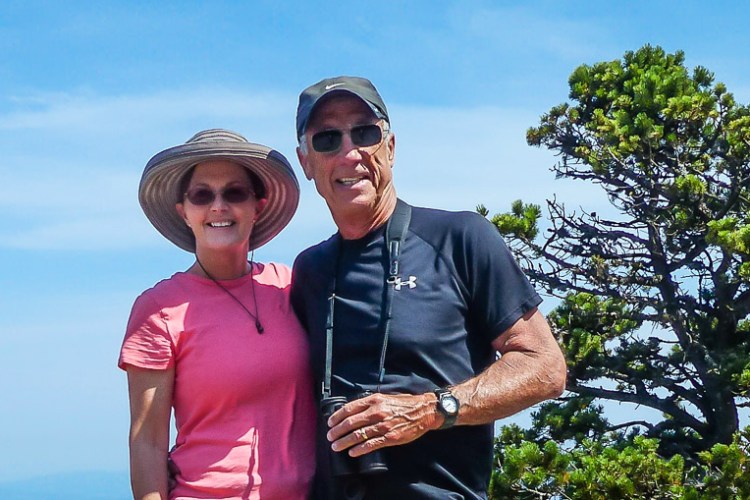
After lengthy careers maneuvering the treacherous waters of corporate America, Terry and I decided in August of 2011 that life was too important to take so seriously. We wrote what was to be our final resignation letters, stuffed our backpacks to maximum capacity, and headed south of the border for a Mexican adventure.Read more About Us
“I have no special talents. I am just passionately curious.” ~ Albert Einstein
Passion is that spark that creates the fire in our soul, allows our hearts to expand, and makes us feel vitally alive. As we move through life passion often evolves from a focus on career and accumulating money to finding our authentic self, peeling away the layers to find the real “me” that has been buried under the needs of others. Read more Pursuing Passion
“Physical fitness is not only one of the most important keys to a healthy body, it is the basis of dynamic and creative intellectual activity.” ~ John F. Kennedy Read more Let’s Get Healthy
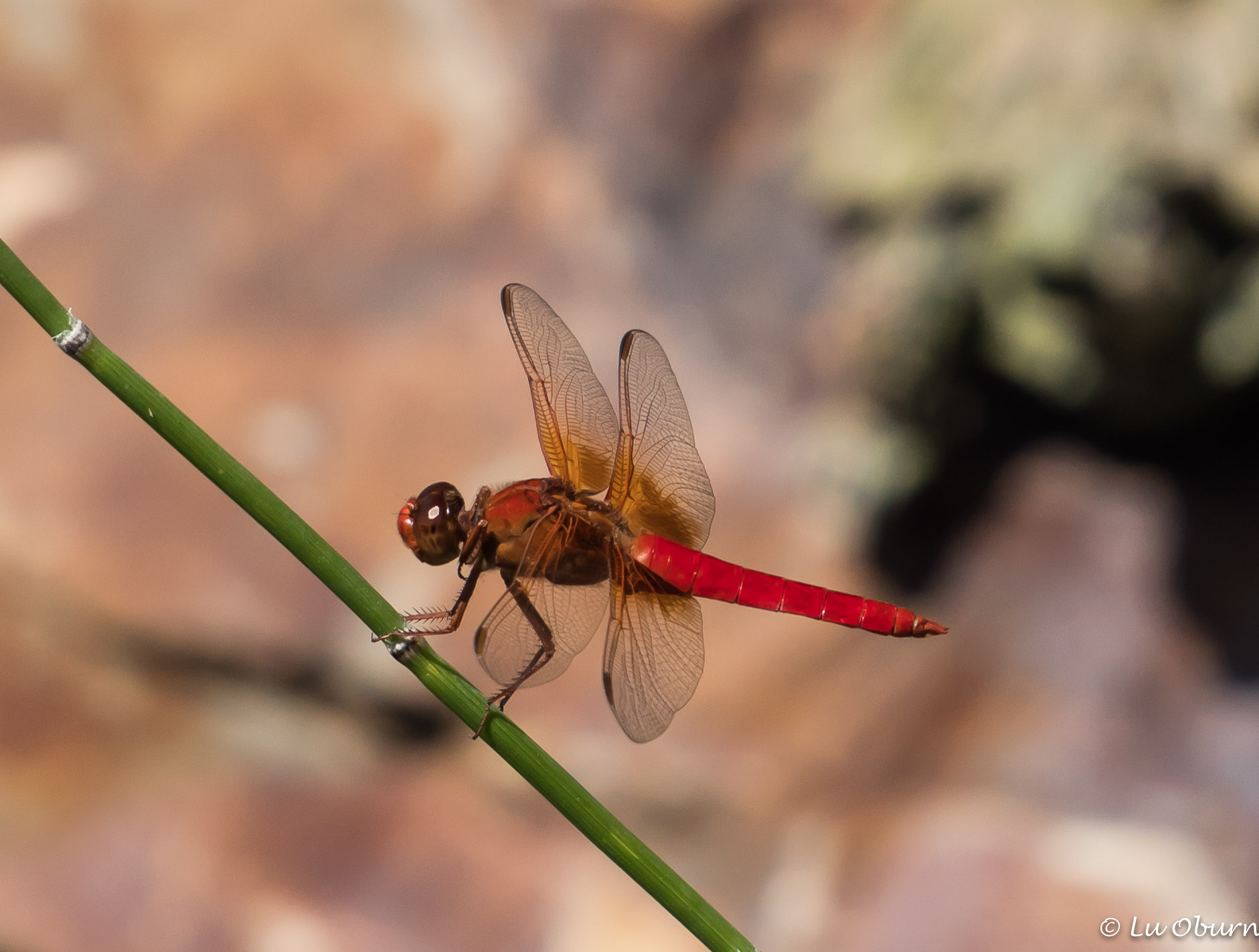
The long summer is drawing to a close and for me, hot summer daze seems to best describe this season spent in Southern California. I realize that as I grow older I tolerate hot weather less and less and find myself dreaming of crisp fall days, days when I step outside and become intoxicated on autumn air. Knowing I was grounded for the summer due to a minor medical issue, I vowed to explore the beauty right outside my door, but as temps creeped into the triple digits I fell short of that goal many days as spending time outdoors could result in an irascible, sweaty meltdown. So when this outdoor kinda gal found herself trapped inside, gym fitness and reading became my go-to activities. Nothing wrong with that, I might add, especially when I have a wise, beautiful friend who recommended a special book to me, knowing I might find myself in an introspective mood from time to time. She couldn’t have suggested a book more conducive to the kind of year it has been and is one we would all do well to read, “The Five Invitations”. I can’t thank you enough Erin.
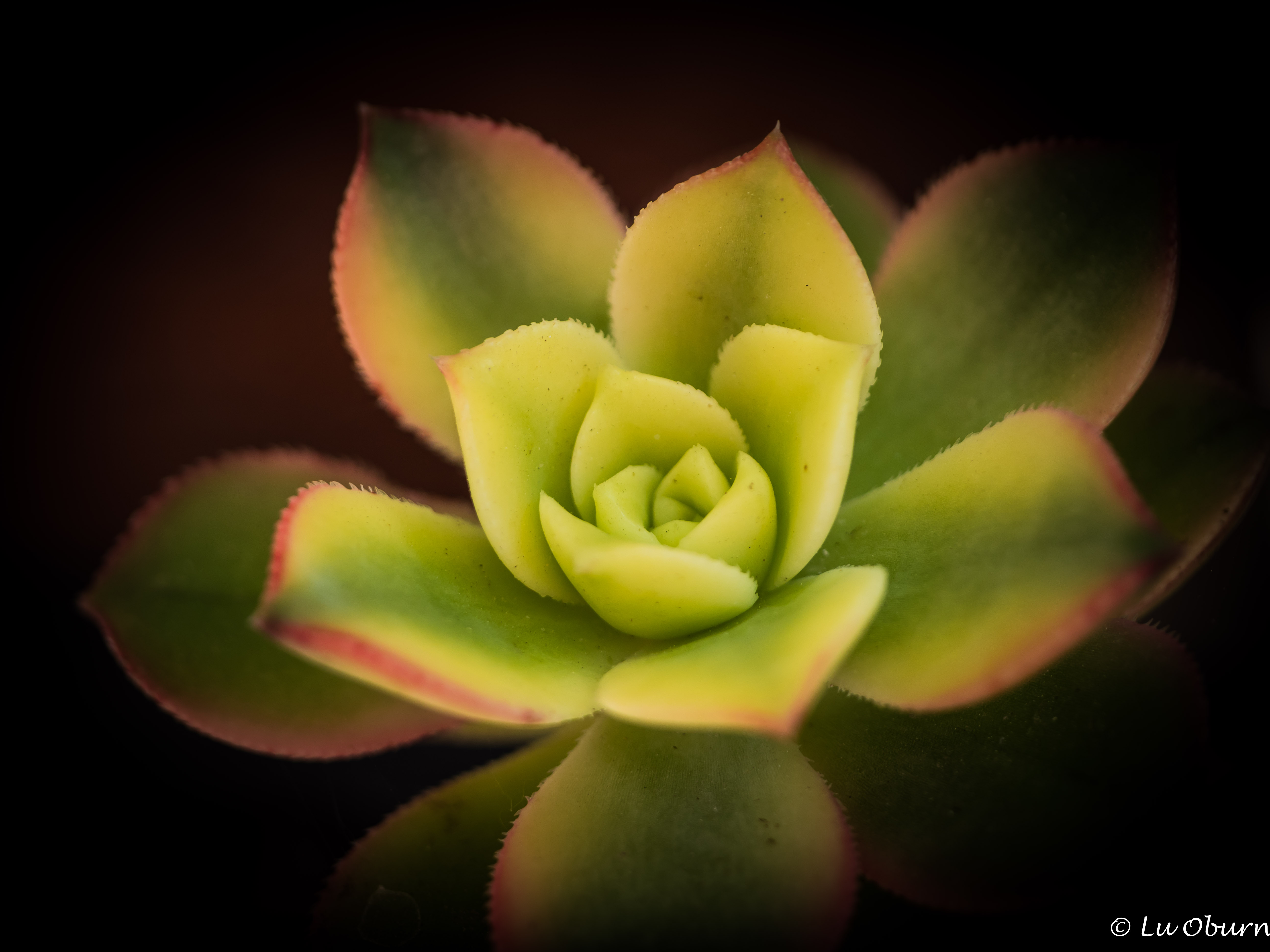
This year has created an interesting array of emotions for me, bringing to life a trip I have longed to take for decades, that being our Patagonian adventure. Coming home with what I thought was a minor finger dislocation became that plus a ruptured volar plate, detached collateral ligament and fractured knuckle. This week I graduated from hand therapy with parting gifts of various torture devices…yay!
Even with 12 weeks of therapy my injury does not even make the list of the tragic turn of events so many of my friends and acquaintances have experienced this year. The list of those we know who have passed this year has now grown to double-digits, not to mention all the public figures whose journey in this life has ended – Aretha Franklin, John McCain, Barbara Bush, Winnie Mandela, Stephen Hawking, just to name a few. Beyond this, we have friends who have had significant medical events and are still struggling with major illnesses, some where hospice has stepped in to provide comforting care. My thoughts are with all of them as they traverse the next phase of their life journey.
The author of “The Five Invitations”, Frank Ostaseski, a contemporary scholar of ancient Buddhist teachings, had me reflecting upon what death can teach us about living, how embracing our impending death, whenever that may be, can allow us to be more fully present, more alive, living each day to its fullest.
“Death is not waiting for us at the end of a long road. Death is always with us, in the marrow of every passing moment. She is the secret teacher hiding in plain sight, helping us to discover what matters most.” ~ Frank Ostaseski
Although my thirst for wandering wasn’t quenched this summer, I am grateful for the insights gained as I practiced being more present each day. We head out for some autumn adventures soon and I hope to carry my lessons learned with me. I’m looking forward to reconnecting with the blogosphere once again.
We have settled back into our part-time home at Jojoba Hills, where memories of our Patagonia trip may have faded a bit but revisiting photos can put that smile right back on my face. One of my more vivid memories of Patagonia was our hike to the Three Towers in Torres del Paine National Park, as this is where I experienced firsthand the “knock-you-down” winds for which Patagonia is noted. This is where I learned to fly during a rainstorm, albeit it briefly, as I made the steep ascent to the towers. This is where a rogue gust threw me off a boulder and, although I didn’t get the iconic shot of the towers that day, I remain grateful that I didn’t suffer a serious injury.
The iconic shot I was hoping for, courtesy of cascada.travel.
An x-ray, a consult with an Argentine doctor, and a splint in place and the next day I was on my way to our next adventure. Although I was told to keep the splint on for three weeks and I should be good as new, I suspected, once ‘sans splint’, that something was amiss. My knuckle looked weird and the more I exercised my finger, the stiffer and more painful it became.
By the time we arrived in the Atacama, weeks later, my finger was red, warm, and not at all happy with me. I worried about an infection, but there was no one to consult in the small village of San Pedro, so I buddy-taped it again and tried not to think about it the last few days of our trip. Out of sight, out of mind, right? We couldn’t return home anyway as our airline went on strike; our flight was canceled; and we couldn’t get out any earlier. The best I could do was schedule an appointment with my doctor back home, so I tried not to let it interfere with the last few days of our trip.
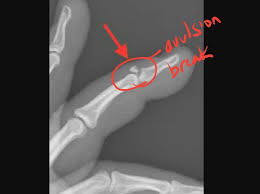
Navigating the healthcare system back home was frustrating as I waited several weeks to see a hand surgeon and get an MRI after my initial x-ray, which revealed a fractured knuckle. The first hand surgeon I visited confirmed the avulsion fracture and a ruptured volar plate (the thick ligament that secures the knuckle and holds the two bones in place in the finger)and when asked what treatment he would recommend, he replied that it was bad and he couldn’t help me. No physical therapy, no surgery…what the heck? Needless to say, he is not my current hand surgeon.
Should you ever have the joy of dislocating a finger, here is some of what I have learned:
Splinting should be done for no more than one week and gentle manipulation should begin immediately after the splint is removed, even with an avulsion fracture. This probably won’t be much fun as the finger will still be swollen and painful to the touch. My accident was three months old when I saw my current hand surgeon and was splinted far too long so my situation was a bit more challenging.
Aggressive range-of-motion therapy can be an option, and was for me. I see my therapist twice weekly for 12 weeks. She is an angel, even though she often hurts me. 😢
If hand therapy doesn’t work, surgery would be a next option. I have found a great hand therapy specialist and she doesn’t see surgery in my future. Yay!! Finding a good therapist who will customize a program for you is a must.
Be prepared for slow progress. I wake each morning feeling like I am starting all over again, which I am told will probably be the case for the next six months. Patience definitely is a virtue at times like this.
Finger dislocations take a minimum of 8 months to heal. It is no wonder my finger is still swollen and stiff, along with other fingers as well.
I’m sad to say that our summer plans for Yellowstone National Park have been disrupted as I focus on getting my hand back in shape. I will be living vicariously through all of you and spending more time discovering the beauty right outside my door. Sometimes we just need to slow down a bit to find that beauty.
We knew the Atacama Desert offered more than enough to entertain us for the five days we were to be in the region. We just didn’t expect to fall so hard for San Pedro.
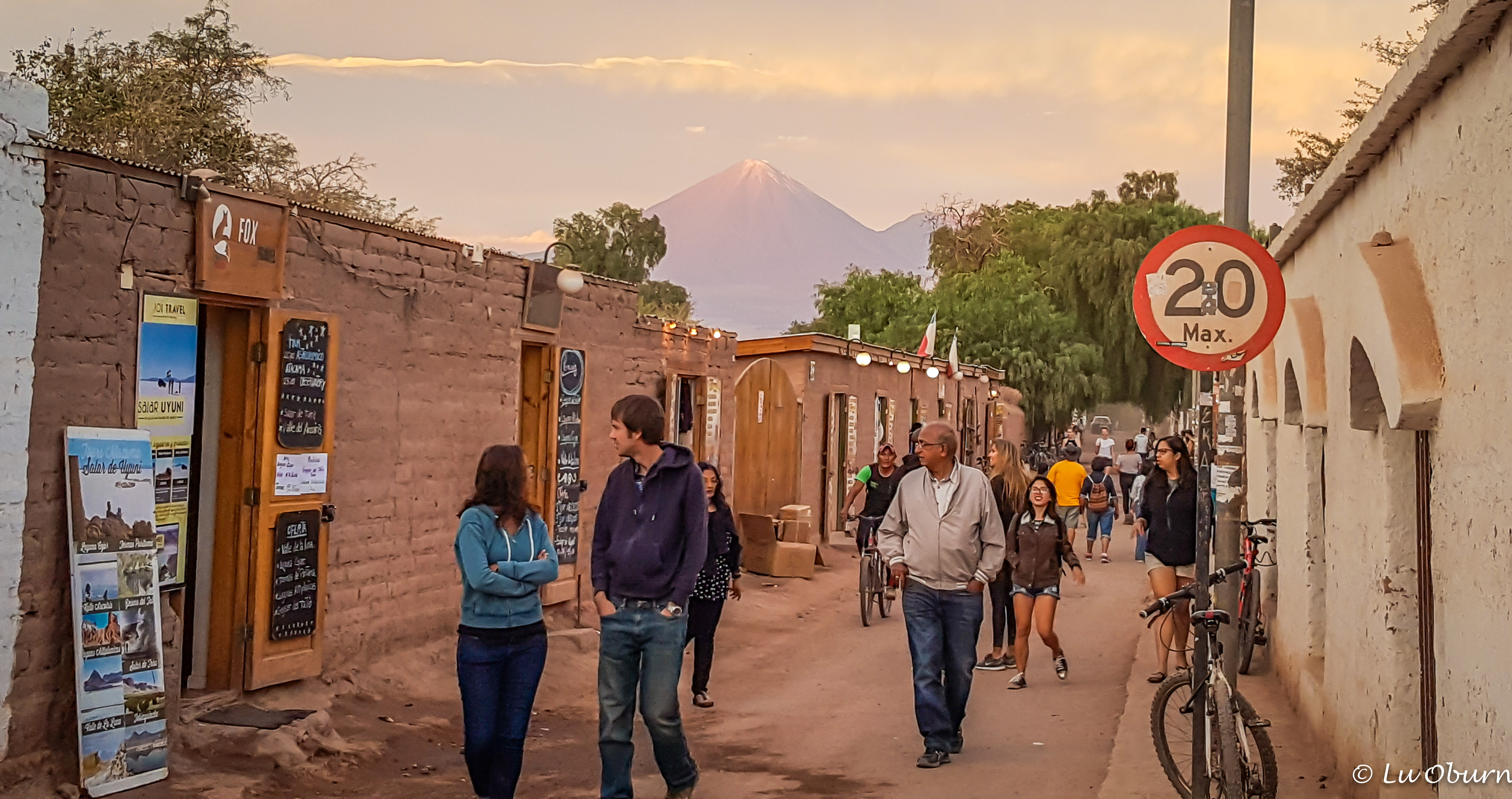
As I sat down to write this post, I struggled, as I did while we were there, to describe why I was so drawn to this dusty little village. Dirt roads, countless stray dogs, more tour companies than we could count, and streets lined with endless shops wouldn’t normally be our ideal place to wander, but it was obvious we were smitten. Behind the doors of these adobe-caked façades lie upscale boutique shops, amazing cafes, great artisanal ice cream, and pisco sours infused with local desert herbs.
Beautiful street art
Colorful gifts to draw tourists in.
Volcano tour, anyone?
Artisanal ice cream…yummy!
One of many great restaurants.
San Pedro is an oasis sitting at roughly 8,000 feet, a swath of fertile desert surrounded by a strikingly conflicted landscape. Sprawling, barren desert of salt flats, hot springs, and contorted rock formations swiftly ascend to the Altiplano, butting up against the soaring Andes and a dozen volcanos. San Pedro is at the center of immeasurable interest for scientists across several branches.
The uniqueness of this village is not lost on Volcan Licancábur, who, at 5,916 meters (19,410 feet), looms over San Pedro like a protector. This volcano is sacred to the Inca Empire, and given its perfect conical shape, it seems to be the model volcano for all others.
Volcan Licancabur standing guard over San Pedro.
There are 360-degree awe-inspiring views here but if you never looked up at night you would be missing a spectacular light show. Given its lack of light pollution, aridity, and altitude, the Atacama has drawn its fair share of astronomers and is known as the place to be if you are an astronomy geek. I wouldn’t call us geeks but we were drawn to the idea of looking at the night sky through powerful telescopes so chose this as our last venture into the Atacama.
With an astronomer as our guide, we soon were educated on terminology, got an impressive laser light show of planets, star clusters, nebulae, galaxies, and zodiac sign constellations, and did some telescope viewing, along with iPhone shots of the moon. It was another great tour experience.
Our little night sky tour group…wonderful but cold night.
Close-up of the moon
Another adventure that we had read was a must-do is the El Tatio Geyser Tour. Since we had lived in Yellowstone National Park for a couple of years and visited several times since, we didn’t feel the need to drag ourselves out of a warm bed at 4:00 am and climb to over 14,00 feet to witness sunrise over the steaming geyser basins. Had we had the time, the 4-day trek to the Uyuni Salt Flats in Bolivia would have been on our agenda.
Beyond the myriad of tours available to hold your interest, just walking the streets of San Pedro is a source of entertainment all its own. This is a people-watching village, as characters from across the globe gather here. And for a town of little more than 2,500 (although it is growing), the number of highly recommended restaurants is impressive. The one we will forever remember is Roots, the place we went for breakfast, every single day. The coffee prepared by a real barista, every menu item we tried, the waitstaff, and the music (watched the cook singing and dancing to Adele vocals) were all wonderful. It was like saying goodbye to family when we departed from San Pedro.
The Atacama Desert and San Pedro seem to have developed a symbiotic relationship of sorts, both needing one another for their vitality. The remoteness of the Atacama draws the curious and San Pedro holds their interest, booking tours into the desert.
The dusty streets of San Pedro never fail to draw a crowd.
He was one of many interesting characters to “people-watch”.
Until recently, discoveries made in the Atacama could be seen in the Gustavo Le Paige Museum in San Pedro, which is no longer open to the public. The world’s oldest mummies, the Chinchorro, a culture found in the Atacama from 7,000 to 1,500 BC, are buried in this unforgiving environment. They, along with other artifacts, are well-preserved, due to the arid climate, and are found to predate even Egypt’s oldest mummies. The indigenous community here finally won the right to have their ancestors removed from the Le Paige Museum, which seems the proper decision.
As we packed to leave this magical place, we agreed that with all the breathtaking scenery surrounding us throughout our time in Patagonia – soaring mountains, jagged, crevasse-filled blue glaciers, grassy steppe, misty forests, the barren Atacama desert, remote, stripped naked of virtually all moisture, may be Chile at her best.
Old-adobe church in the town square.
Two talented young locals on the didgeridoo and the flute.
What we initially saw as a passable event on our trip planning calendar was one of the great joys of our South American adventure. This land of such breathtaking natural beauty, born from the basic elements of gravel, clay, salt, and minerals, provided us some of our richest experiences and heightened all our emotions. Even the “animas” we saw on our drive to the airport, those little houses built along the side of the highway to memorialize those who had died on the roads, seemed to flow with the drama and mystique of the Atacama.
Upon our arrival back to Santiago, Chile, where we started this journey, we drank our final pisco sour in honor of our time in the Atacama Desert.
If you want to read more about our time in the Atacama, here are links to my earlier posts:
We are now home in southern California, back a bit earlier than we had planned, due to the wild Patagonia weather and a dislocated finger that has plagued me since early March. More on that later, as I wade through the U.S. healthcare system, which is always a joy.
There are countless ways to see the Atacama. Because it is so vast, a local guide is key to experiencing its intense beauty. Since there are tour companies on almost every block in San Pedro, it pays to do your homework first, as there is always someone ready to grab you off the street and entice you with their colorful photos.
Given how much I loved my first tour with CosmoAndino Expediciones, who seems to steadfastly adhere to their motto “quality time in the Atacama”, I booked a second tour, and this time I would have my hubby by my side and Pablo as our guide once again. 🙂 Valle de la Luna, also part of the Los Flamencos National Reserve, was our tour of choice.
The tour began at the CosmoAndino office where our little group of roughly a dozen hopped onto an awaiting van. A short drive outside of San Pedro we stopped at the Mirador Piedra Del Coyote for some photos of this windswept landscape, warming us up for what was to come.
Terry at the Coyote Rock viewpoint.
From here we jumped back on the van for the short drive to Mars Valley, where the real adventure began. The soil here has been compared to that of Mars, hence the name. NASA has used this region to test instruments for future Mars’ missions.
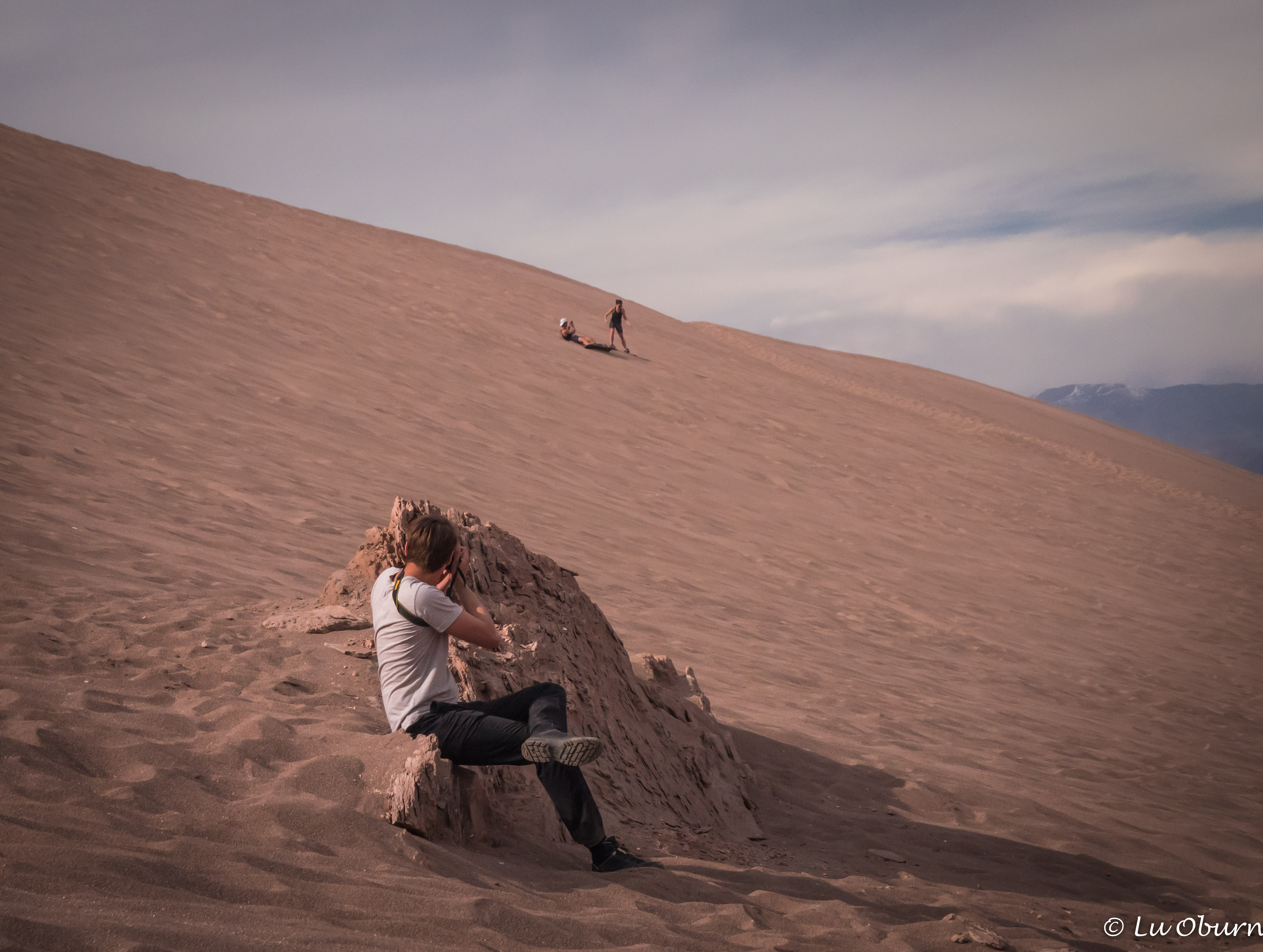
Hiking along the rim of a vast red rock canyon rimmed with towering mountains and volcanos, sand dunes rose at dizzying angles before us, the steepest the perfect setting for sandboarding.
Trying their “feet” at sand boarding. Not as easy as it looks.
Pablo took us back in geologic time as we hiked to the point, then proceeded to share our next adventure, running down a 230-meter (755 feet) sand dune to join up with our van parked far below us. That sounded intriguing, except none of us could see how we were going to get down from the top of the canyon to the top of the sand dune. As we continued our trek, Pablo joked about making sure we all had our travel insurance cards handy.
Pablo in Mars Valley, always educating or entertaining.
Hiking out to the point.
Our van, that white dot on the road far below us.
Our escape route was finally made known and we were helped down from the rim. Pablo assured us there was no danger, then proceeded to begin running down the steep dune, encouraging us to join him, running in a zigzag fashion. We all giggled as we sank to our shins in loose sand. Halfway down we stopped on a ridgeline for photos and removed our shoes. There was nothing better than pulling off hiking boots we had lived in for the past two months and playing in the warm sand.
With a little help we are off the ridge.
Toes in the warm sand as we run down to the van.
Stopping for photo ops at the halfway mark.
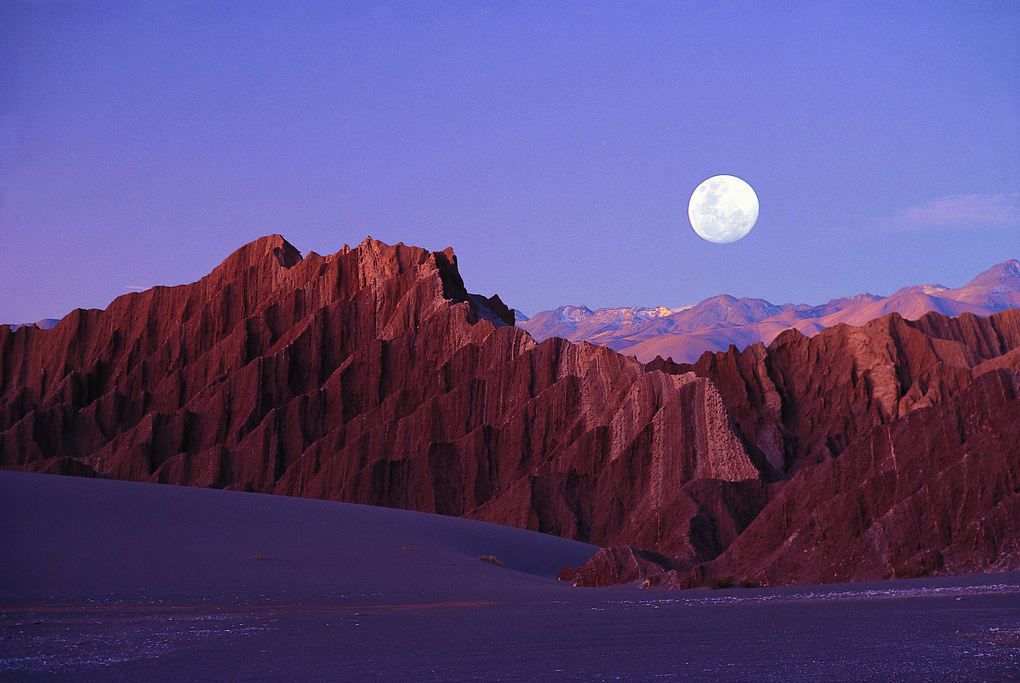
With huge smiles on our faces, we piled into the van and headed to Moon Valley, a striking lunar landscape formed by eroding salts and minerals. Several mountain ranges surround this region, as well as a chain of volcanos, not surprising, as this stretch of Chile falls within the Pacific Ring of Fire. The most active in northern Chile is 5592-meter tall (18,346 ft.) Lascar, which looms over Lake Miñiques.
Gnarled fingers of rock reaching skyward came into view as we walked through red-rock sand rimmed with salt. One of the more famous formations in this area is “Tres Maries”, created by gravel, clay, salt, and quartz, worked by the whims of wind and erosion for over one million years.
I’m not sure any of us saw the Three Marys in this rock formation.
Inspiration for the Pac Man video game?
We found one of the more interesting structures in Moon Valley to be the “Amphitheatre”, part of the Cordillera de la Sal (Salt Mountain Chain), formed by horizontal accumulations of sand, clay, salt, and movements in the earth’s crust.
The action of wind, with a little water thrown in for good measure, created a sequence of peaks that are similar to the bellows of an accordion. Some see a resemblance to the Colosseum in ancient Rome. I have to agree.
Our final hike was up to a vantage point overlooking a ridge skirted in dunes, with the Amphitheatre as a backdrop. This is where one hopes to get the iconic shot of the moon rising over the Atacama, as well as a sunset shot bursting with color. We were not confident of either as clouds had chased us all day, with rain a possibility, a most unusual occurrence in this land devoid of moisture. We saw neither the moon nor an enchanting sunset, but still labeled this a magical day.
Welcome to Moon Valley.
Pablo and one of the fun members of our group at the salt mines in Moon Valley.
Our silhouettes as we walked Moon Valley, admiring her seductive beauty.
Ridgeline in Moon Valley where we awaited a sunset that never came.
Moon Valley near sunset.
Moon Valley iconic shot. Photo credit – kimkim.com.
As I perched on the ridgeline overlooking this ethereal void, I mused how an area so remote, so empty of life, could make me feel so alive, so full. I was reminded of the quote:
“Sometimes you find yourself in the middle of nowhere, and sometimes in the middle of nowhere you find yourself.”
Next Up: Night Sky, a Stroll through San Pedro, and Final Thoughts
The Atacama wasn’t on our agenda. We had lived in a desert environment for over 25 years and I have not so fond memories of symptoms I’ve experienced at higher altitudes, so we filled our South American itinerary with other adventures. I did have some wildlife ‘must-sees’, however, and as we approached the middle of April, I had yet to see flamingos in the wild, except from afar. I couldn’t fathom returning home if there was still a chance to see them, and since we were ahead of schedule, thanks to the wild Patagonia weather, I looked to Terry and said, “I want to go north to the Atacama” and, without further discussion, he agreed.
First, a few facts about the Atacama, one of the oldest deserts in the world:
Photo courtesy of Google maps.
It covers a 1,000 kilometer (621 miles) strip of land near the Pacific coast, west of the Andes, primarily in Chile.
It is the driest, non-polar place in the world, according to NASA, barely registering more than one millimeter of annual rainfall, although that has begun to change. It is 50 times drier than Death Valley National Park.
The extreme dryness is due to two mountain chains, the Andes and the Chilean Coast Range, each tall enough to prevent moisture from reaching the desert floor. Many of the region’s mountains taller than 6,000 meters (20,000 feet) are completely free of glaciers.
Some of the weather stations in the Atacama have never registered any rainfall!
Every 10-15 years a rare phenomenon called desierto florito, when the desert bursts into prolific bloom, is a result of the El Niño effect. Rainfall is such a rare event that knowledge of some of the flora is relatively unknown. This is now happening more often due to an increase in annual rainfall.
So, why come to such a desolate region? I was drawn by the compelling brazenness of wind and relentless sun to sculpt a landscape like no other, and of course, the allure of wild flamingos was never far from my mind.
San Pedro de Atacama is the place to position yourself if you want to experience this otherworldly landscape. Tourism has a foothold in this small town of 2,500 residents, as evidenced by the tour companies advertising on every block. Although San Pedro’s population continues to expand, only two pharmacies exist, a telling sign that the local indigenous community still uses medicine found in nature to heal, a concept that resonates with me.
After settling into our hostel, we walked down the main street, Caracoles, to find CosmoAndino Expediciones, the tour company I had chosen after much reading. The detail they provided and the warmth of their staff told me I had made the right decision. After settling up with them, we walked down to the town square where music and dancing could be heard. What a wonderful way to begin our San Pedro stay!
At 6:30 the next morning the van picked me up to begin the ‘Salar y Lagunas’ tour. Terry had decided to stay back and piece together a new route to get us back home after learning that our flight had been canceled because of an airline strike. I was bummed but he insisted, which was probably for the best, as it took him most of the day to piece together a new flight plan.
This tour (I believe a must-see) begins with a stop within the National Reserve “Los Flamencos”, at Laguna Chaxa, the salt flats where migrating birds can be found, most notably pink flamingos. Although not as expansive as the Uyuni Salt Flats in Bolivia, I knew I was going to get my flamingo fix! We arrived before any of the other tour companies, which is one of the reasons to use CosmoAndino. The solitude allowed for viewing and taking photos before the crowds arrived, and before the birds took flight.
This slideshow requires JavaScript.
Three species of flamingos migrate to Laguna Chaxa – James, Chilean, and Andean, although the James are only seen here in the winter. The Andean, one of the rarest flamingos in the world, are larger than the Chilean, have yellow legs, and a large black swath on their wings. The Chilean have bright pink knees and feet, and eat by digging in the mud while turning in circles. The Andean flamingo also dig in the mud for food but walk in a straight line…interesting.
Chilean flamingo feeding
Chilean flamingo spinning in circles with a Puna plover waiting nearby for a little snack.
Andean flamingo – note the yellow legs and black-tipped wings
Flamingos mate for life, laying one egg per year during December and January, in cone-shaped nests they build in the mud. Babies are white-gray, then turn pink after they begin eating brine shrimp, which are prevalent in the salt flats. They live 30-40 years and have few predators.
The Puna plover and Andean avocet, who also love saltwater marshes, can be found at Laguna Chaxa.
Andean avocet
These salt flats, created by water that flowed from the Andes, were the site and much of the cause of the War of the Pacific, also called the Saltpeter War. The result was that Chile obtained most of this valuable, mineral-rich territory that was desired by both Bolivia and Peru.
Salt crust caused by extreme evaporation.
Different morphologies created due to the presence of chloride and sulfate.
Interesting landscape created by a lack of moisture.
Beneath this salt (the largest deposit in all of Chile), lies a massive salt lake, and beneath this huge lake lies 27% of the world’s lithium reserves, the purest active source of lithium available. As lithium is the key ingredient in rechargeable batteries, it is a much coveted resource. Our tour guide, Pablo, told us it is a delicate balance to remove lithium and not disrupt the salt flats and the wildlife that is drawn to them.
To learn more about lithium mining, two interesting articles can be found here and here.
After spending time with the flamingos, we were served a yummy breakfast of fresh fruits, guacamole, ham, and cheeses. Coffee, hot chocolate, and tea helped to take off the chill, and coca leaf tea was available for those of us challenged by high altitude. As we would be spending 4-5 hours of our day at elevations in excess of 13,000 feet, I was thankful for the tea. This, along with staying hydrated, provided me a symptom-free day. 🙂
Socaire’s original church, from the 18th century.
A peek on the inside.
One of the local artists.
Beautiful art created from salt, cacti, volcanic rock, and textiles by Socaire residents.
After leaving the salt flats, we stopped at the small village of Socaire, where we visited an 18th-century church and enjoyed seeing some of the creations made by local artisans before continuing our ascent to the highlands.
Our amazing, crazy tour guide Pablo.
Laguna Tuyaito
Might as well jump!
We stopped at various viewpoints and saw the smallest and rarest of the camelids, the shy vicuña, from our van window. They prefer higher elevations and are found mostly in northern Chile. Its wool has been prized since Inca times.
Mama vicuña
Baby vicuña, who will stay with mom for the first year.
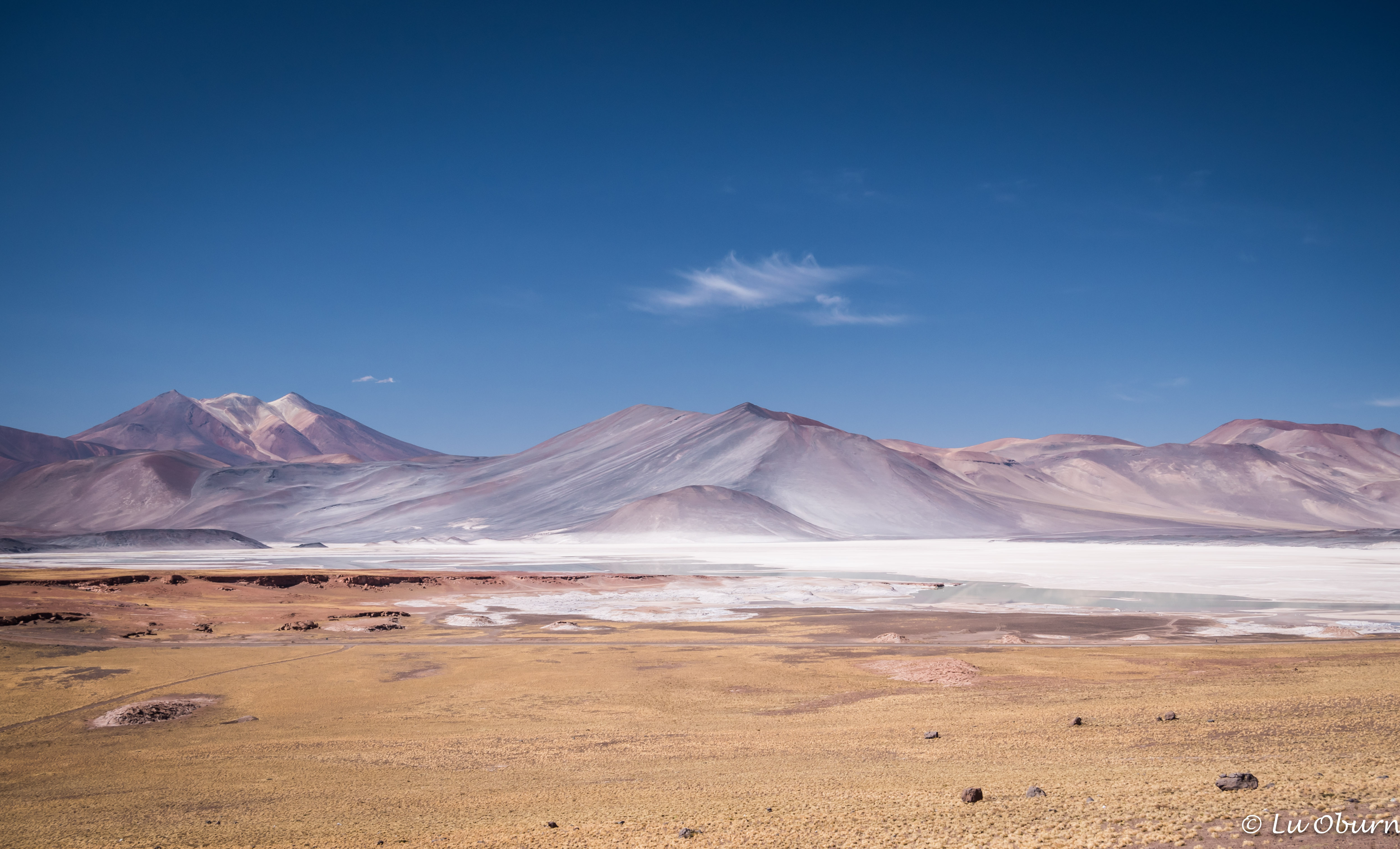
Our final stop of the day was to Lakes Miscanti and Miñiques, named after their namesake volcanos. These lakes formed about 1,000 years ago when the eruption of the Miñiques Volcano, 5,910 meters above sea level, blocked the waters that once flowed freely in front of these volcanos. Due to geomorphological changes in the area, natural dams were created, resulting in the lakes we see today.
Lake Miscanti, ringed by volcanos.
Breathtaking!
Lake Miñiques
So many volcanos dot the landscape.
A great lunch was served before we headed back to San Pedro, wrapping up a fabulous day.
Over our 5-day stay in San Pedro we took three tours, two with CosmoAndino Expediciones. I cannot say enough about the quality of this tour, our tour guide Pablo, and the professionalism of this company.
 The long summer is drawing to a close and for me, hot summer daze seems to best describe this season spent in Southern California. I realize that as I grow older I tolerate hot weather less and less and find myself dreaming of crisp fall days, days when I step outside and become intoxicated on autumn air. Knowing I was grounded for the summer due to a minor medical issue, I vowed to explore the beauty right outside my door, but as temps creeped into the triple digits I fell short of that goal many days as spending time outdoors could result in an irascible, sweaty meltdown. So when this outdoor kinda gal found herself trapped inside, gym fitness and reading became my go-to activities. Nothing wrong with that, I might add, especially when I have a wise, beautiful friend who recommended a special book to me, knowing I might find myself in an introspective mood from time to time. She couldn’t have suggested a book more conducive to the kind of year it has been and is one we would all do well to read, “The Five Invitations”. I can’t thank you enough Erin.
 This year has created an interesting array of emotions for me, bringing to life a trip I have longed to take for decades, that being our Patagonian adventure. Coming home with what I thought was a minor finger dislocation became that plus a ruptured volar plate, detached collateral ligament and fractured knuckle. This week I graduated from hand therapy with parting gifts of various torture devices…yay!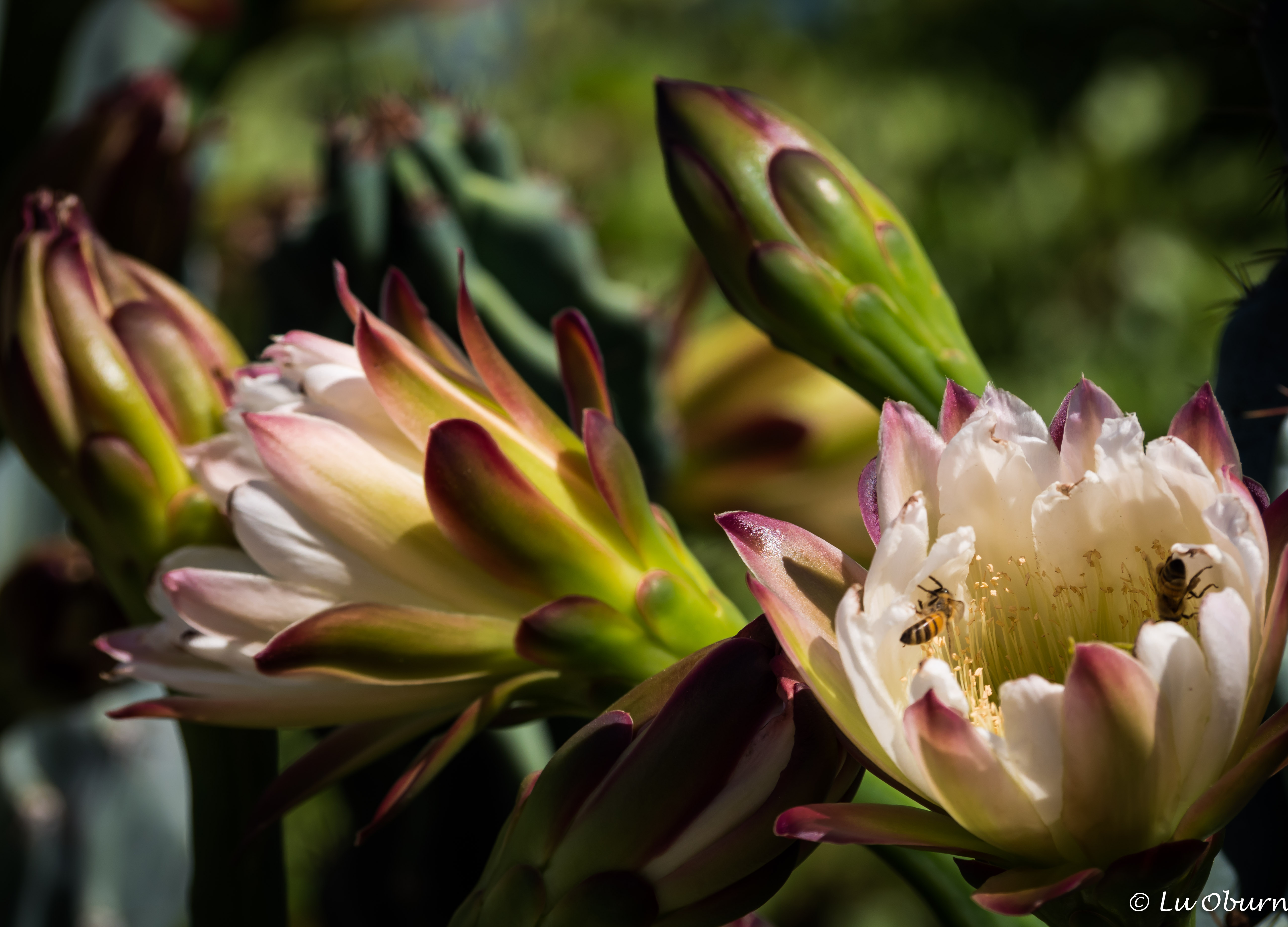










 Paint Your Landscape