Citizen Science ~ Yellowstone Forever Field Seminar Series

“The real wealth of the Nation lies in the resources of the earth soil, water, forests, minerals, and wildlife.  To utilize them for present needs while insuring their preservation for future generations requires a delicately balanced and continuing program, based on the most extensive research.  Their administration is not properly, and cannot be, a matter of politics.”  ~  Rachel Carson

I recently had the opportunity to support one of Yellowstone Forever’s naturalist programs, Citizen Science.  Although I have now supported many field seminars, this program continues to evoke special memories for me. Along with seeing breathtaking sights, as we do with all programs; e.g. wildlife, birds, plants, etc., and studying new and interesting topics, this was an opportunity to take the knowledge and data we collected and give back.  The research we conducted and data we garnered from the field was passed to the National Park Service, with whom we have a collaborative relationship.

What is Citizen Science?

Citizen Science is the name given to projects and activities sponsored by a broad array of organizations, state and local government, community environmental groups, and international organizations.  It is a wonderful way for “non-scientists” to make a difference.  Citizen Science programs allow the average layperson to contribute to scientific studies by supporting professional researchers.

Who can participate?

Volunteers of all ages who are concerned with the environment can participate in Citizen Science programs.

The Citizen Science program I supported through our Yellowstone Forever field seminar was three-pronged.  The first day we hiked to a one-hundred meter transect that had been laid out earlier by our instructor, Joshua.  We collected data on the specific wildflowers we located there, broken down into quadrants.

Students inspecting wildflowers along the transect

Our second day was focused on the invertebrates feeding and pollinating these wildflowers.  This study was led by the park entomologist, Erik.  We set up pit-fall traps at the transect the evening before and the next morning hiked back to the transect, doing net-sweeping to capture insects in the area, checking and emptying our pit-falls to see which insects had visited the previous night, and participating in timed observations to see which insects were actively pollinating the plants.  We returned to the classroom to look at these interesting little invertebrates under the microscope and learned how to mount insect samples, like you might find in the Smithsonian Museum in Washington, D.C.

Our final day found us gleefully standing in the pouring rain and hail to study collared cow bison.  This bison survey was led again by Joshua.  Our research took us to a specific area of the park where telemetry had given him the information we needed to locate the collared cows within a herd.  Our task was to count how many cows, bulls, and yearlings we found, determine if the collared cows had any calves, and collect fresh scat and grasses found in the area where the herd was congregated.

Many of the yearlings were quite inquisitive but never aggressive as we approached.  It bears mentioning that wildlife should not be approached in this manner without a professional guiding the way.  It took some time for us to determine if one little “red dog” belonged to the collared cow, but eventually the adorable little calf wandered over to mom, touching noses, a tender moment that registered success.  We collected our necessary samples and moved along, letting the bison do what they do best, munch their way across the meadow.

We had an incredible three days, learned an immense amount about the landscape we walked, and left with the students feeling euphoric about what had been accomplished.

If you have a passion for nature and would love to give back, here are a few organizations that have established Citizen Science programs, also known in some circles as Citizen Naturalists:

Look for Citizen Science programs in your area.  Happy researching!

Disclaimer:  The views expressed here are my own and do not necessarily represent the views of Yellowstone Forever.  

Intro to Wolf Management & Ecology ~ Yellowstone Forever Field Seminar Series

After a few weeks of preparation, it was finally time to support my first field seminar, Intro to Wolf Management and Ecology.  Since the reintroduction of wolves to Yellowstone in 1995, debates relative to this alluring creature have been tireless and complex.  Wolf watchers in the park are enamored by them, ranchers and hunters not so much.

Sunrise at Slough Creek, site of an active wolf den.

I had heard several park employee discussions on the topic of reintroduction of the wolf, namely Doug Smith, project leader for the Wolf Restoration Project, since our arrival to the park.  He has studied wolves for the past 20+ years and still brings the same passion to the topic as he did as a Yellowstone freshman.  I was anxious to hear some fresh views on this subject from our class instructor, Jon Trapp.  Beyond  embracing many of the views presented by Doug, Jon also spoke on the topic of wolf denning, subject of his master’s thesis.

Our classroom time took us through the past couple of decades since reintroduction, how many of the wolves have been collared and tracked, the family dynamics of how they hunt together, and what happens when an alpha member of the pack is killed.  It was most informative and supporting this field seminar added another dimension to my time at the Buffalo Ranch.

Field time at the Slough Creek den

Wolves get a bad rap, some of it deserved, as they do kill some livestock.  No rancher wants to work hard to grow their herd, only to have a predator take from him.  The good news is that when this happens, the rancher is compensated for his loss.

Hunters who share the sentiment that the only good wolf is a dead wolf feel that the elk population has been jeopardized by the reintroduction of the wolf.  It is true that the mainstay of the Yellowstone wolf’s diet is elk; however, statistics have shown that many more elk are taken down by cougars than wolves.  I learned that 85-95% of the time when hunting an elk, the wolf is not successful, and their elk hunting is compensatory, killing weaker elk who were most likely going to die anyway.

Instructor Jon Trapp balanced over an abandoned wolf den

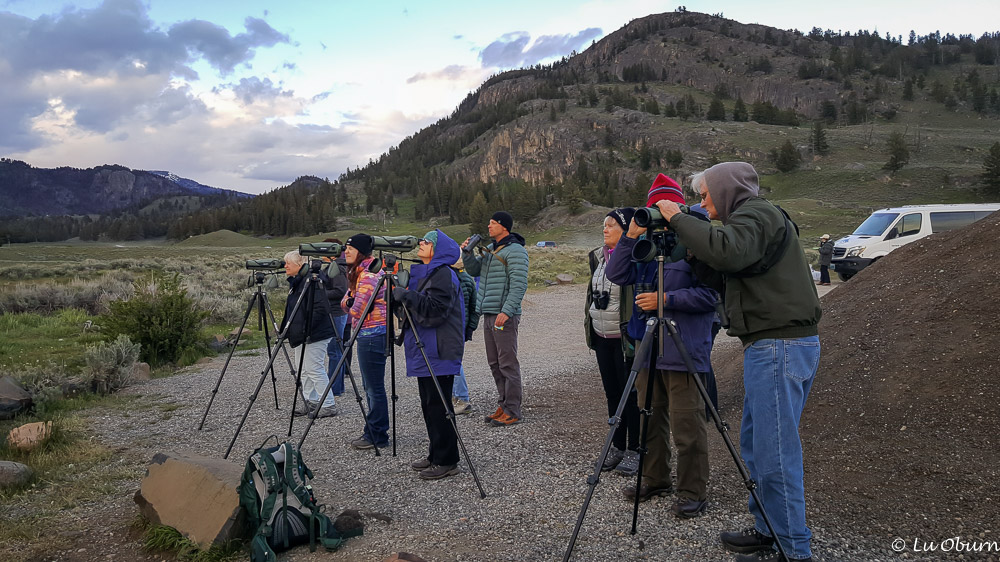
Our field studies were the most exciting, taking us to an area of the park where we could view an active wolf den using spotting scopes.  Watching the pups emerge from the den, tumbling over one another, frolicking in the sunlight, delighted us all.  Jon also took us to one of the first acclimation pens, Rose Creek, where we read the story of the first alpha female to the reintroduced to the park.  On another outing we inspected an abandoned wolf den.

With the wolf’s return to the world’s first national park, Yellowstone has regained its balance of historic mammals and is now described as the largest intact ecosystem in the temperate world.  We now see this region as it was before the Europeans arrived.

Biologists and scientists spend significant time in the field tracking the wolves of Yellowstone, but in the end what matters most is that we carved out another little piece of wildness with their reintroduction.  We need these wild spaces, their coarseness, erratic ebbs and flows, the magic and mystery.

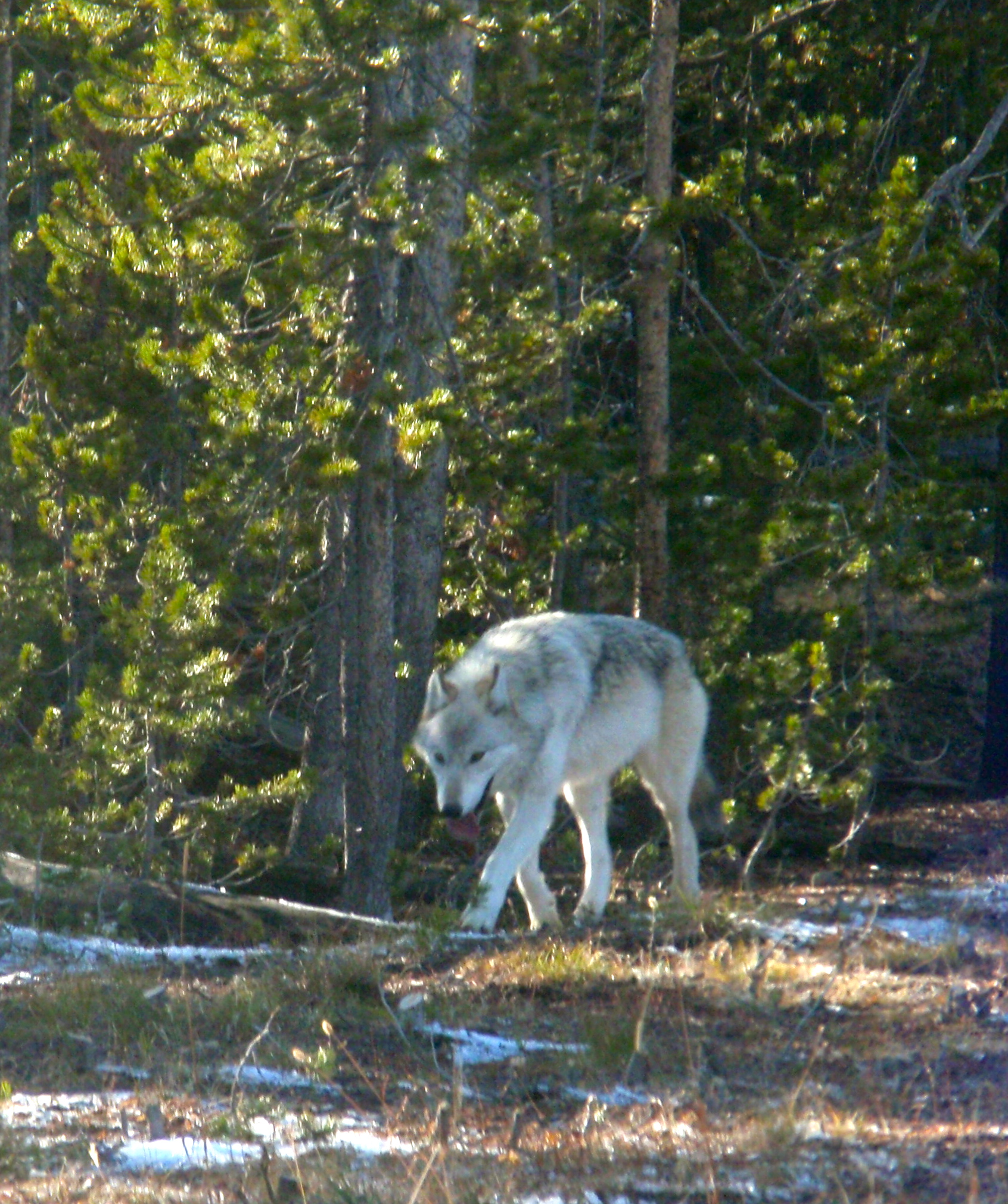
Photo of the white wolf from September 2010, recently shot and killed within Yellowstone NP.

Disclaimer:  The views expressed here are my own and do not necessarily represent the views of Yellowstone Forever.  
SaveSaveSaveSaveSaveSave

SaveSave

SaveSave

SaveSave

SaveSave

SaveSave

SaveSave

SaveSave

SaveSaveSaveSave

SaveSave

SaveSave

SaveSave

SaveSave

SaveSave

SaveSave

SaveSave

SaveSave

A Yellowstone Forever Summer

Planning for our summer began in earnest several months ago but we just arrived at our destination, Yellowstone National Park, a few weeks ago and what a whirlwind it has been.

Giving back by way of volunteering is a passion of ours and this year we have elected (and been chosen) to be program volunteers for Yellowstone Forever.  Formerly known as Yellowstone Association, a merger in October 2016 between the Association and the Yellowstone Park Foundation created Yellowstone Forever, the educational and philanthropic partner of the park.  We will be supporting the naturalists who conduct the Field Seminars and soaking up every bit of knowledge we can along the way.  Their subject list is diverse, ranging from wildlife, birding, photography, geology, sketching, hiking, Native American studies, backpacking, fly-fishing, and an entire new Naturalist Series.  It is going to be an active and educational summer, one in which we feel fortunate to participate.

Training for our Yellowstone summer adventure spanned a couple of weeks and covered a broad spectrum of activities; e.g. orientation, bus driver training, an intensive two-day wilderness first aid class, course preparation, and camp duty…whew!

When we finally arrived at our summer home, the Lamar Buffalo Ranch, we hit the ground running with a dedicated group who travel from near and far to ready the campus for the upcoming summer season.  From top to bottom we scrubbed and scoured the bunk house, bath houses, and cabins, in anticipation of a busy summer.  If it sounds like a lot of prep, it is, but the care taken by Yellowstone Forever to ensure happy field seminar participants has resulted in numerous returnees year after year to consume the knowledge eagerly shared by the engaging naturalists who conduct the classes.

This slideshow requires JavaScript.

Yes, it has been a whirlwind few weeks, tiring yet exhilarating.  Although far from being expert program volunteers, we both have one field seminar under our belts, “Intro to Wolf Management and Ecology” and “Bears, Bones, Signs, and Stories”.

As I sit on the back porch of our bunkhouse looking out over the heart of the Lamar Valley, known as the “Serengeti of North America”, I listen to the resounding thunder rolling across the landscape. Countless bison can be seen grazing, while their young “red dog” calves frolic.  I am humbled by the wonder of this magical landscape. I have no doubt that my Yellowstone Forever summer will change me in ways I cannot foresee.

Rumi said:

“There is a voice that doesn’t use words.  Listen.”

I believe that voice can be found in the wilderness, in places like Yellowstone National Park.  I plan to spend plenty of time listening.  As time and the internet permits, I hope to share what I have learned.

Hope you are all having a great start to your summer!

Disclaimer:  The views expressed here are my own and do not necessarily represent the views of Yellowstone Forever.  

SaveSave

SaveSaveSaveSave

SaveSave

SaveSave

SaveSave

SaveSave

SaveSave

SaveSave

SaveSave

SaveSave

SaveSave

Rome ~ The Final Chapter

By now those who have read my earlier posts on Rome know that I was smitten.  The history, ancient ruins and towering monuments called to me at every turn.  I could have easily spent a month here, diving deeper into all she offered.  Our week slipped by quickly and we left the city on a rainy pre-dawn with the news that a couple of earthquakes had hit nearby Umbria and Marched, areas that had been hit two months earlier, resulting in the loss of 300 lives.  This was a solid reminder that, although we spent our week walking streets littered with evocative ruins that have stood the test of time, Mother Nature can wreak havoc in the blink of an eye.

As we walk away from our time in Italy, I leave you with a few more sights to consider should you find yourself in romantic Roma.

Rome’s first Christian church, built in A.D. 318 by Constantine, the first Christian emperor, was the Church of San Giovanni in Laterano.  It was the most important church during medieval times and today is the home church of the Bishop of Rome, the pope.  This church was the model for all those to follow, even St. Peter’s Basilica.  Her tall green bronze doors once greeted those entering Rome’s Senate House in the Forum.

Directly across the street from the Church of San Giovanni in Laterano are the Holy Stairs, sacred steps taken from the home of Pontius Pilate in Jerusalem, believed to be those that Jesus climbed on the day he was sentenced to death.  Today it is the place where those seeking atonement climb on their knees, reciting prayers.  These steps lead to the “Holy of Holies”, the private chapel of the popes in the Middle Ages, still used today.  For those who want to save themselves from aching knees, a separate set of stairs can be walked.

Down the street from the Colosseum sits a large multiplex of ruins, thought to be the world’s oldest shopping mall.  Trajan’s Market, built in A.D. 100 was part mall, warehouse, and a series of government offices.

The first monument we saw as our driver carried us across the city to our apartment was the Victor Emmanuel Monument, hard to miss as it rises skyward 230 feet and spans 443 feet.  If its size didn’t capture your attention, its stark-white marble in a sea of surrounding earth-tone ruins certainly will. This massive shrine celebrates Italy’s unification and honor’s her first king.  The 43-foot statue of Victor Emmanuel sitting proudly on his horse is one of the largest equestrian statues in the world.  At the base is the museum of Italian Unification and the Tomb of the Unknown Soldier, with the eternal flame.  A lift was added in 2007, allowing all who visit to breathe in sweeping views of Rome.  For all of its grandeur, many locals consider it to be ostentatious.

We awoke to rain our last day in Rome, and although the Borghese Gallery is best seen on a sunny day, as this villa turned museum is set amid lovely gardens, we had no choice but to brave the weather.  The opulence-loving Borghese family commissioned all the artwork, which still stands in the rooms for which they were originally intended.  Beautiful frescoes and marble add to the grandeur.

The cardinal who commissioned the artwork was controversial as he wasn’t religious.  But nepotism was alive and thriving in the 17th-century so being a nephew of the pope put him on the fast track to being a cardinal.  It’s hard to believe that this family of religious figures introduced so much artwork laced with erotic themes but they felt that all forms of human expression celebrated God.

Our final week in Rome was spent in a beautifully appointed apartment in the bohemian neighborhood of Trastevere, a delightful place to wander.  Our favorite restaurant became Cajo & Gajo, which we frequented three times, for its food, atmosphere, the yummy homemade biscuits and limoncello served after a meal, and the lovely young waitstaff.

Our time in Italy may have ended but so many wonderful memories remain.

Addio Italia!

Smallest Country in the World ~ Vatican ~ Rome Series, Part 4

Measuring just 0.2 square miles (100 acres), the Vatican is the world’s smallest country according to land mass. Completely walled, it is tucked neatly within the city of Rome, with nary a single street address.  Vatican City may be the tiniest of nations but don’t mistake that for lack of power.

Here are some interesting tidbits about this mini empire:

  • It is the center of the Catholic Church, the religious capital for 1.2 billion Roman Catholics.
  • Its income is derived from the generosity of world-wide Catholics, along with tourism revenue and postage stamps, which are quite famous.
  • Two of the most important sights housed within its walls are St. Peter’s Basilica, the world’s largest church, and the Vatican Museums, which house some of the most symbolic art works of the Renaissance.
  • It has its own armed guards (Swiss Guards), train station, post office, radio station, and helipad.
  • The Pope is both religious and secular leader of Vatican City.

A visit to Rome is incomplete without a trip to the Vatican, especially if you came into this world as a Catholic, as I did.  We chose to pay for the “Pristine Sistine Tour” through Walks of Italy, allowing us to get into the Sistine Chapel one hour before the crowds (highly recommended).  This tour is a 3.5 hour guided walk through the Sistine Chapel, Vatican Museums, and St. Peter’s Basilica.  Our tour guide, Francesca, a gifted archeologist, generously gave us five full hours since our small group of 12 was so fascinated with the sights and history lesson being given.

Sistine Chapel

As magnificent as the Sistine Chapel is on the inside, the exterior leans to the nondescript, a small brownish building with a pitched roof topped by an antenna.  A tiny chimney along the roofline is where the white puffs of smoke announce the election of a new pope.

The tiny, nondescript Sistine Chapel
The Sistine Chapel overshadowed by St. Peter’s Basilica

You are required to practice silence when you enter the Sistine Chapel.  I don’t believe I could have uttered a word had I wanted to.  The moment I gazed upward and looked upon Michelangelo’s ceiling, I fell into a reverent state of awe.  I was looking at the crown jewel of the Renaissance, with only a couple of dozen others in the entire chapel!

When Pope Julius II first asked Michelangelo to paint the chapel’s ceiling, he respectfully declined, seeing himself as a sculptor and not a painter.  With much cajoling and a few threats, Michelangelo finally agreed, but only on his terms.  To say that his vision was much grander than that of the pope is an understatement.

Michelangelo laid out the history of the world before the birth of Jesus and spent the next four years (1508-1512) working on scaffolding six stories high, covering the chapel ceiling with frescoes of biblical scenes.  Imagine how physically demanding this must have been, how paint constantly dripping in your eyes could sap your creative juices, how the demands of a pushy pope could drain you.  But the public was blown away when it was revealed.

The centerpiece of Michelangelo’s work, the reaching of God’s and Adam’s hands. Note that Adam’s reach is passive, God’s is strong – the moment of creation.

The subject was universal, although deeply personal for Michelangelo.  It is evocative, at times shocking, and very emotional, perhaps the greatest work of art ever.

Michelangelo returned 23 years later to paint The Last Judgement on the altar wall, a time during which  religious wars had sprung up across Europe and the Catholic Church had stifled free thought.  Michelangelo’s views on the inherent goodness of mankind had changed and his work reflected those thoughts.

In The Last Judgement Christ is not depicted as loving but rather as judgmental, come back to see “who’s been naughty and nice”.  This time when his work was revealed to the public, it caused a shock wave, especially with Church authorities.  Michelangelo rebelled by painting his worst critic into the scene, shown in hell.  He also painted his own face into the painting, giving voice to the belief that he too questioned how he would be judged on his final day.

St Bartholomew sits at Christ’s left foot, holding his flayed skin with the face of Michelangelo, a self-portrait of a self-questioning man.

Note:  Both photos of the Sistine Chapel were obtained online – Wikipedia and pbs.org respectively.

St. Peter’s Basilica

Named to memorialize the first pope and Jesus’ closest disciple, St. Peter’s Basilica is the largest church in the world and the main altar is built on the site where St. Peter’s remains are buried.  The original church stood for 1,200 years and the one we see today was begun in 1506, taking 120 years to complete and another 200 to decorate.  Everything here is larger than life, including the statues, and 60,000 Catholic devotees can gather here at one time.

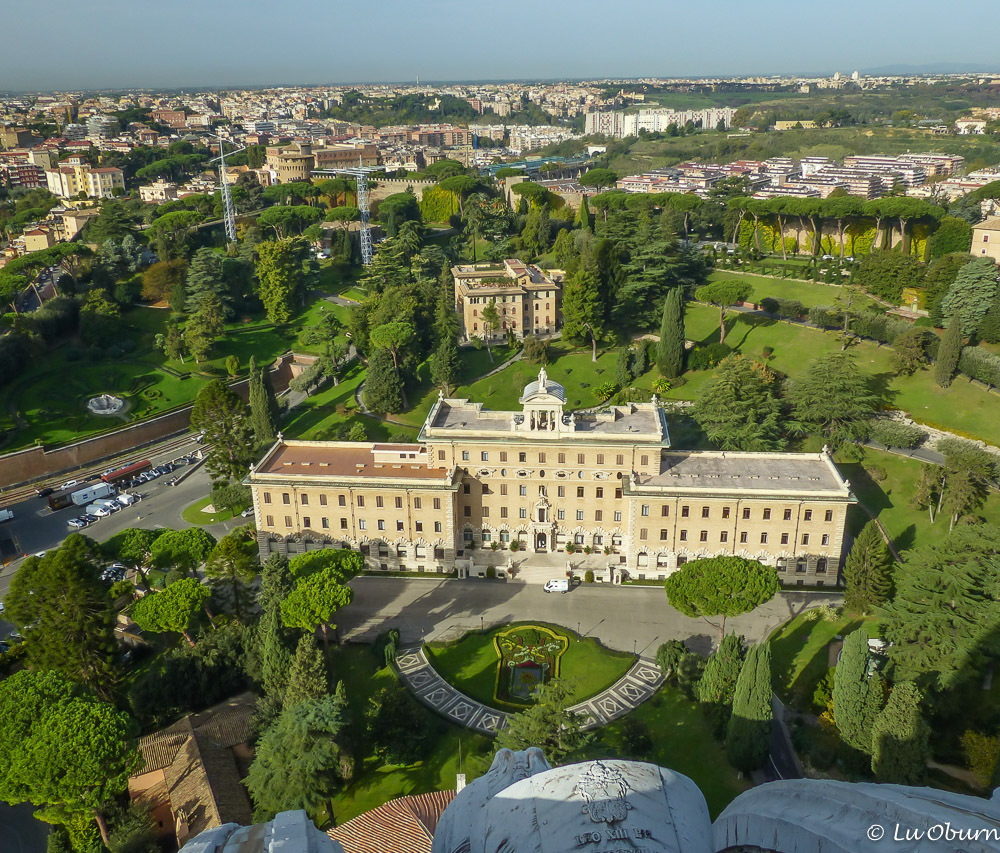
Michelangelo had a hand in designing the magnificent dome, which rises 448 feet from the floor to the top.  Terry and I decided a climb to the top was a must, all 554 steps.  Had I known beforehand that the staircase winds between the outer and inner shells of the dome I may have reconsidered.  It was a bit disconcerting to have the walls angling inward as I climbed the narrow, winding stone steps.  But the views at the top…wow!  This is the only way to catch a glimpse of the beautifully manicured gardens without a guided tour, booked several days in advance.

Vatican's manicured gardens
Vatican’s manicured gardens

The stoic mercenary Swiss Guards guard the Vatican City border crossing and are responsible for the personal safety of the pope.

Vatican Museums

A composite of several museums, the Vatican Museums contain some of the greatest artwork to be found anywhere.  Many of the statues and paintings found in the museums had the private parts of the anatomy draped in cloth or fig leaves when the church decided around 1550 that nudity was obscene.

The tapestry and map room was one of our favorites.  Workmanship dating back to the 1500’s was stunning.  And the Raphael rooms, named for the artist, with beautifully painted ceilings and walls, depict impressive scenes from ancient Rome into the Renaissance.

This slideshow requires JavaScript.

Next Up:  One final Rome post (maybe) – a little of this, a little of that