Quiet, Uncrowded Waterton Lakes National Park ~ Alberta, Canada

What started at an annual Rotary meeting between clubs in Montana and Alberta quickly blossomed into an international spirit of cooperation, a convergence of like values, celebrating the peace and goodwill between two nations with the longest globally undefended border.

Upper Waterton Lake
Upper Waterton Lake

In 1932 Waterton Lakes National Park and Glacier National Park joined together as Waterton-Glacier International Peace Park, the first of its kind.  The joint efforts of both the U.S. and Canada are reflected in their wildlife and vegetation management, search and rescue programs, and joint interpretive programs.  In 1995 Waterton-Glacier International Peace Park was designated a World Heritage Site.

In the 80+ years since, 138  international peace parks and similar protected transboundary areas have sprung up on five continents, some in the most combative corners of the globe.

Cameron Falls
Cameron Falls

While still in Glacier National Park I enrolled us for the International Peace Park Hike, an 8-mile hike along Upper Waterton Lake, which included a boat shuttle trip back from Goat Haunt.  Jointly led by a Glacier Park Ranger and Waterton Park Interpreter, this seemed the perfect way to begin our Canadian adventure.

Bright and early on a gray, cloudy day we headed for Waterton Lakes National Park, giving ourselves plenty of time, or so we thought, to purchase tickets at the marina and meet our guides at the trailhead.  Not aware of the road construction between Glacier and Waterton Lakes, the delays prevented us from arriving on time.  To placate my disappointment, Terry convinced me that a rainy, foggy day wasn’t the best time for a hike or a boat ride.  I reluctantly agreed.

Prince of Wales Hotel

We waited a couple of hours until the fog burnt off then proceeded to the same trailhead we missed earlier and hiked the Bertha Lake Trail, a 6.5-mile hike to an alpine lake.  The switchbacks seemed to never end, and at one point I remarked to Terry, “there had better be a damn fine lake and waterfall at the end of this trail”…and there was.

Bertha Falls
Bertha Falls
Bertha Lake
Bertha Lake

After a pizza/microbrew meal and a stroll around town, we decided, weather permitting, that a hike to Crypt Lake should be on the agenda for the next day.  It is rated by National Geographic as “one of the world’s most thrilling trails”.  Sadly it was a wash-out as the rains moved in and stayed for the day.  Nonetheless, we found Waterton Lakes to be a lovely little town, and vowed to return to finish the two hikes we had on the agenda.

“Shaped by wind, fire, and water, Waterton remains for all time a place of spectacular beauty, a Canadian legacy of mountains, lakes, prairies, forests, alpine meadows, and wildlife.”  Our visit to Canada may have gotten off to a soggy start, but an anticipated visit to friends put the sun right back into our days.

Next up:  Cochrane
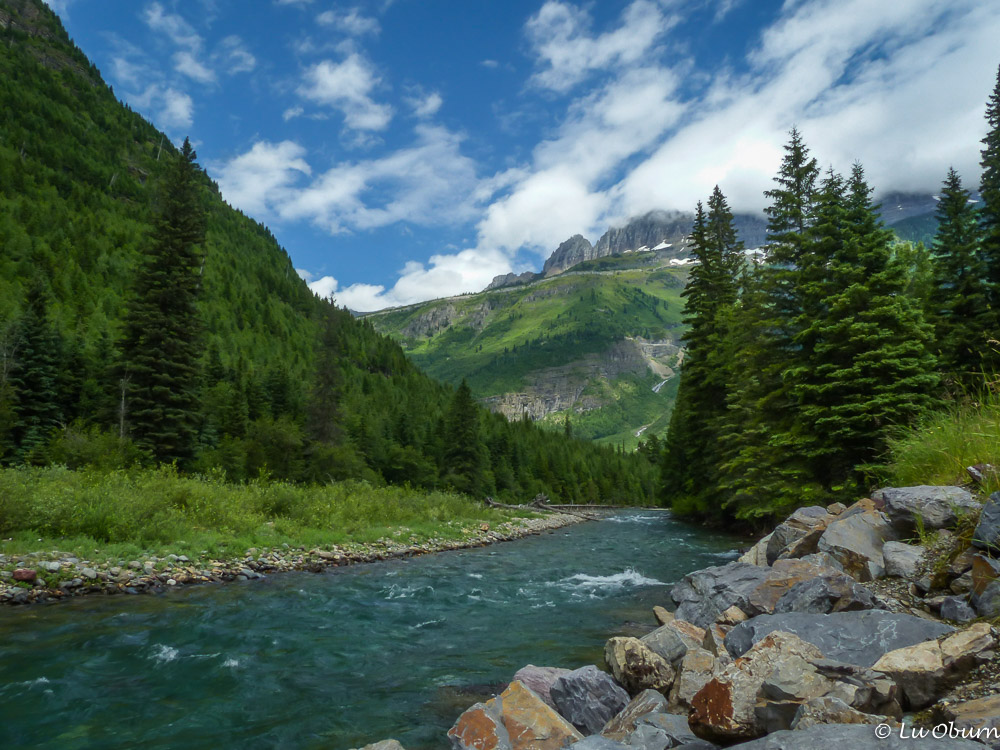
“Crown of the Continent” ~ Glacier National Park

“A man who keeps company with glaciers comes to feel tolerably insignificant by and by.”  ~  Mark Twain

Imagine what the early explorers must have felt as they pushed their way across the Great Plains and saw a wall of mountains far in the distance.  Imagine their amazement as they moved further west and those mountains loomed ever larger, peaks bathed in sunlight, surrounded by long finger-like lakes and rushing streams.  As they moved deeper into the mountains, most likely bighorn sheep and mountain goats dotted the hillsides, while osprey and eagle glided overhead.  Huge glaciers clung to the cliffs of the Continental Divide, instilling a sense of awe and wonder.  Except for the swiftly retreating glacial ice, Glacier National Park still embodies much of this same spectacular scenery.

This was our first visit to Glacier and our 29th national park to add to our slow-growing list.  We have so much more to see!  This trip was long overdue, as two previously planned visits were thwarted due to family emergencies.  Our timing certainly wasn’t the best, this being the centennial – 100 years since President Woodrow Wilson signed legislation creating the new National Park Service.  Record numbers of tourists are descending upon the parks this year and Glacier was no exception. But neither the hordes nor the rainy weather dampened our spirits.

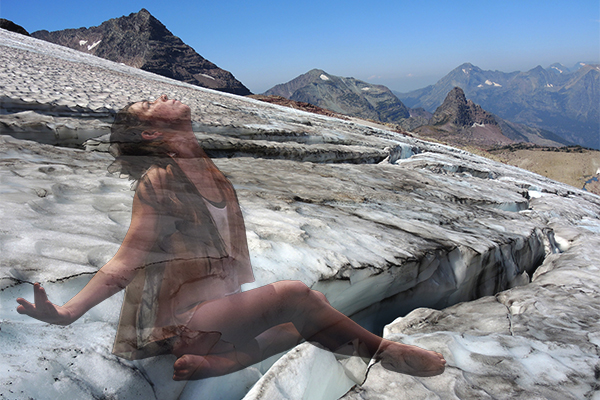
While perusing displays in a visitor center, we stumbled across some interesting and alarming statistics about the glaciers in this beautiful park.  In 1850 there were 150 glaciers; in 2010 only 25 remained. One placard we read claimed, “Current climate models suggest that all the glaciers in Glacier National Park will be gone by 2030.”  This is a powerful example of what will be lost without global action to reduce greenhouse gas emissions.

sperrydancer_web_5
“Changing Balance/Balancing Change” dancer superimposed on Sperry Glacier – photo credit nps.gov

Terry reminded me as I remarked about the high treelines on the mountains that this is yet another example of global warming.  As the treelines continue to rise, alpine areas will disappear. If this occurs, what will happen to the species that depend on them?  Certainly something to ponder.

One of the highlights of a visit to Glacier is traveling the Going-to-the-Sun Road, a 50-mile meandering road that combines both history and breathtaking scenery.  Many national parks we’ve visited have similar roads spanning their length and, while we have found all to be beautiful and unique, Glacier may take the top prize for those parks visited to date.

Plenty of time is needed to do this road justice, as the sights seem almost endless and the photo ops many.  The lush Garden Wall section will slow you down, as often there are vertical rock faces that jut out into the winding roadway, but it is a magnificent stretch of road, not to be missed.

Our top 3 picks of the park are shown below.  Granted, we didn’t see all this impressive national park has to offer, but everything we saw spoke to us.  What better way to describe such beauty than through photos.

1)  Going-to-the-Sun Road

Just a few magical moments found while “going to the sun”.

2)  Many Glacier

Situated in the northeastern corner of the park, it is often called the heart of Glacier.  It was our favorite and certainly touched our hearts.

3)  Hiking

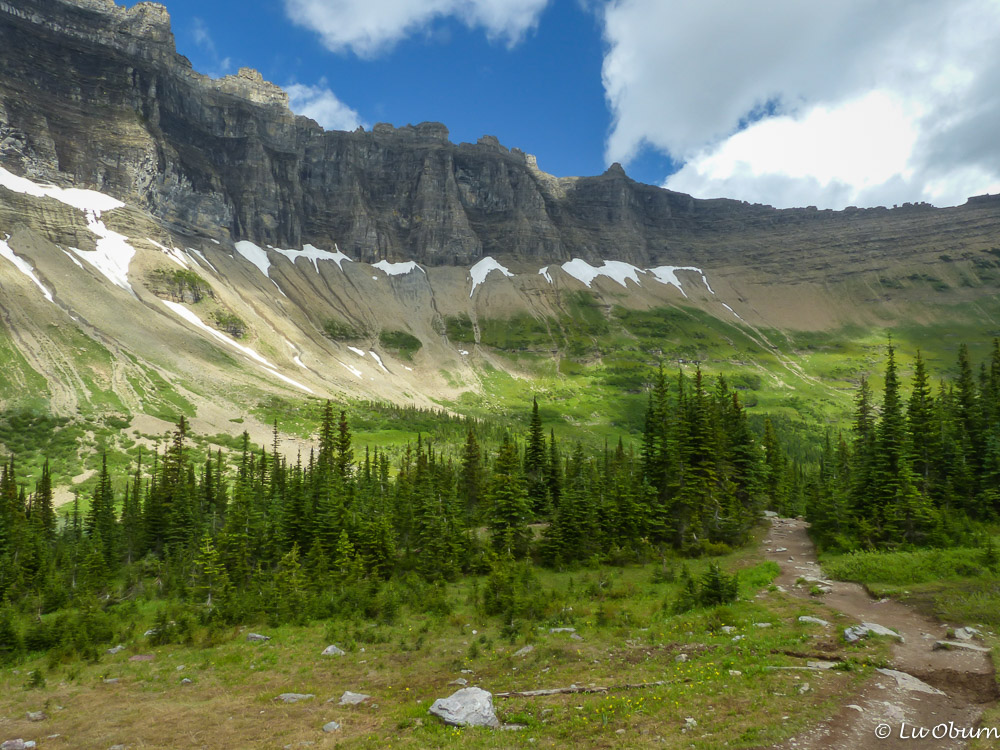
More than 700 miles of trails meander through alpine meadows and creep up mountain passes.  Iceberg Lake Trail and Ptarmigan Tunnel were given high marks by friends.  Because both originated from the same trailhead and we had some gas left in our tanks after going to Iceberg Lake, we decided to trek to Ptarmigan Tunnel.  And boy, was it a trek!  This 15-mile combo trail, with about 3000 feet of elevation gain is a not-to-be-missed hike.  Be forewarned that once you get to Ptarmigan Lake, there is a series of long, steep switchbacks to trek before you arrive at the tunnel, but it would be a sin to stop at the lake.

We had also planned to hike to Grinnell Glacier, which has significantly retreated in recent decades, but time escaped us.  The wheels are already in motion for another Glacier visit. 🙂

Next Up:  Oh Canada, here we come!

The American Alps ~ North Cascades National Park

“Wilderness is a human concept…an idea about a place and its effect on us.  It is a state of mind devoted to an experience and the contemplation of natural places.”  ~ Unknown

As we headed northeast towards our next destination, I was reminded of how we once scoffed at tourists who would pull up to the visitor center at Yellowstone NP, saying they had three or four hours to spare, so what should they see.  Although we had three or four days to tour North Cascades National Park, I was feeling like one of those tourists trying to see the highlights in such a short time.  Smoke from the many fires devastating eastern Washington had moved back our visit so our available days to enjoy this park were shrinking and now we had rain moving into the picture as well…ugh!  But we knew that if time and weather permitted only one hike, a special trek was in our future.

With her spectacular craggy peaks, sheer-walled cliffs, spires, and pinnacles, many know North Cascades National Park as the “American Alps”.   Few roads lead into the park, so much of the beauty is best seen on her 400 miles of mountain and meadow trails, which could be why she is one of the least visited National Parks, receiving only 21,000 visitors in 2013.   The North Cascades National Park Service Complex consists of the National Park, Ross Lake National Recreation Area to the east and Lake Chelan National Recreation Area to the south.  Both of the Rec Areas receive more visitors.

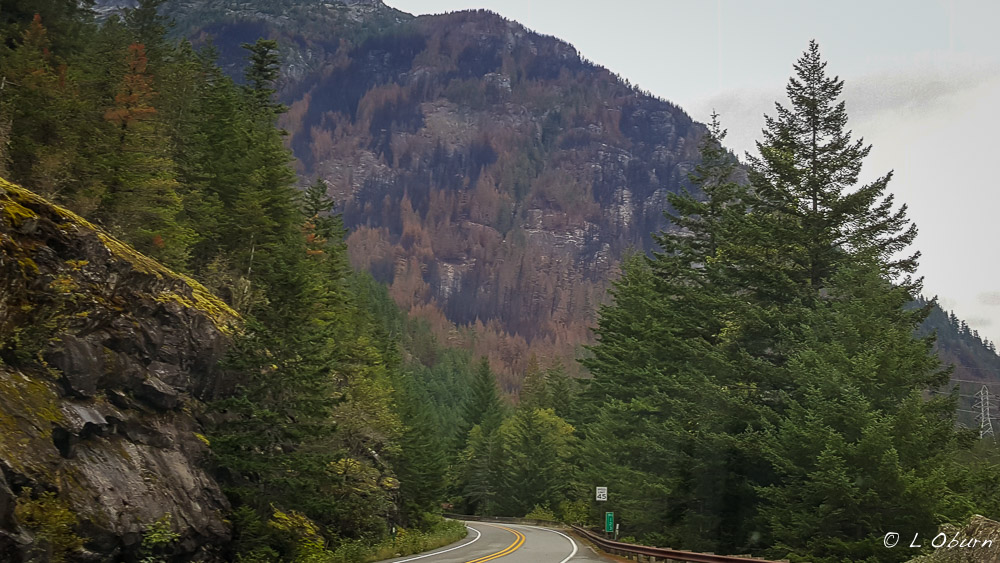
As we neared the Visitor Center we were hit with the devastation caused by one of the Washington fires.  Had it not been for the road acting as a firebreak and the actions of the brave firefighters, the Visitor Center would have been lost.

After being mesmerized by the glaciers hugging Mt. Rainier’s peaks I was anxious to lay eyes on some in this park.  I learned that the North Cascades is home to a whopping 318 moving ice masses.  More than 1/3 of all glaciers in the U.S. call this land home.  It’s no wonder the streams and creeks are crystal clear, and the rivers and lakes are beautifully colored with glacial runoff.

Although we loved our time in the San Juans, we sorely missed long mountain hikes.  A warm-up seemed to be logical before our grand adventure so I chose the 7.5-mile Diablo Lake Trail.  With not too much elevation gain, it seemed like a great precursor hike.  However, a very narrow, winding road stood between the trailhead and us so we parked further away and elected to hike the Diablo Dam Trail to our trailhead.

As we came off the final switchback, on our way back to the truck, my “finance hubby” started to add up the numbers.  It seems our warm-up hike topped off at over 10 miles and Terry is now thinking I have adopted our friend Pam’s approach to hiking.  I wouldn’t have it any other way. 😉

If I had one complaint about North Cascades National Park, this would be it.  I struggle with the many dams that have been carved out of the wild rivers and bedrock.  When the dams turned Skagit River into tamer lakes, it dramatically altered the life of the gorge, wildlife in both water and on land bearing the greatest suffering.  It is difficult to take a photo without capturing many power lines running across the frame.  I reflected on something I had read recently – “if the wilderness disappears, will the wildness remain”?

The next day the dreaded storm front arrived.  Although we basked in early autumn sun at the Lone Fir Campground, the mountains towering above us told a different tale, shrouded with gray clouds.  A road trip to Mazama was added to the agenda as we waited out the mountain storm.  This teeny little village is a cross-country skier haven, with many already taking to the roads on roller blades and poles in hand, practicing for a much-anticipated winter of groomed trails.

Unfortunately the storm refused to move on quickly so we were faced with another day of rain and cloud cover.  Although hiking in the rain is never out of the question, the cloud cover was worrisome as mountain views could be obliterated.  We opted to hang back one more day.  Another road trip took us to Diablo Lake Overlook, where many brochure photos I had seen were taken, as well as Washington Pass, a must-see in our opinion for gorgeous mountain peak views.  Winthrop, a quaint little mountain town, became our lunch stop at the Old Schoolhouse Brewery.

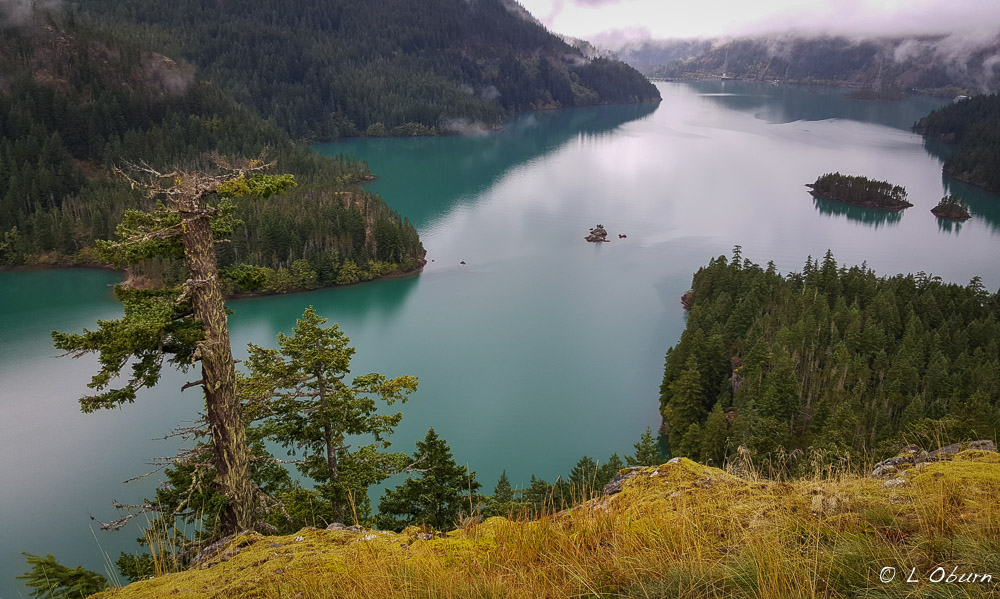
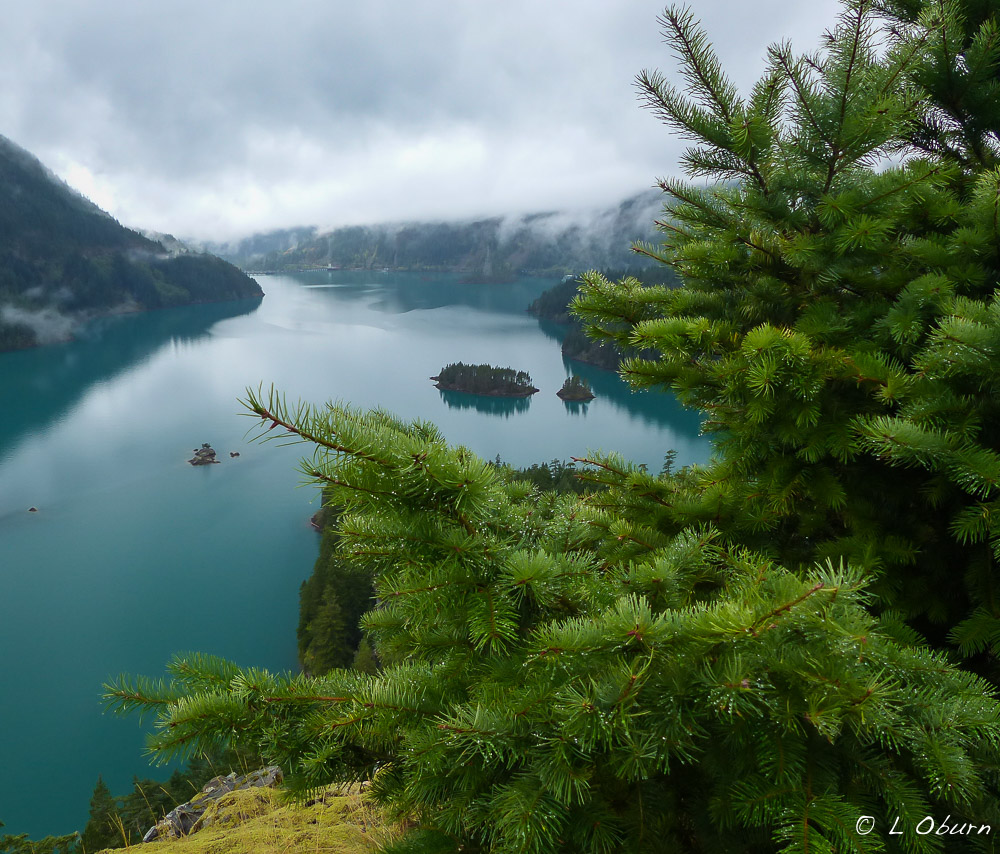
Diablo Lake Overlook
Washington Pass
Washington Pass

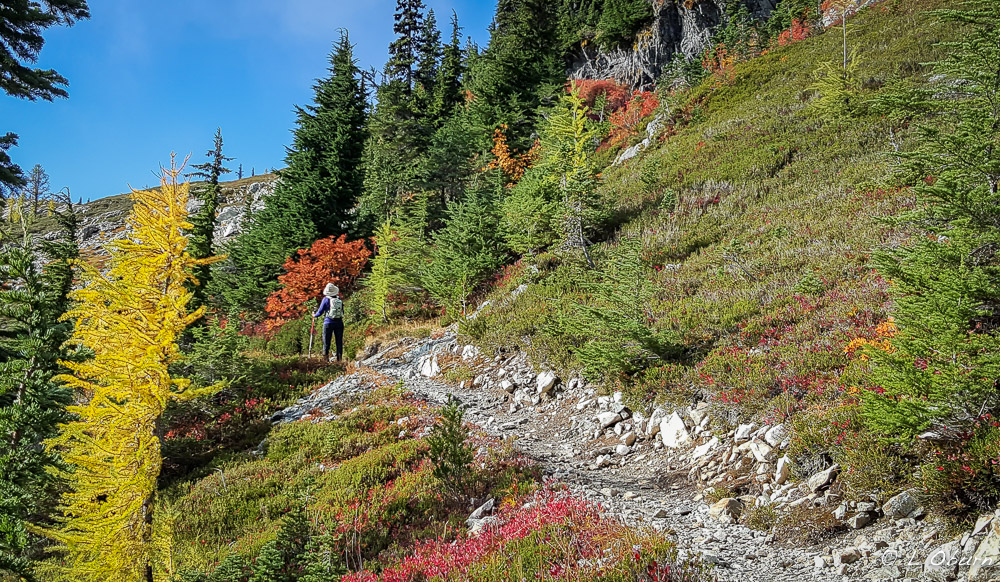
Thank goodness we woke to blue skies the next day, as our time in the North Cascades was dwindling.  We arrived at the trailhead by 8:00 am to a brisk 38º for our much-anticipated hike on the Maple Pass trail . With so few roads in the park, many of the mountain passes much be seen and traversed on foot, and Maple Pass is one of those.

If time limits you to one hike in the North Cascades Complex, this should be the one. We’d heard this from friends Jim and Gayle and had it reinforced by many since then.

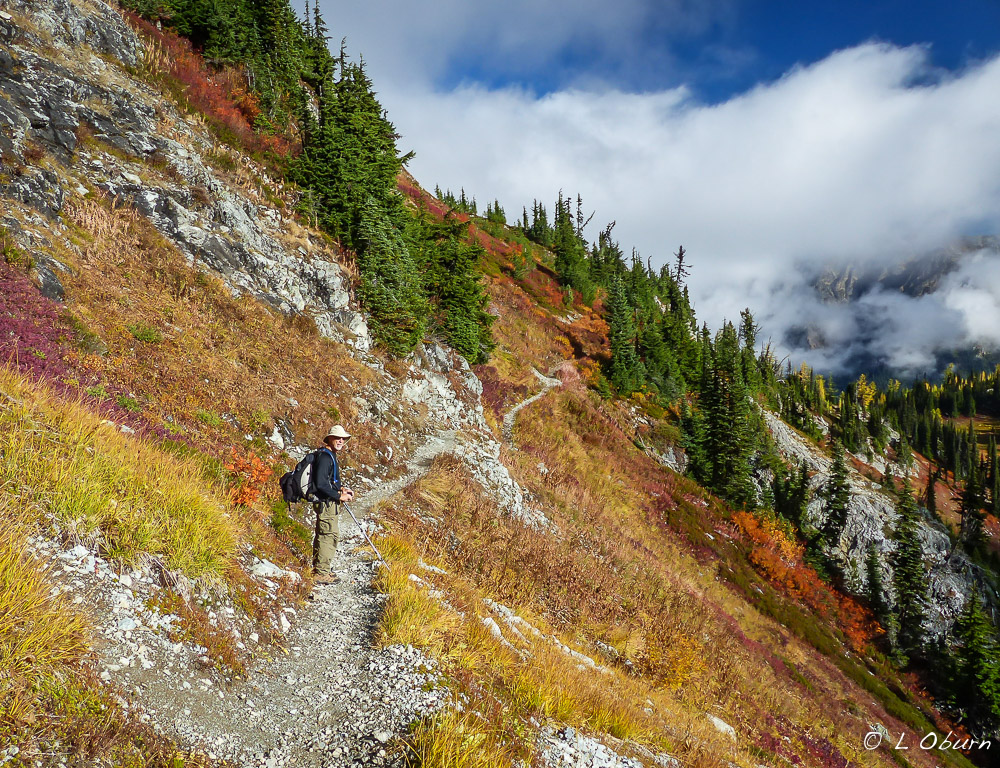
The views are drop-dead gorgeous, with low clouds draping the mountains, stunning views of glaciers from just above the pass, glacier-kissed mountain lakes, and brilliant fall colors that took my breath away.  Well, maybe the 7.5 miles and 2100’ elevation gain had a bit to do with that.

I'm in awe at the glorious vistas before me.
I’m in awe at the glorious vistas before me.
Rainy Lake
Rainy Lake
Heading back down the trail

Standing looking out over the glorious mountain peaks, I couldn’t help but feel a connectedness with the entire Universe.  What a remarkable feeling!

Next Up: Idaho Visit with Friends

Tidepools, Waterfalls, Moody Beaches ~ Olympic National Park

Olympic National Park, encompassing 1441 square miles of the Olympic Peninsula, is known as “a gift from the sea” by its native residents.  It has three distinctly different ecosystems – jagged, glacier-capped mountains, more than 70 miles of rugged Pacific coastline, and majestic stands of old-growth trees and temperate rain forest.

Although we had carved out a month to visit the Olympic Peninsula, time became elusive.  The Pacific Northwest weather can be a fickle gal so staying put awaiting a clear day can quickly find you rushing to catch up to your fleeting schedule.

Leaving South Beach on a clear, cloudless day, we hoped for a clear view of one of the more scenic beaches, Ruby Beach. Beaches on this craggy coastline have as many moods as do we, sometimes bright and clear but other times dark and brooding, laden with fog.  Our initial visit to Ruby Beach was the latter, but I so love all the many moods of these coastal beaches.  Misty, foggy days, a freshness to the wind as if it had been infused with ozone…oh my!  The light mist seemed to heighten smells, enhancing the richness of the sea air.

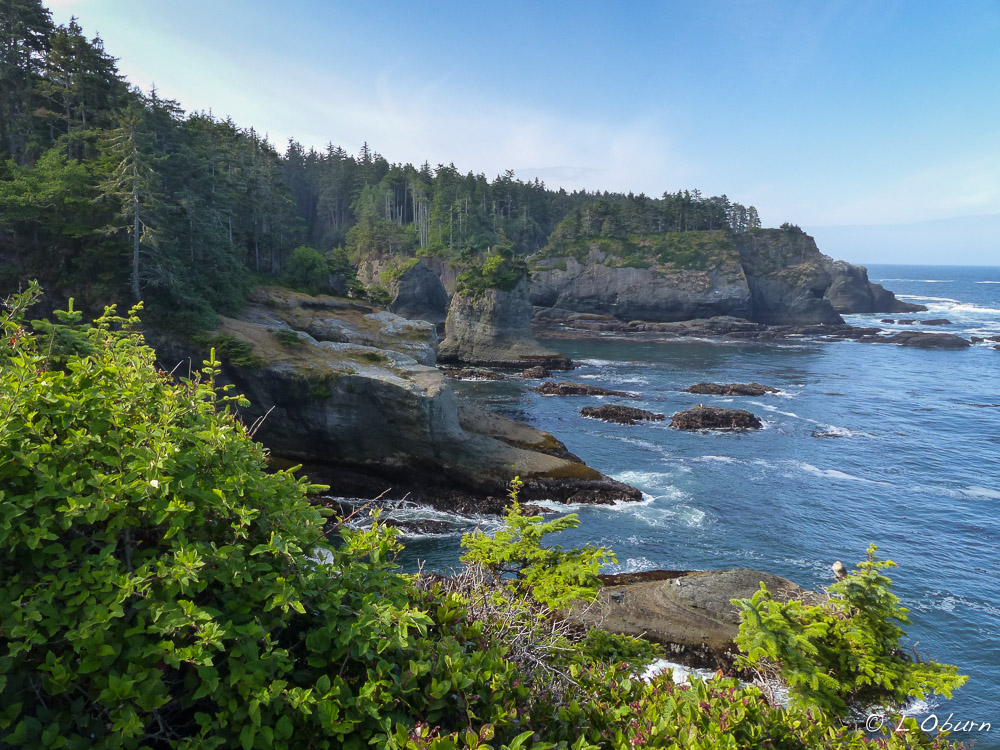
Mora Campground, just north of La Push was our next stop in Olympic NP.  Like many other national park campgrounds, unless you are packing a tent or pulling a small RV, you may want to seek camping outside the park.  We had scoped out this campground to visit Rialto Beach and hike to the sea-carved arch, Hole-in-the Wall, at low tide.  Two trips to Rialto were needed as our first attempt brought us to an invisible beach of dense fog.  Later that evening she was still a brooding beach but with enough visibility to make our way up to Hole-in-the Wall.  Low tide revealed little interesting sea life but made for a nice three-mile out-and-back walk near sunset.

Bleached driftwood strewn along the beach reminded me of prehistoric bones picked clean by the sea, enhancing the eerie feeling.

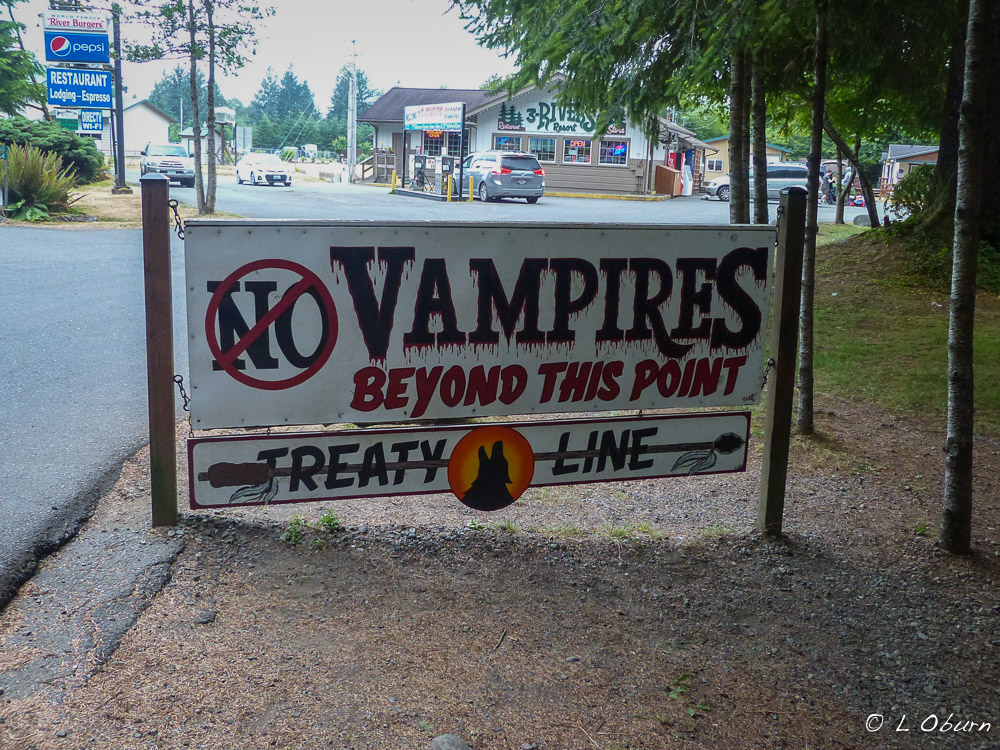
Then it was on to the mystical land of vampires and werewolves, thanks to Stephanie Meyer’s successful “Twilight” series.

This sign did the trick. No vampire or werewolf sightings in the area.

Many travel to the north Olympic Peninsula to retrace the footsteps of some of their favorite “Twilight” characters, the epicenter being Forks and La Push.   Although none of the movies were filmed in either of these small towns, tourists still flock to the area to visit sites such as the Forks High School, where Bella and Edward met, and La Push, where Bella visited her werewolf friend, Jacob.  Click here to see where the movies were filmed.

Forks is one of the region’s logging capitals and Washington’s wettest town, charting 100+ inches of rain per year.

We had read that Second and Third Beaches were both great for tide pooling. As our time was short we chose one, Second Beach, and hit the jackpot at low tide. The area was bursting with ochre sea stars, green sea anemones, and aggregating anemones.

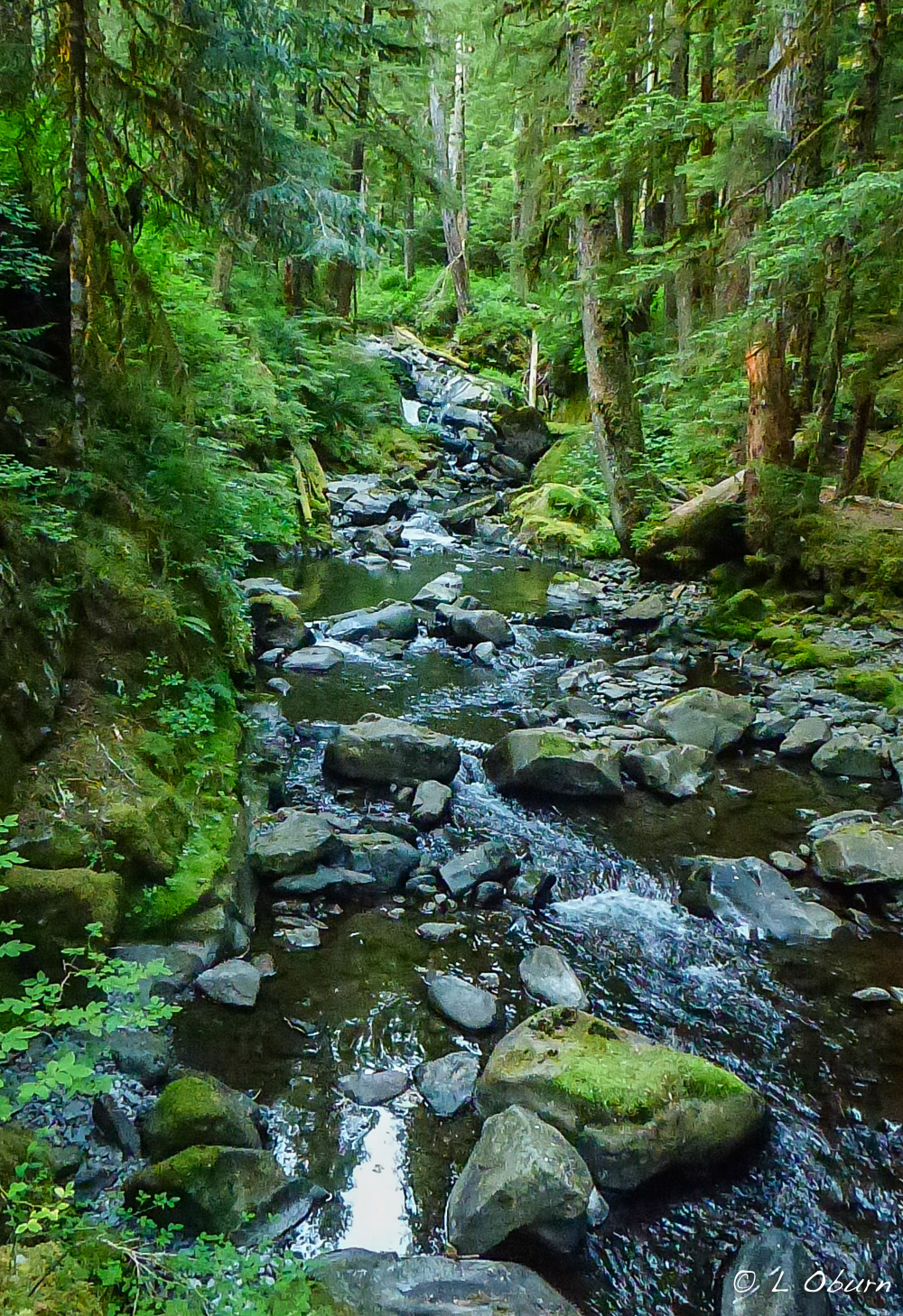
Stepping away from the coast for a few days, we moved east to Sol Duc Hot Springs Campground, where we hiked the six-mile Sol Duc Falls/Lovers’ Lane Loop. The Sol Duc Falls is a segmented waterfall, quite the stunner, and the old-growth forest we hiked was lush.  The Sol Duc River that meanders through the forest serves as a key waterway for coho and chinook salmon.  It is one of the few places where salmon run in every season.  This area is also home to the Sol Duc Hot Springs, which has an interesting Native American legend tied to it.  You can read all about it here.

This forest, like others, had a smell reminiscent of cotton candy, transporting me back to my childhood. Images of sticky smiles, colored pink and blue, danced before me as I dodged tree roots in the path, while the smell of spun sugar teased my memory.

Smoke-filled Lake Crescent

After one night in Sol Duc Valley we were on the move again, stopping at Fairholme Campground on Lake Crescent.  This lovely lake is known for its brilliant teal-colored waters and extraordinary clarity, due to a lack of nitrogen in the lake that inhibits algae growth.  Instruments have recorded depths in excess of 1000′, although many records reflect a maximum depth of 625′ in this glacially carved lake.

Kayaking was on the agenda but two fires nearby caused smoke to settle over the lake.  Biking the Spruce Railroad Trail made the list instead for a nice 15-mile bike ride.

We then took to the forest and hiked 2 miles to little Marymere Falls, where a side trail ended at Historic Lake Crescent Lodge.  We both agreed this would be a great place to come back and stay.

This rounded out week two of our enchanting time in Olympic National Park.  It was time to  get back to civilization.

Land of Diversity ~ Olympic Peninsula, Washington

Snow-capped mountains, temperate rain forests, fog-shrouded beaches, and wild coastline – this is the Olympic Peninsula.

Over 3600 square miles of land in western Washington, largely unmapped until 1898, encompass the Olympic Peninsula.  Although not an island, it is technically bordered by water on all sides: to the north, the Strait of Juan de Fuca, or the Salish Sea as it is known by the locals, separates the US from Canada; on the east the Puget Sound extends nearly 100 miles; the vast Pacific Ocean crashes into the rugged west coastline, creating dramatic tree-topped sea stacks; and the only fresh water barrier is the Chehalis River on the south.

The Olympic mountain range dominates the center of the peninsula, the second largest range in Washington behind the Cascades.  This is not a tall mountain range, Mt. Olympus being the tallest at just under 8,000’, but can still boast about 266 glaciers crowning their peaks.  The most prominent of these glaciers, eight of them, cover 10 square miles of slopes on Mt. Olympus.

The Olympic peninsula contains many salmon-bearing rivers, several natural lakes, many state parks, and one national park, Olympic, where we focused our explorations.

The Wild Olympics Campaign is underway to protect additional wilderness areas within the peninsula, protect salmon under the Wild and Scenic River Act, and provide Olympic National Park a way to acquire additional land near the park from willing sellers.

Olympic National Park protects one of the largest stretches of wilderness coastline in the lower 48 states, over 70 miles.  Rough seas have resulted in treacherous shoreline, no doubt helping to preserve this remote and pristine coast.  Eight American Indian tribes continue to call small fishing villages along this coastline home, working to keep their ancestral traditions alive.  Today the coast appears much as it did when their ancestors paddled cedar canoes past rocky coves and beaches.

Even today severe weather and currents have doomed many a ship that has challenged this remorseless shoreline.  Lives have been lost and thousands of gallons of spilled oil have devastated immaculate beaches, killing sea birds and disrupting delicate ecosystems.

We planned a month here to soak in the beauty of the national park and surrounded headland, absorbing as much history of the area as possible, with the added bonus of meeting several sets of friends along the way.

Our first week on the coast proved to be a laid back time.  With a holiday and the potential for crazy busy campgrounds, we booked a reservation at Kalaloch Campground in Olympic National Park, ensuring we had a place to call home for the 4th holiday.  Although our Arctic Fox is small in stature, our campsite was an unlevel tight fit.  Adjacent sites were close together as well, but we were happy to be here so quickly set up and headed to the beach to walk in the fog and shake off some road dust.

Terry being enveloped by the fog

When we returned to camp our neighbor had his rap music cranked up and felt the need to berate his wife and children in front of the rest of the campground.  Surprisingly the kids were much better behaved.  As this continued throughout the day we made it our mission the next morning to find a suitable campground for the holiday weekend. South Beach was our answer.  Though nothing more than a gravel parking lot, we had a beachfront site where we enjoyed brisk ocean breezes, long walks on fog-shrouded beaches, lovely sunsets, and easy access to day trips.

We explored the Lake Quinault area, where the 1926 historic Lake Quinault Lodge stands.  This area is often called the Valley of the Rain Forest Giants, being home to some of the largest and most impressive trees, such as the largest Sitka spruce tree in the world (how do they know this?).

We had read much about the Hoh River Rain Forest, which is purported to be one of the best examples of a temperate rain forest in the world, so this became another of our scheduled day treks.  We hiked the Hoh River Trail, winding through a forest of spike moss-laden trees.  It doesn’t harm the trees but can weigh as much as four times that of the trees own foliage.  We both agreed that this rain forest looked very dry, likely the result of this year’s drought.

Beyond this we were content to walk miles of driftwood-strewn beaches for the week and our fireworks were compliments of Mother Nature. 🙂

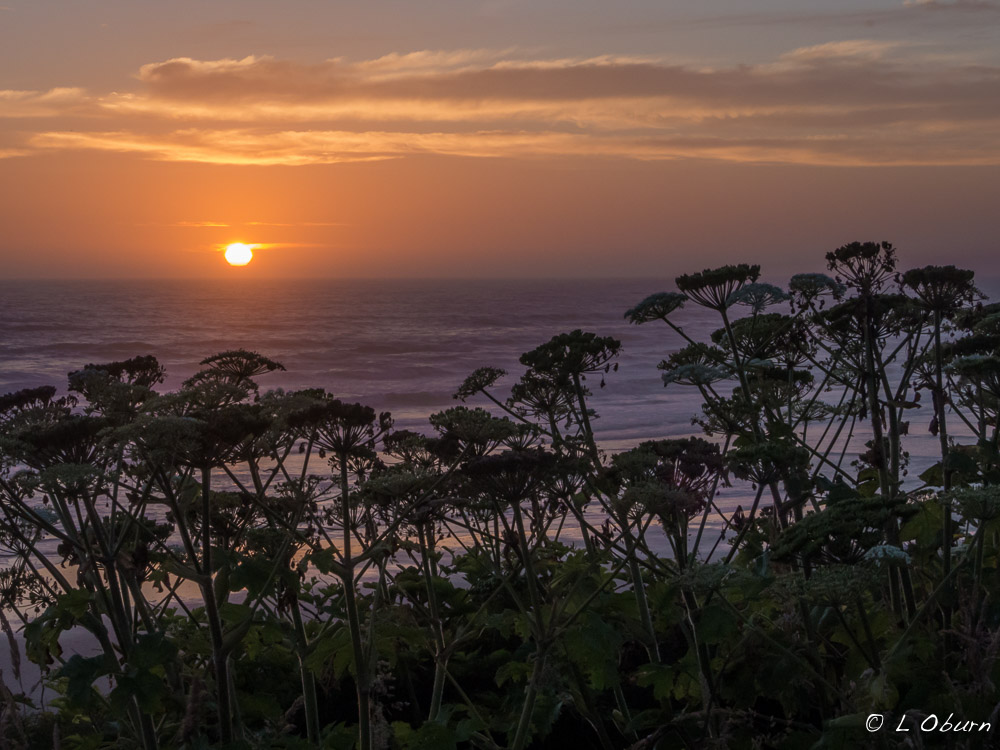
This was our fireworks display on the 4th, at South Beach.

Next Up:  Moody beaches and tide pools