Penguins, Parks, & Ports ~ Punta Arenas, Chile

04 March – 07 March, 2018

Patagonia’s largest city and the regional capital, Punta Arenas, can be approached by air, a long bus ride, or sea. We opted for the 3.5 hour flight from Santiago on Sky Airline. From the air we got a peek into what was in our future – glaciers and brilliant turquoise lakes.

Although the magnificent granite needles of the Torres del Paine put Chile’s most southerly region on the international map, today many tourists come to this city on the Strait of Magellan to see penguins in all shapes and sizes, or continue to Ushuaia and Antarctica. Our original intent was to head to Ushuaia, the southernmost city in South America, but our plans changed as we continued to fill in the empty spaces on our travel calendar. “Can’t see it all” became our mantra as we narrowed the scope of our trip, so instead we settled for the southerly most city in Chile, Punta Arenas. This industrial city relies on fishing, shipping, petroleum, duty-free retail, and tourism for its continued economic health. Our intent was to take a tour to Isla Magdalena to see the delightful burrowing Magellanic penguins and visit the Chilean sector of Tierra del Fuego National Park, to see the majestic King penguins.

After a short taxi ride to our hostel, we tossed our bags into our room and took to the streets for a short walk along the water.

Bronze and stone statue along the waterfront

Day 1 Punta Arenas

The next day before dawn we set off for the office of Solo Expediciones, where we began our tour that took us to Isla Magdalena and Isla Marta. We chose this tour company because of the size of their fleet and their ability to get closer to the sea lions that live on Isla Marta.

Jonathan was our wonderful guide as we boarded the Isla Isabel speedboat and traveled across the choppy channel to Isla MagdalenaHe gave us some history on the burrowing Magellanic penguins that we would spend the next hour with, explaining that 80% of them had begun their migration north about 30 days ago and almost all of the chicks had left. There were still plenty to see and a welcoming committee to greet us as we docked. This year they had ~ 44,000 pairs of penguins on the island and we were able to find one fluffy chick that remained behind with mom and dad.
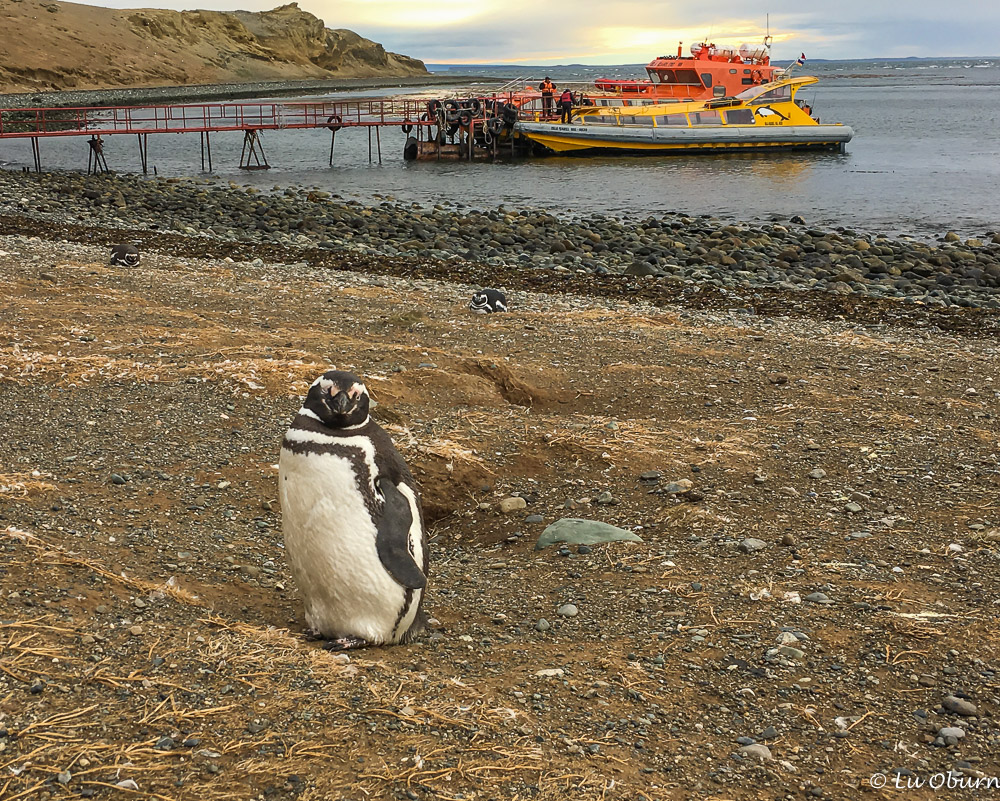
The welcoming committee!

This slideshow requires JavaScript.

Our time had ended and we were back on the boat to hopefully get close to Isla Marta, in search of sea lions. Weather allowed our approach and we climbed to the outside bow of the boat for some photo ops.

Day 2 Punta Arenas

Rainy day in Punta Arenas allowed us time to explore, book our tour for the next day, and enjoy some of the local fare. La Marmita Restaurante was highly recommended and was so wonderful that we dined there twice. Braised lamb in red wine, guanaco, sweet corn pie, local greens, and figs stuffed with nuts and a spun-sugar crown dazzled our palates.

Day 3 Punta Arenas

A recommendation from Alison of Adventures in Wonderland led us to Turismo Laguna Azulwhere we booked our much-anticipated King penguin tour. Another early morning for us and what would prove to be a late night brought us to our first national park in the country, Tierra del Fuego National ParkA large island off the southern coast of South America houses what is one of only three King penguin colonies outside of Antarctica, or so we were told by our colorful guide Diego. As a side note, when I asked our guide Diego where he would visit in the United States if he could, his response was “Burning Man”, which is an annual gathering in northwest Nevada. It is described as an “annual experiment in temporary community dedicated to radical self-expression and self-reliance”. 🙂
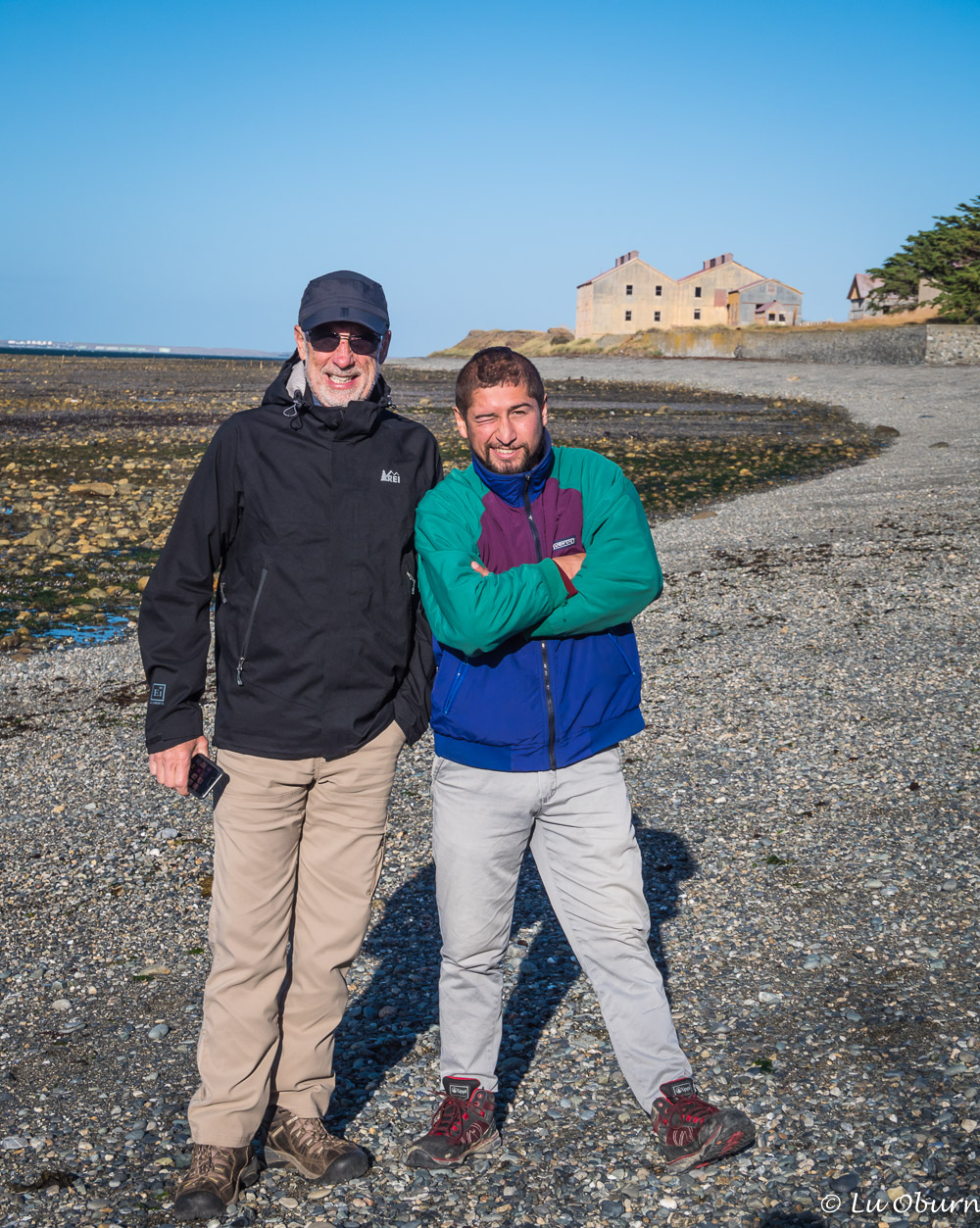
Terry & Diego

You really have to want to see King penguins to do this tour, unless you love crazy-long days (7:30 am – 10:30 pm) traveling across wind-swept steppes, on gravel roads strewn with potholes, in close quarters with 12-15 of your newest best friends, and on crowded ferries. Yes, we wanted to see them that much, even though our time with the penguins was for only an hour of this day. Would we do it again? Heck yes!

The colony of King penguins we saw had established themselves at Estancia San Clemente on Bahía Inúit (Useless Bay) and have made their annual pilgrimage for the past 11 years. This colony consists of ~ 150 penguins, although we weren’t sure just how many we were viewing from our secure platform across the inlet. Besides the majesty of these wild creatures, the sound they exhale as they throw back their heads to sing is eerie and beautiful all at once, an odd-pitched whirring clamor. We were in awe.

A short stop in the port town of Porvenir rounded out our day. Although it looked like an interesting little borough, we had little time to visit the small museum and grab dinner before we had to leave for the ferry. One of our German travel mates almost caused us to miss the boat as he disappeared and couldn’t be found until minutes before it was time for the ferry to depart. He was not the most popular guy on the shuttle after his disappearing act. 😉

Next Up: Time to Hike in Torres de Paine National Park
SaveSave

SaveSave

SaveSave

SaveSaveSaveSave

SaveSave

SaveSave

SaveSave

SaveSave

SaveSaveSaveSave

SaveSave

SaveSave

SaveSave

SaveSave

SaveSave

SaveSaveSaveSave

SaveSave

SaveSave

SaveSave

SaveSaveSaveSave

SaveSave

SaveSave

SaveSave

SaveSaveSaveSave

SaveSaveSaveSave

SaveSave

SaveSave

SaveSave

SaveSave

SaveSave

SaveSave

SaveSave

SaveSave

SaveSave

SaveSave

Tapping into Native Roots

Although “native roots” may conjure up thoughts of the medicinal plant cannabis, that is not what this post is about. Sorry guys, but many of you probably already have your sources and could teach me a thing, or two, or three about that ancient plant. What this post is about is learning to use the native plants we have all around us, for medicine. Since this is one of my many passions, it was not surprising to hubby that I asked (ok, maybe begged a bit) the Campus Manager at Yellowstone Forever to allow me to support this field seminar. My charms won out as he graciously agreed. 😉

Linda Black Elk

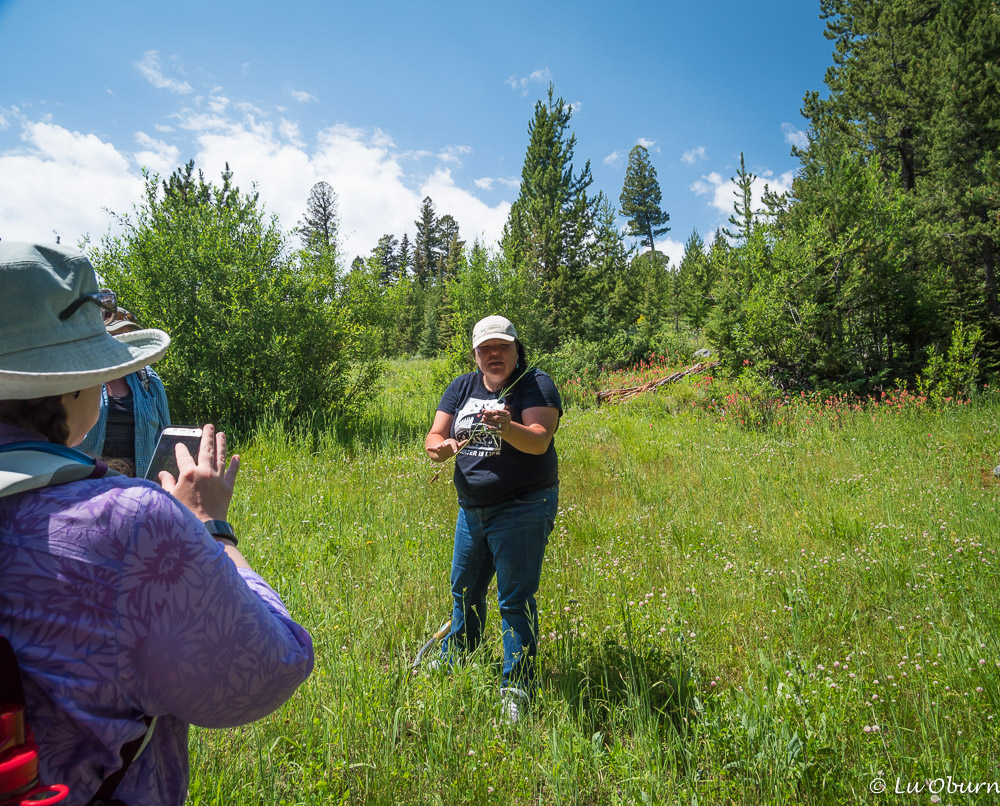
I was so honored to be a part of this course, led by Linda Black Elk, PhD and Ethnobotanist. Linda is part of the Catawba Nation and is married to Lakota native, Luke Black Elk, who has an illustrious family history – activist mother and revered grandfather, Chief Black Elk.  Side note:  Black Elk Speaks is a great read.

Hubby supported Luke’s course on Lakota Creation Stories immediately after the Native Plants class. Sadly no amount of begging or bribing has convinced him to write a guest post about his experience, which he loved. Fortunately for me, the Native Plants and Their Uses class began with singing and praying by both Linda and Luke, in their native Lakota tongue. It brought me to tears it was so beautiful. No photos were allowed during this sacred ceremony.

Luke and Linda sharing stories around the campfire.

Our Native Plants’ course consisted of indigenous stories (many were heartbreaking), identifying and learning the beneficial uses of local plants, foraging for specific plants, and bringing our bounty back to the Lamar Buffalo Ranch to make balms, salves, and elixirs. Seeing what I do at home, making so many of my own products, hubby said he couldn’t imagine a more perfect course for me to support. I had to admit that it was very special and completely in line with my belief system.

Classroom time after some foraging.

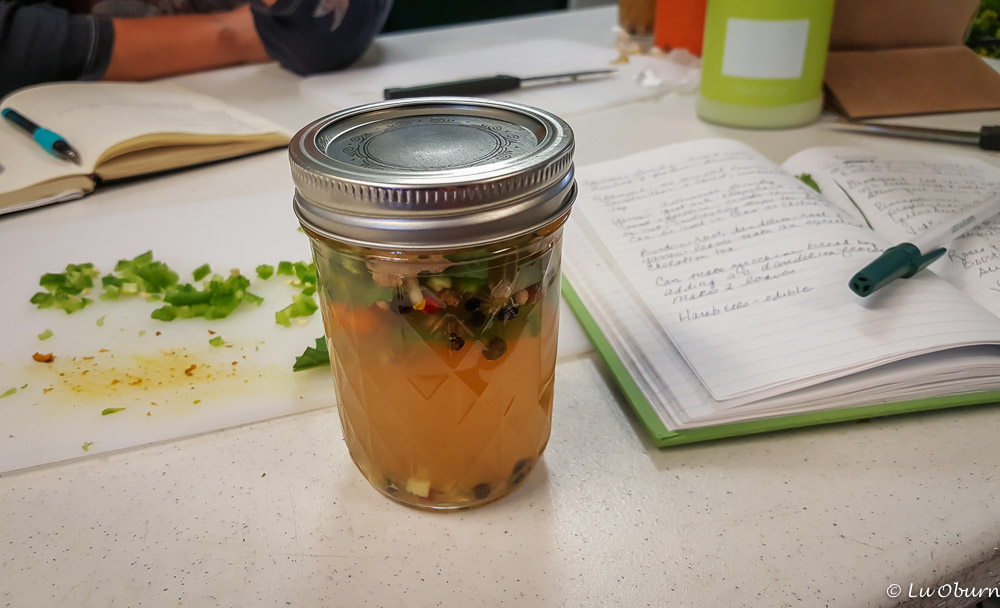
Since removing anything from a national park is strictly forbidden, our foraging for two days took us outside the park, where we strolled through forest lands for several hours, as Linda educated us on the medicinal properties of the many plants we found along the way. We harvested fireweed, sticky geranium, and yarrow, to be used later in the making of balms and salves, as well as wild onion and garlic for fire cider.

Salve in the making

There is something so comforting about walking in nature, harvesting plants that have been on this earth since ancient times, providing countless generations of people food and medicines. I’ve been told a time or two that I am an old soul and being in this environment, feeling such a strong connection to the past, I feel that may be true.

I loved this course and would highly recommend it for anyone interested in creating their own elixirs, salves and balms or want to learn more about native customs. Check out Yellowstone Forever for this and other great field seminars here.

Linda Black Elk and her husband Luke are a fantastic couple, armed with a wealth of indigenous history they are anxious to share.  It was a humbling experience to be in their presence. I walked away with a notebook full of information that I am happy to share if anyone is interested.

Since cold and flu season is upon us, here are a couple of recipes that might be of interest, because it’s all about keeping it natural (at least for me):

Elderberry Elixir

Ingredients:

  • 1 c. dried elderberries (I purchase mine from Mountain Rose Herbs.)
  • 1 star anise
  • 1 cinnamon stick
  • 3 cloves
  • one good-sized piece of ginger (~4 slices)
  • 4 c. good quality water
  • 1-2 c. raw honey

Add all ingredients except honey to heavy-bottom pan. Bring to boil, then reduce to simmer. Cook down liquid to 1/2. Add honey at end, after pan removed from heat. Keep in the fridge so elixir doesn’t ferment. Lasts a long time.

 NOTE: Powerful anti-viral & anti-bacterial agent. Great for treating colds.

Fire Cider

Ingredients:

  • 1 onion, diced
  • 1 head garlic, cloves separated & minced
  • 3/4 c. horseradish root, finely diced
  • 1 (6″) piece of ginger, diced
  • 1 (6″) piece of turmeric root, diced
  • 2-3 T. peppercorns
  • Chilies, sliced – add according to your heat preference. One large jalapeño might be a good start.
  • Unfiltered, raw apple cider vinegar

Pack all ingredients besides vinegar in 2-quart jar. Add enough vinegar to fill the jar.

Let fire cider steep for 3-4 weeks on your countertop. Shake periodically.

Strain the vinegar into a clean jar & store in fridge, where cider will keep for up to 12 months.

Enjoy a shot of this daily. Honey can be added for a little sweetness. Be forewarned, this one packs a bit of a punch! 😮

NOTE: This can be used as an expectorant and is a great tonic for sore throats. Great for those with high blood pressure and is also good for the heart.

Disclaimer:  The views expressed here are my own and those of the instructor and do not necessarily represent the views of Yellowstone Forever.  

SaveSave

SaveSave

SaveSave

SaveSave

SaveSave

Artistry Forged by Fire and Ice ~ Yellowstone Forever Field Seminar Series, Part II

“There are two kinds of truths:  the truth that lights the way and the truth that warms the heart.  The first of these is science, and the second is art.  Neither is independent of the other or more important than the other….The truth of art keeps science from becoming inhuman, and the truth of science keeps art from becoming ridiculous.”  ~  Raymond Thornton Chandler

Day 2 of the Yellowstone Forever Field Seminar “Observing Thermal Biology and Geology” took us to Mammoth Hot Springs, where art and the world of science collide.  Brace yourself for another geology lesson. 🙂

The geology at Mammoth Hot Springs, aka Mammoth Terraces, is older than that at Norris Geyser Basin, and without the “rotten egg” smell of hydrogen sulfide found in many of the thermal features throughout the park. Non-existent at Norris, limestone, a soft sedimentary rock with a high calcite mineral content, is found in abundance near Mammoth Hot Springs.  It is soluble in water and weak acid solution, dissolving into calcium carbonate, also known as travertine.  And it is travertine that has molded Mammoth Hot Springs in a big way.

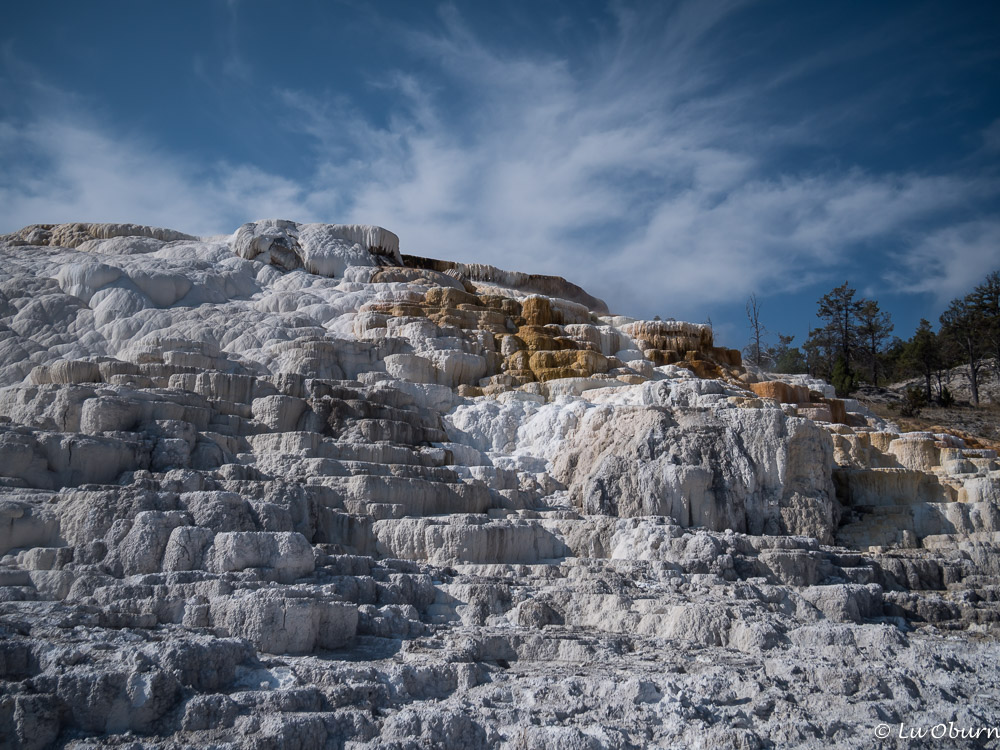
Mammoth Hot Springs Terraces

Travertine is deposited here at the Mammoth Terraces faster than anywhere else on earth, at a rate of 5 mm per day or 7 feet per year.  Mammoth Hot Springs today would have looked far different to those early visitors to the park who actually climbed onto the Terraces to soak in these waters, seeking relief for their physical ailments.  In fact, travertine is being deposited at such a rapid rate that unstable rock formations have been created that often collapse under their own weight.  It is not surprising that no one is allowed onto these Terraces anymore.

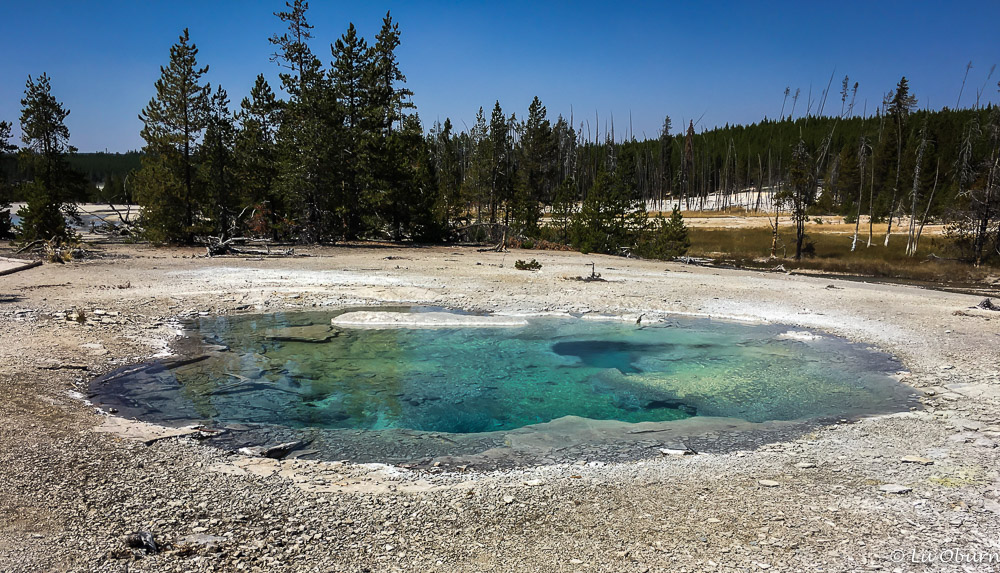
As our class stood looking out over Palette Springs, found at the Mammoth Terraces, we were asked to describe what we were looking at.  I couldn’t help but feel like I had stepped onto another planet.  Almost devoid of trees, except for those left standing as ancient silent sentinels, this sculpted, terraced alabaster mountain loomed over me, capped by a dazzling cerulean sky.  Water cascaded over the edges in rivulets, and a patchwork of orange, gold, and green graced the sides and base, thanks to the work of a myriad of microbes.

Palette Springs at Mammoth Terraces. The large egg-shaped boulder on the left is Devil’s Thumb.

As at Norris Geyser Basin, microbes have created these intriguing formations.  This is how cellular life began on our planet, with microbes swimming in hot spring environments.  I have read that roughly 60% of all life on our planet is microbial, most buried deep below the soil we walk on.

Bruce Fouke, geobiologist who recently authored the book “The Art of Yellowstone Science – Mammoth Hot Springs as a Window on the Universe”, along with the help of professional photographer Tom Murphy, believes that it takes the blending of art and science to unravel the mysteries of hydrothermal features such as Mammoth Hot Springs.

Canary Springs majestically stands above the Mammoth Upper Terraces.  The white and gray travertine are older deposits.

He has said that “the water temperature, chemistry and flow at Mammoth are similar to that found on the early Earth, and the hot springs still harbor microbial life that evolved billions of years ago.”  And he should know, as he has studied this park since 1996, doing research for NASA and now through his own foundation.  He had the good fortune to meet Tom Murphy in 2008, whose photographic passion since 1975 has been in telling Yellowstone’s story in breathtaking images.  And I was fortunate to meet Tom Murphy and attend a slideshow presentation of his work several years ago, as well as listen to Bruce Fouke speak this past summer on his studies at Mammoth Hot Springs.  As volunteers we were given a copy of his new book, which I am in the process of finishing…a fascinating read.

“Daily it is forced home on the mind of the geologist that nothing, not even the wind that blows, is so unstable as the level of the crust of this Earth.”  ~  Charles Darwin

There are several boardwalks surrounding both the upper and lower Terraces.  As we wandered those walkways during our class, Joshua broke down the creation of these terraces, what we were seeing above ground, and what was most likely occurring below the surface as well.  To say he bolstered the elasticity of my brain matter these two days was an understatement. 🙂

Our fearless leader Joshua challenged us to participate in active observation.

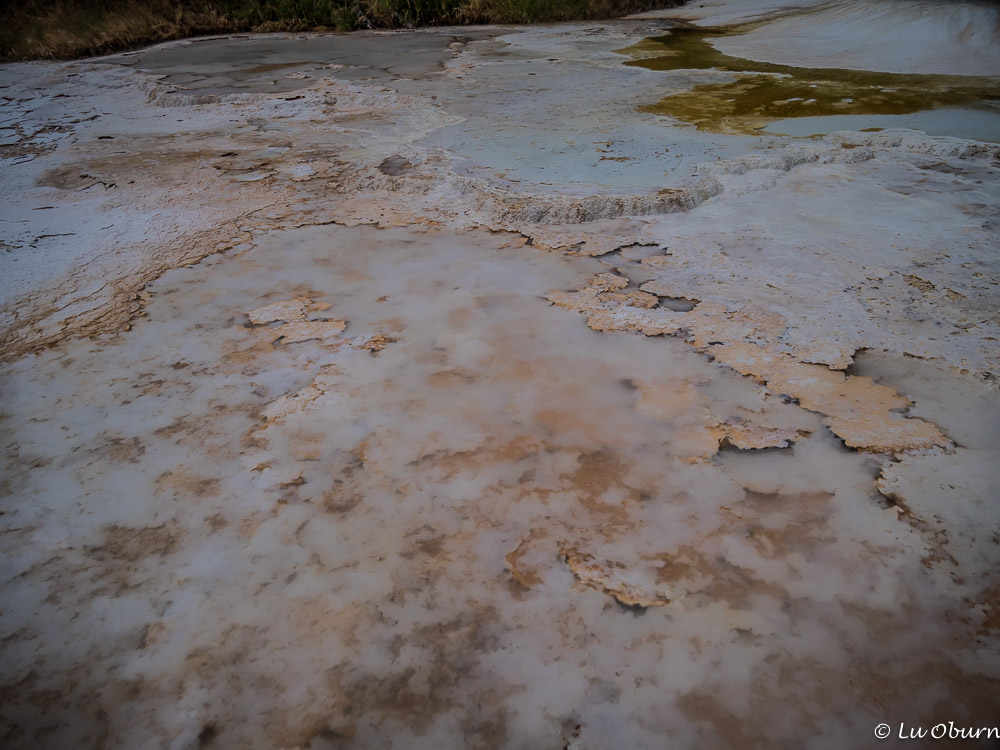
When we arrived at the Upper Terraces at Mammoth Hot Springs, our naturalist assignment was made clear to us – find a pattern in color or structure and attempt to determine the microorganism involved and why the area we selected looks unlike others around it.  Huh?

This is the pool I studied for my assignment. The milky substance that floats upon the surface, then later sinks, is calcite ice.

Armed with an infrared thermometer gun, pH strips, a book identifying the characteristics of specific microbes, and a journal, we went to work. Suffice to say, this assignment challenged me, but it was a great exercise in looking beyond the surface and making observations, something we often don’t take the time to do.  And, I passed the class!

If you love the national parks and would love to learn more, check out the Yellowstone Forever Field Seminar catalog. There is something for everyone who has a passion for the natural world.

Disclaimer:  The views expressed here are my own and do not necessarily represent the views of Yellowstone Forever.  

“Humanity’s quest for a sustainable existence will define our present and future place in the universe.  The art and science of Mammoth Hot Springs provides an unexpectedly insightful vantage point from which to envision this future.”  ~ Bruce W. Fouke & Tom Murphy

SaveSave

SaveSave

SaveSave

SaveSave

SaveSave

SaveSave

SaveSave

SaveSave

SaveSave

SaveSave

SaveSave

SaveSave

SaveSave

SaveSave

SaveSave

SaveSave

Artistry Forged by Fire and Ice ~ Yellowstone Forever Field Seminar Series, Part 1

I have said time and again that this past summer was stimulating and educational for us, but I know as a blogger that my passions may not match yours so if geology isn’t your thing, feel free to look at the pretty pictures instead.  I say this as someone who gave geology a mere passing nod until I supported a couple of naturalist courses on the subject.  Now I am spellbound and will never look at Yellowstone the same, nor anywhere else for that matter, where geologic forces come together to create majestic peaks, valleys, and canyons.

I can’t say which of the Yellowstone Forever field seminars I supported was my favorite, but without a doubt I can say that the instructor who led the Thermal Biology and Geology course this summer, Joshua Theurer, is extremely bright, passionate about Yellowstone, and can hold a student’s attention like the most seasoned of instructors.  I was fully engaged in both his field seminars I supported and look forward to participating in more of his classes in the future.

Steamboat Geyser, world’s tallest active geyser, whose last major eruption occurred in Sept. 2014
Cistern Spring, which drains when Steamboat Geyser erupts. This spring grows more in one year than most do over 100 years – 1/16″.

Joshua’s “Observing Thermal Geology and Biology” course, which followed on the heels of Virginia’s “Landscape Geology” class (also wonderful), was fortuitous for me (or so I thought), giving me a leg-up, as it were…hardly. This is a complex subject, and we were required to complete an exercise before the end of the course, in order to receive credit for this naturalist class.  I could go on and on about everything I learned but instead will touch on some of the highlights, so as not to put anyone to sleep.

Imagine, if you will, the earth as an egg:

  • The outer layer of the earth, the crust, is analogous to the shell of the egg.  It is ~ 25 miles thick.  Yellowstone has a much thinner crust than average, as little as three miles thick in places.
  • The mantle, which makes up the bulk of the earth and moves in enormous convection cells, is like the egg white.  It averages about 3000 miles in thickness.
  • The core of the earth, resembling the egg yolk, is composed mostly of metals and acts as a nuclear reactor, our primary heat source.

There are about two dozen hot spots on earth, with Yellowstone being one of the largest.  The theory is that a hot spot originates at the core of the earth and doesn’t move.  The continental plates move across them.

Given the 10,000+ hydrothermal features in Yellowstone, one would assume a significant magma chamber below the park, deep in the mantle of the earth, and you would be right.  In 2011 the University of Utah’s research concluded that this chamber was at least 400 miles thick and this was all they could determine as their equipment went no further.  In 2015 they discovered a “mantle plume” of roughly 1000 miles below the original magma chamber, a reservoir 4.5 times larger than their initial discovery!  We now believe there is enough magma below Yellowstone to fill the Grand Canyon 11 times.  Although this sounds ominous, given Yellowstone is classified as a “supervolcano”, scientists don’t expect a major eruption is in the park’s near future, and feel that there would be weeks, if not months, of increased seismic activity prior to such an eruption.

Echinus Geyser, the largest acidic geyser in the world, and one of the most popular in Yellowstone.

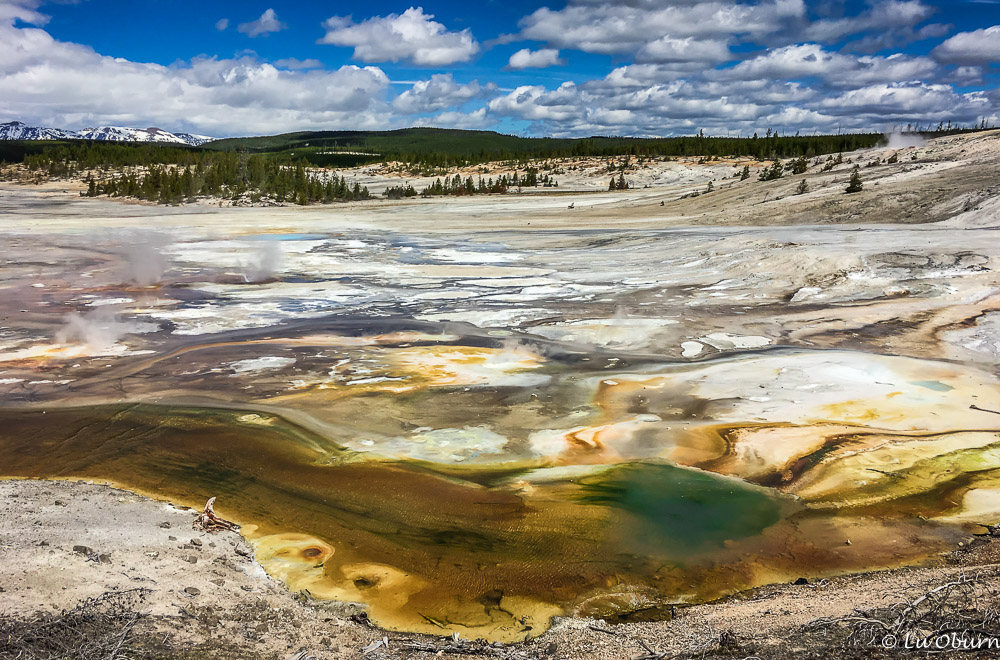
Day one our course took us to one to the hottest and most rapidly changing thermal areas in all of Yellowstone – Norris Geyser Basin.  Mechanically it functions like other geyser basins but is far more complex, due to the converging of three fault lines beneath it.

Porcelain Basin resides within Norris and was so named for the milky color of the mineral deposits found here.

There are four types of thermal features found within the park:

  1. Hot springs – most common and have no constrictions.  Water continually circulates, preventing the water from reaching a temperature needed to produce an eruption.  The deeper the blue color, the hotter the water.  Deep blue signifies temps of at least 159º F.
  2. Geyser – around 500 in the park.  These features erupt when the gas bubbles’ surface area is so great that the water is lifted outside the reservoir.
  3. Mudpot – most acidic, with a pH of 2 or less and a limited water supply.  Gases convert rock to clay.
  4. Fumarole – known as a steam vent, and is the hottest hydrothermal feature in the park.  Water is converted to steam even before it reaches the surface, and is usually announced with a loud hissing sound.  Temperatures can reach to 280º F.  Norris’ hillsides are dotted with these steam vents.

Hot springs, geysers, and fumaroles can be found within the Norris Geyser Basin.  I am not aware of any mudpots within Norris, but some can be found just a few miles south at Artists’ Paintpots.  The varying colors found within these thermal features are due to special microbes, called thermophiles, that make their home here, and the off-putting smell (think rotten eggs) is due to the elevated levels of sulfuric acid and hydrogen sulfide gas found in the thermal features.

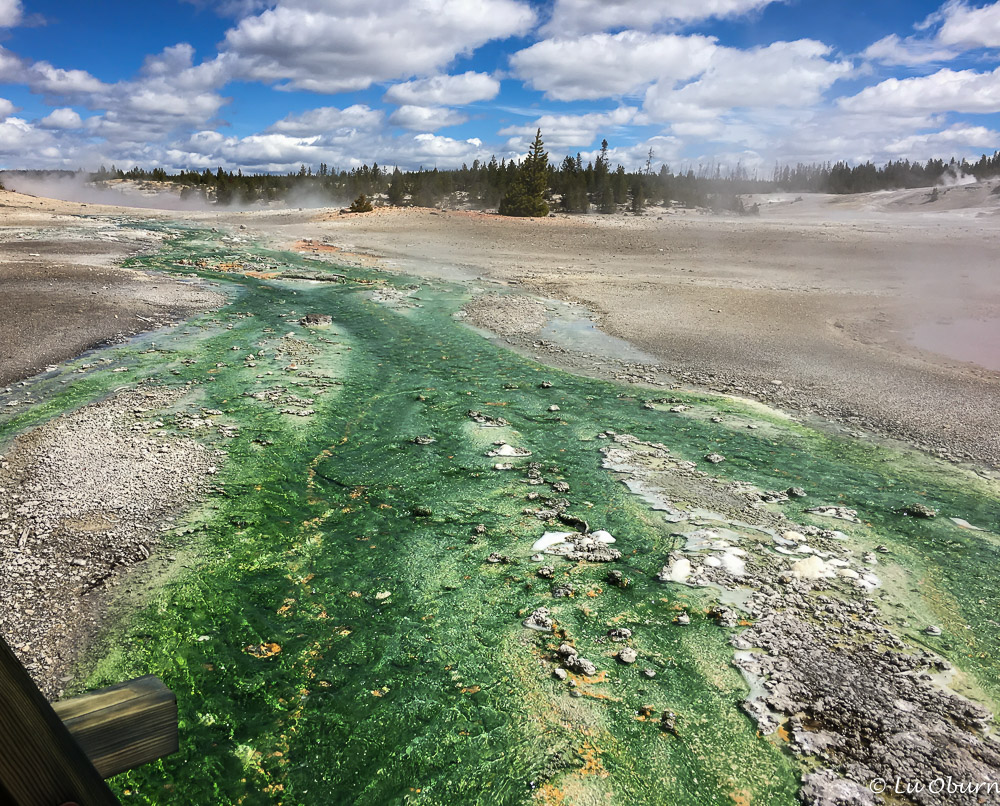
Thermophilic algae, known as “Cyanidium” create the bright-green color seen in this area of the Porcelain Basin in Norris.  Temperatures here average about 120º F, with a pH of 3-4.  This organism can be found nowhere else in the park.
Crater Spring

And one of my favorites…

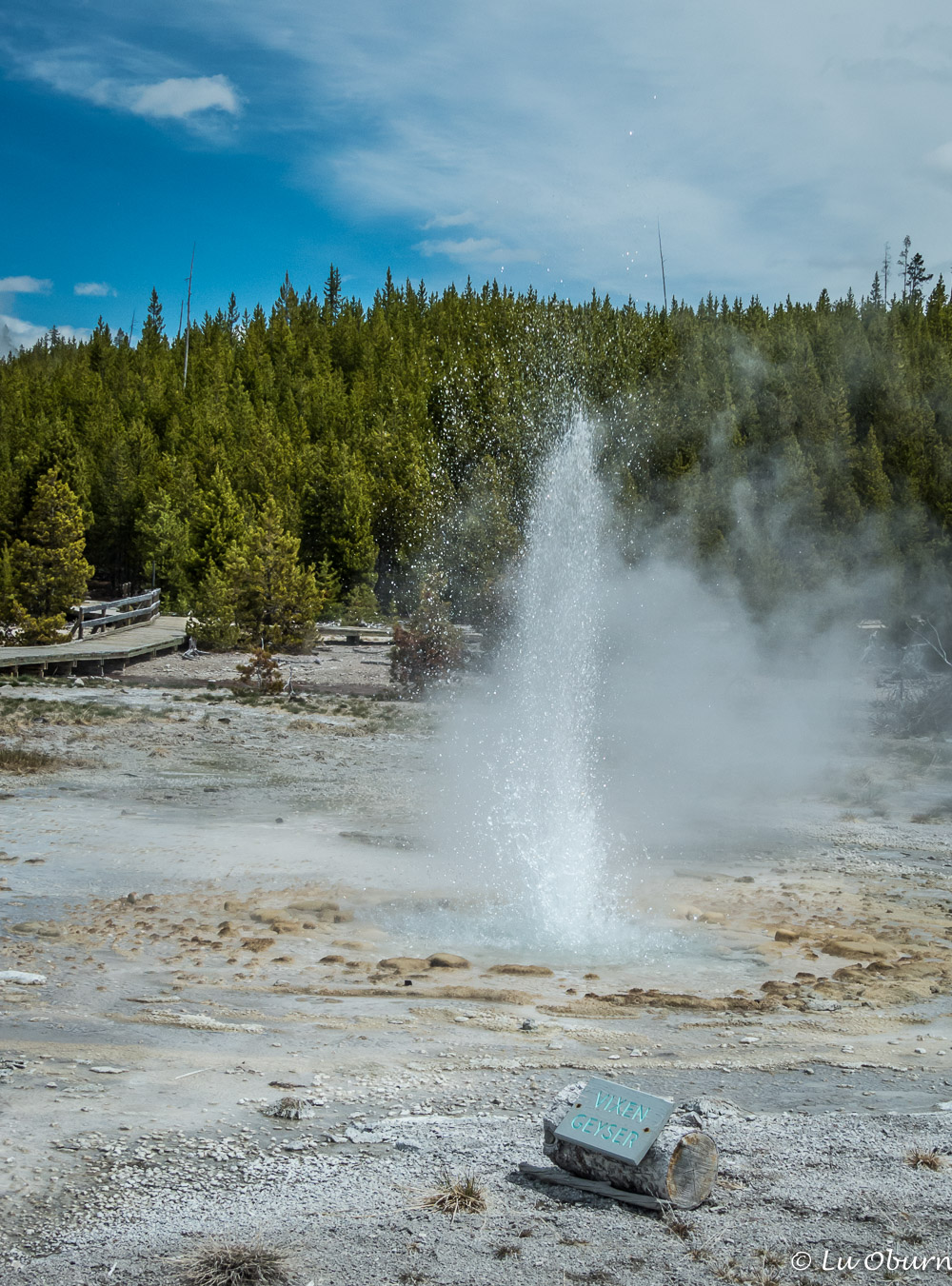
Vixen Geyser, a sassy little gal, who is very active.

Disclaimer:  The views expressed here are my own and do not necessarily represent the views of Yellowstone Forever.  

Next Up:  Day 2 of Thermal Biology, where travertine abounds.

SaveSave

SaveSave

SaveSave

SaveSave

SaveSave

SaveSave

SaveSave

SaveSave

SaveSave

SaveSave

SaveSave

SaveSave

SaveSave

SaveSave

River Otters of Yellowstone ~ Yellowstone Forever Field Seminar Series

When I think of cute and cuddly mammals, both in kid and adult form, what comes to mind is the gregarious, charismatic river otter, which may be elusive but can be found in Yellowstone National Park.

I was preparing to support the river otter field seminar but I wasn’t confident we would actually see any otters.  It wasn’t that pessimism was rearing its ugly head, more that few otters had been spotted this summer.

There was a photography course running simultaneously with the river otter course and as the photographers were leaving for the field, I jokingly gave one of the instructors his marching order for the day – find river otters. His reply, “Since we are going to a lake, I guess we won’t be finding any river otters.” Ok buddy, I’m not that naïve.

Otter tracks…could sightings be in our future?

The otter class left for the field as well, hiking down to the Lamar River to scout for otters but, in lieu of the actual mammal, what greeted us was a fresh stonefly hatch. No matter how tightly I buttoned my shirt, those fat, juicy flies found their way in…lovely!  Although we found no otters that morning, we did find evidence they had been there recently – prints down by the shore, as well as denning signs and latrines.  We headed back to the ranch feeling one step closer to finding the real deal.

When the photography class returned later that morning they were gloating as they showed us photos of river otters at Trout Lake, just east of the ranch, where the cutthroat trout were spawning.  Our plan was to head there after dinner, hoping dusk would find these little cuties still romping around the lake.

Hiking around Trout Lake near dusk was lovely but devoid of otters so we headed over the hill to Buck Lake, where we found an otter trail but none in sight.  Thinking our day was going to be a bust, we hiked back over to Trout Lake and as we crested the hill we saw a mammal swimming across the lake and soon found not one but four otters on a fallen log, near the inlet where the cutthroat were spawning.  We spent two gleeful hours busily snapping photos of their antics – fishing, eating, and playing.  Nothing more would have needed to happen during this seminar and it would have been labeled a success.

Just a few stats on these little charmers:

  • The species found in Yellowstone National Park is the North American river otter.  They are a member of the weasel, badger, and marten family.
  • Mostly crepuscular, they can be best spotted at dusk or dawn.
  • They grow to an adult length of 3.5 to 4 feet and weigh from 11 – 33 lbs.
  • Long, stiff facial whiskers can detect prey, even underwater.
  • They close their ears and nostrils when swimming underwater, allowing them to easily stay under for 2-3 minutes.
  • They have large, fully webbed feet and a tail that serves as a rudder.
  • Females breed in the spring and the egg floats freely in the womb until winter, when it attaches to the uterine wall.
  • Typically 2-3 pups are birthed per litter.

We turned up ‘otterless’ the next two days but there was plenty of sign (scat) to collect, to clean and view under the microscopes, telling us on what these little guys were eating.  We were more than content with that. 🙂

Yellowstone river otters can most easily be seen in the winter, when their dark fur readily stands out against the white snow.  They do not hibernate like other park mammals, so can be seen slip sliding across the ice and snow.

If you are interested in learning more about the educational programs offered by Yellowstone Forever, go to www.yellowstone.org and check them out.  You won’t be disappointed.

Disclaimer:  The views expressed here are my own and do not necessarily represent the views of Yellowstone Forever.  

SaveSave

SaveSave

SaveSave

SaveSave