Georgia’s Oldest Jewel ~ Savannah

We have settled into Skidaway Island State Park, a convenient location for exploring historic Savannah.  Large pull-thru sites beneath arching canopies of live oaks greet you as you enter the campground and  seven miles of trails wind through maritime forests, a relaxing place to spend a week.  Just beyond the borders of the park, on the island, lie 40 miles of biking/walking trails, meandering through genteel southern neighborhoods, through forests of oak and pine, and past salt marshes.  While we have spent most days “spinning our wheels”, we set aside plenty of time to wander the historic streets of Savannah.

Savannah’s history began in 1733 when British General James Oglethorpe founded the colony of Georgia as a place to resettle Britain’s poor who were housed in debtors’ prisons.  His design for Savannah was patterned after a contemporary military camp, a central square surrounded by eight city blocks, which formed a ward.  This concept grew until there were 24 squares and of those, 22 still exist today, making Georgia’s oldest city a jewel unlike any other in the US.

All the squares are part of the historic district, encompassing a one-half mile radius, each serving as memorials, with statues or fountains surrounded by lush foliage.   Historic churches and 18th and 19th architectural styling of every kind can be found in the blocks lining the squares, along with azaleas and dogwood adding a breathtaking lushness to the ambiance.  These squares are the heart and soul of Savannah.   The streets surrounding the squares allow for a continual flow of traffic, at a nice pace, making this a pedestrian-friendly city. We chose to spend our days walking it but there is a trolley service available as well, allowing tourists to hop on and off at their leisure.

During one of our many strolls through historic downtown, we found ourselves in Washington Square, where the oldest homes in Savannah can be found. A smartly dressed man, walking a lovely little dog, proceeded to introduce himself as Fred and invited us to take a tour of a lovely historic home that dated back to the late 1700’s, still featuring the original hand-hewn oak walls and hardwood floors.  This historic home was where Fred, his wife Susan, talented artist and author, and adorable rescue dog Lucy live.  Susan was gracious and let us intrude on her day, and we walked away with an autographed copy of her book, Spirit Willing.  
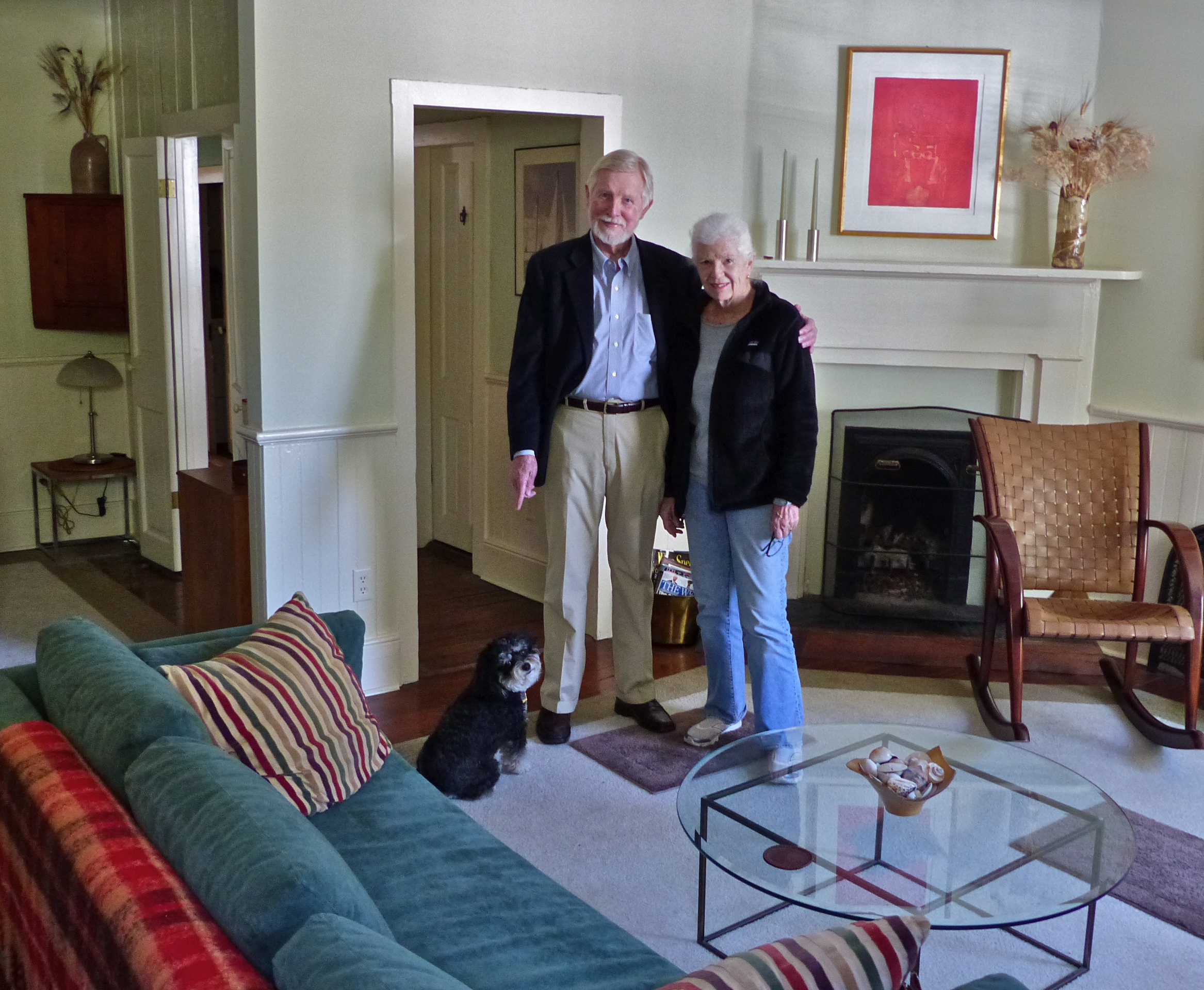
Fred, Susan, and the lovely Lucy

Few cities with such a colorful past would be complete without sightings of restless spirits wandering the cemeteries late at night and Savannah is no exception.  Colonial Cemetery, the oldest in the city, is said to be one of the most haunted places in Savannah, where Voodoo ceremonies once took place in the wee dark hours.  This is the final resting place for many of Savannah’s earliest citizens and a signer of the Declaration of Independence is also buried here.

Bonaventure Cemetery, Savannah’s most famous, thanks to being prominently featured in John Berendt’s best-seller Midnight in the Garden of Good and Evil, is also alleged to have ghostly sightings.  Bonaventure stands on the grounds of what was once a plantation.  Legend has it that the main house caught fire during a party and the host calmly suggested the guests pick up their crystal glasses and take them outside to continue the party.  As they watched fire consume the house, the partiers  smashed their empty crystal against an oak tree, and it is said that on quiet nights you can still hear the laughter and the shattering of crystal.

We can’t attest to roaming spirits, but the grounds where generals, poets, governors, and Academy award-winning lyricist Johnny Mercer lie in eternal rest are hauntingly beautiful.  Many elaborate crypts overlook the Wilmington River, with live oaks, azaleas, dogwood, and roses surrounding intricate headstones and life-size statues.

Since Savannah’s history is rooted in the American Revolution and Civil War eras, we decided a visit to Fort Pulaski National Monument was in order, a fort meant to guard the river approaches to the city.  We have seen many forts during our travels and I must admit to many holding little interest for me, but this one was  different.  Strategically built on Cockspur Island and named for Count Casimir Pulaski, Polish hero of the American Revolution, Fort Pulaski was thought to be impregnable.  However, during the Civil War a Confederate garrison was forced to surrender the fort when a Union army used rifled cannons during an attack (new military technology for that age), landing mortar dangerously close to the magazine storing 40,000 pounds of gunpowder.   The scarred wall of the fort remains today.

We were so impressed with Savannah’s quaint elegance, her azalea-lined cobble stone streets beneath emerald-green canopies, and her historied architecture.  Should you decide to visit, don’t leave without a stop at Leopold’s Ice Cream, ranked one of the top 10 in the world.  I leave you with a few other images of Savannah, as we say farewell to this fascinating city and move on to a sister city, Charleston, South Carolina.

Mesmerizing Trees, a Bit of History, and Wonderful Friends ~ Golden Isles, GA

It seemed strange to leave Florida after spending the entire winter here but we have so much more of this beautiful country to see so northward we head. Crossing the state line into Georgia we felt winter’s final vestiges as a blustery, rainy day greeted us at Coastal Georgia RV Resort in Brunswick.  Given the forecast it seems our time here is destined to include wind, overcast days and cold.  We have been spoiled by southern Florida’s dreamy winter weather so we can endure a bit of cold.

We are exploring the Golden Isles of Georgia for the next few days, in the southern part of Georgia’s scenic coastline.  The four barrier islands of St. Simons Island, Jekyll Island, Sea Island, Little St. Simons Island, and the mainland of historic Brunswick join together to form the Golden Isles.  Alluring marshland, sandy beaches, and maritime forests create a land of serene, natural beauty.  Historic landmarks, museums and art galleries provide the back story and legacy for the area.  And the southern charm and hospitality found around every turn cannot be beat.

Jekyll Island offers visitors a tranquil setting thanks to a strict conservation clause that limits development to only 35% of its land and with only 220 residents occupying the northern part of the island, much of Jekyll Island will always retain its natural wildness.  On a calm, chilly morning we biked the island before the winds gathered steam later in the day, passing under live oaks dripping with Spanish moss, crossing boardwalks spanning marshes, and through pine-scented forests.

One of our favorite stops on Jekyll Island was Driftwood Beach, a mesmerizing, haunting stretch of beach that looks like a tree graveyard due to slow erosion of the northern end of the beach being deposited on the south end of the island.

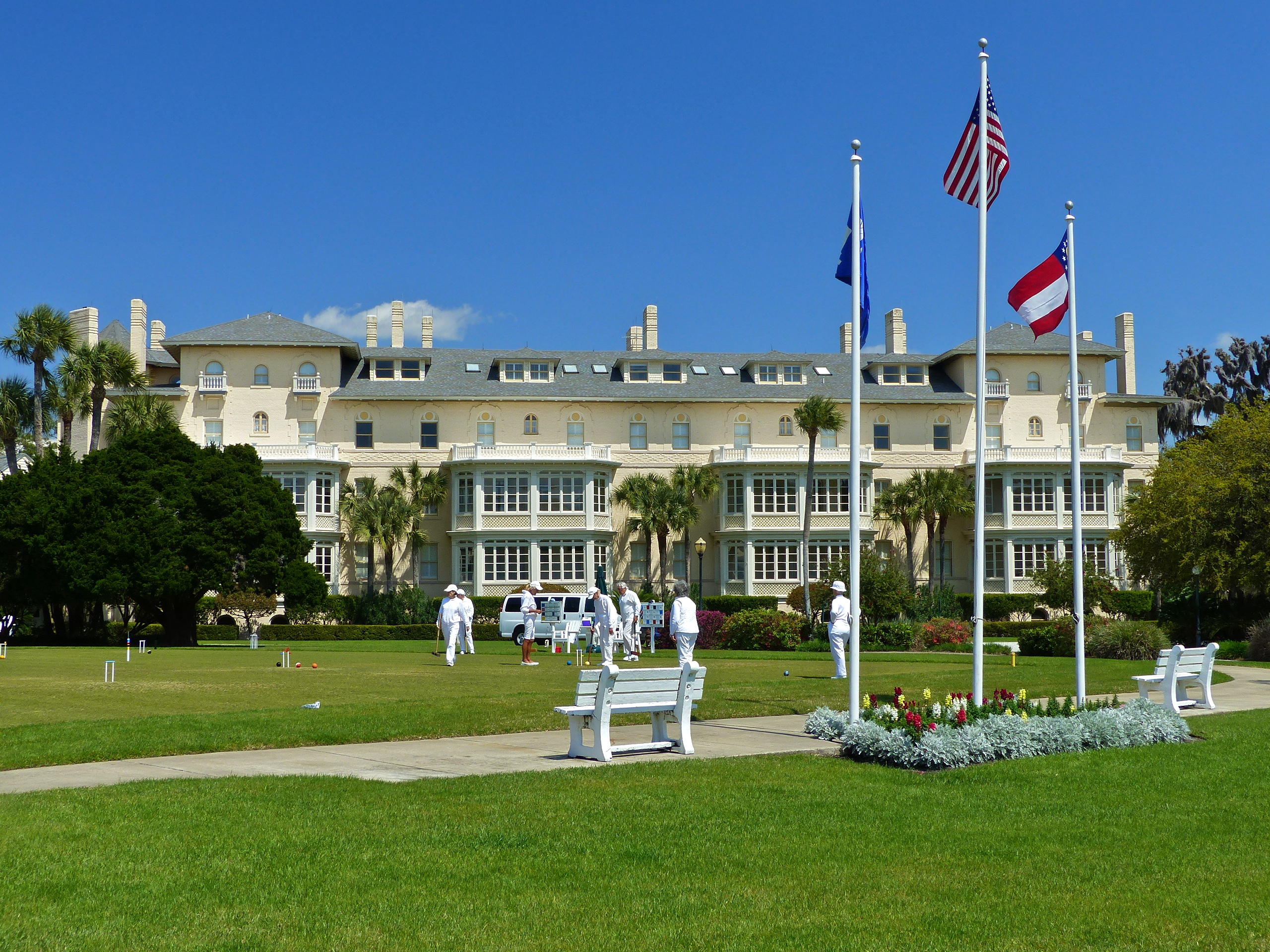
Jekyll Island has long been appreciated for its landmark historic district.  Built in 1886, the Victorian Inn known as the Jekyll Island Club Hotel is the focal point of the historic district and many of the surrounding “cottages”, which can be toured, add to the opulence.

Once a private club for some of America’s wealthiest, with member names such as Morgan, Rockefeller, Pulitzer, and Vanderbilt, Jekyll Island Club Hotel is now one of Georgia’s top resorts, open to the public.  On the day we visited there were three couples playing croquet on the lawn, dressed all in white.  It felt like stepping back into the 1900’s.

St. Simons Island, the largest of the barrier islands, lies across the salt marshes which were celebrated in the poem Marshes of Glynn written by renowned Georgia native and poet Sidney Lanier.  Majestic live oaks draped with Spanish moss line many of the streets on this beautiful island, framing the lovely properties beyond, some steeped in history.

We headed to the Visitor Center to get some information and I hoped to get a map of the mysterious Tree Spirits I had read so much about.  It seems that local artist Keith Jennings began carving soulful faces into St. Simons Island live oak trees in 1982 and to date has created 20 of these works of art.  Jennings says he works with the tree’s soul and as the wood speaks to him the face begins to develop and peers back at him.  They are so popular they even have their own Facebook page.

Surprisingly, there were no maps available for the location of these tree spirits, at least none that the Visitor Center employee was aware of, although she did have a vague idea of where we could find a few of these unique carvings.  So with cryptic notes in hand, I headed out with a skeptical husband in tow.  To say Terry was less than excited about this scavenger hunt was an understatement, given the traffic and cold, windy day, but he knew I was determined to find at least one.  We found four before I felt I was pushing hubby’s patience button, with directions like “go to Redfern Village and find Gnat’s Landing.  There is a tree nearby that has a tree spirit carving”.

Each we found were wonderful discoveries, the weathered faces working well with the drooping, moss-covered branches to create haunting, contemplative features.

The trees on these barrier islands never failed to enchant us and seemed to be a recurring theme during our visit.  The Avenue of the Oaks was our next stop, a must-see in our opinion.  Once the entrance to Retreat Plantation, known for its superior sea island cotton and sweeping flower gardens, this double row of 188 year-old live oaks now grace the entrance to the Sea Island Golf Club.

This short trip to the Golden Isles was made more special by a visit from our good friends Stan and Marilyn.  We enjoyed revisiting Jekyll Island with them and sharing a yummy meal at Southern Soul Barbeque on St. Simons Island. Visits with them are guaranteed to leave our sides aching from laughter and bring tearful goodbyes as we part.   We can’t thank them enough for taking the time to come our direction during their recent travels.

Good friends Stan & Marilyn on Driftwood Beach.

A few images on the grounds of Christ Church on St. Simons Island:

Our next stop is Savannah.

Our Nation’s Oldest City ~ St. Augustine

This past week has been spent with family, and although we had lots planned when we arrived in Titusville, much was set aside to reconnect and relax with sister and niece.  This visit had been a long time coming so we decided that days devoted to conversation and cooking meals together trumped lots of activities.  We did explore Merritt Island National Wildlife Refuge and Canaveral National Seashore and if you find yourself in and around Titusville, I would recommend both.  And of course, there is the Kennedy Space Center.

Leaving Titusville behind and arriving at our final stop in Florida for the winter, we decided to play tourist one last time before we head further north, and where better than in our nation’s oldest city, St. Augustine.  In doing research you will find there is plenty to occupy your time here, whether you enjoy history, the beach, culture, nightlife, shopping, or delving into the paranormal.  And when you tire of all this sightseeing, there are many interesting restaurants downtown to saté your appetite.

The trolley seems to be the most popular way to traverse this city, with about 20 stops along the route, allowing you to hop off and on at your leisure, all while getting a little history lesson from your driver.  We prefer to walk instead, planning our own route and getting some exercise, unless the city we are in is too spread out and St. Augustine is a very walkable city.   There are plenty of brochures to grab from the visitor center to educate you about this historic city and a public parking garage right at the visitor center that can be accessed for $10/day.

This is where colonial America began, 55 years before the Pilgrims set foot on Plymouth Rock.  First visited by Spanish explorer Juan Ponce de Leon in 1513, St. Augustine was later founded by Pedro Menéndez de Avilés in 1565.  Over three years Avilés would import 500 African slaves to this city, the first slaves brought to this country, a sad piece of history.

Over many years the Spanish, French, British and finally the United States fought for control of St. Augustine.  I am not a huge history buff so I will leave you to read the details online if you are interested.   There are two forts in the city, Fort Matanzas and Castillo de San Marcos, for those who love history, and we found both to be interesting.

Our interest in this historic city lies more in the striking architecture found around the Old Town area, particularly some of the old hotels and churches, almost all that were influenced by Henry Flagler, a Standard Oil executive and partner to John D. Rockefeller.   In the 1880’s Mr. Flagler decided that St. Augustine should be a winter resort for the wealthy.  The stunning details in the Lightner Museum (formerly Hotel Alcazar), Flagler College (once the grounds for the Ponce de Leon luxury hotel), and the Memorial Presbyterian Church were certain to lure the affluent.

Tours are given at many sights around the city, some for a small fee and some that are free of charge.  We found the docent-led tour of the Memorial Presbyterian Church to be fascinating, and the architecture had already drawn us in.

Built in 1889 by Henry Flagler, this is the only Presbyterian church of its kind in the world.  It is of the Venetian Renaissance architecture style, shown in the copper dome and ornate terra-cotta frieze, and was inspired by St. Mark’s Basilica in Venice.   It is breathtaking both inside and out.

This sacred building was a labor of love for Henry Flagler, dedicated to his daughter Jennie Louise Benedict, who died due to childbirth complications the same year this church was constructed, hence the word “memorial” in the name.  Every last detail reflects Flagler’s loving touch, particularly the 92 stained-glass windows, designed by German artist Herman Schladermundt. Each window represents a segment of the “Apostle’s Creed” and they are all spectacular.

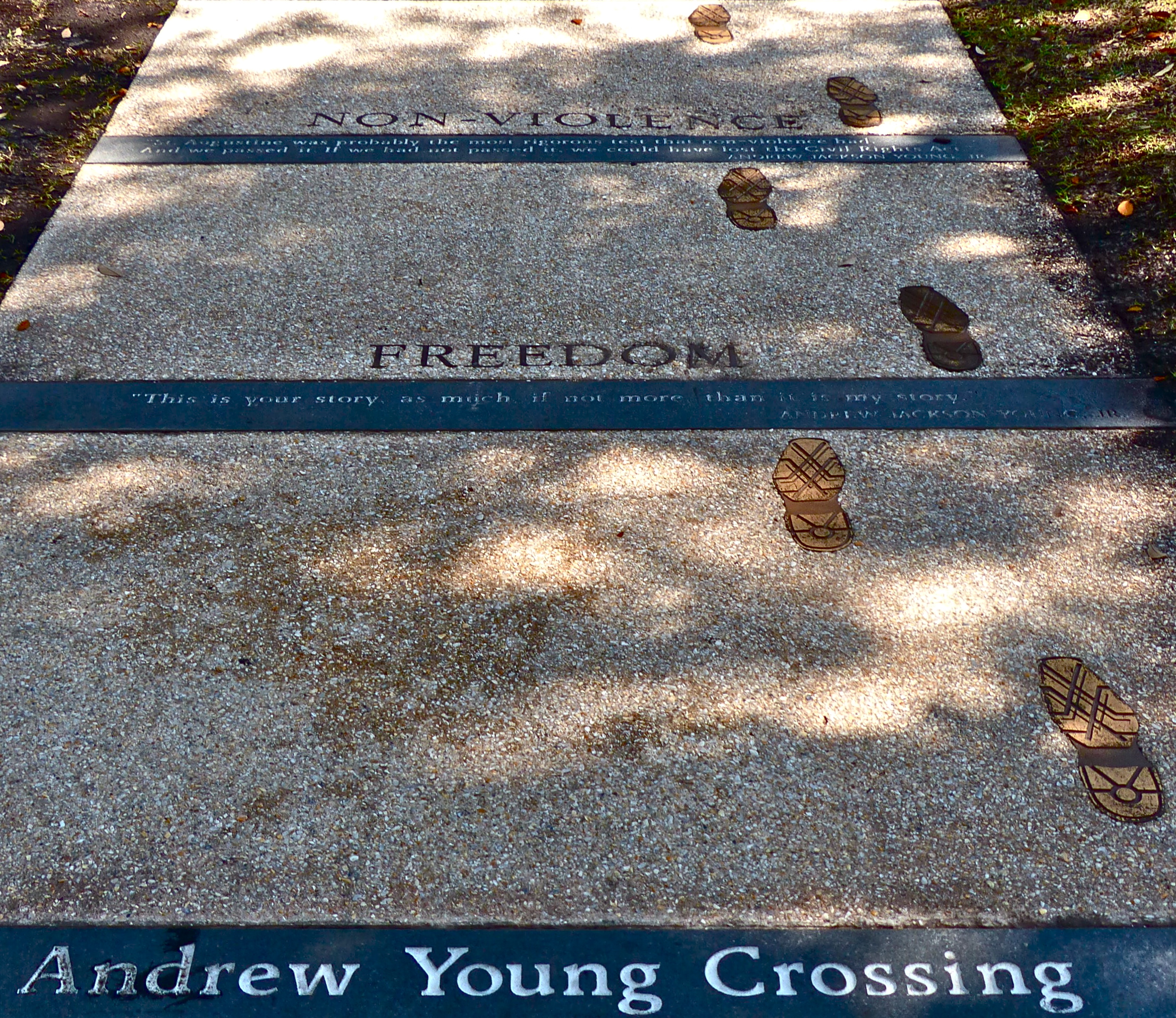
I must admit that until we arrived in St. Augustine I did not realize the importance of this city to the Civil Rights movement.   On June 9, 1964, Andrew Jackson Young, Jr., Civil Rights activist, led a march from Lincolnville, a St. Augustine district founded by former slaves, to the downtown plaza.  Mr. Young was sent to the city by his friend, Martin Luther King, Jr., to organize a peaceful human rights protest.  When his group arrived at the downtown plaza, they were confronted by a large white mob and were beaten.  Always vigilant to Dr. King’s non-violent strategy, they walked away.   This was a pivotal event that aided in the signing of the Civil Rights Bill on July 2, 1964.

These bronze footsteps, incorporated into the sidewalk that runs diagonally through the plaza, honor this leader who received his first beating in the Civil Rights movement.

Our nation’s oldest city is rich in history, expressed in both her simplest of buildings and her most opulent.  Although a part of her story reflects some of our nation’s less than proudest moments, St. Augustine still maintains a charm all her own.

From here we continue north into the “Peach State” ~ Georgia.

Something So Strong

I have never participated in a WordPress Daily Prompt before, but at this time of year, I am adrift on a sea of memories.  This prompt spoke to me.

On a warm summer day, against a stunning backdrop of shimmering red rocks, I spotted you sitting alone, listening to the music wafting through space.  It seemed my soul already knew you and raced to greet yours before my feet could carry me to your side.  Everything around me seemed to slow as our eyes met and introductions were made.  Deep within I knew ours was to be a lifelong friendship, even if you had yet to make this discovery.  I seldom left your side that day and quickly learned that on the surface we seemed to have little in common, mine a life revolving around finance, yours that of talented musician and artist.

No one could have guessed the depths our friendship would reach, something so strong drawing me back time and again to your beautiful melancholy smile. With each visit, familiarity gained momentum.  Vulnerability and timidity gave way to raw honesty as we explored our feelings, new discoveries about each other and ourselves unraveling.  A piece of my soul that had been lost once again had found its rightful place.

Yours was a life of great struggle Barb, a battle difficult to witness at times. However, even during some of your darker days, which brought forth tears of anger and frustration, I always felt a calm countenance within you, ready to face whatever life had yet in store for you.  Some of my most cherished memories will always be those rather prosaic tasks we shared that so many of us take for granted, exercises you coveted as your body began to turn against you. Greeting you in the morning and gently lifting you into your wheelchair, brushing your beautiful blond hair as you silently cried, seeking acceptance of the terrible affliction that had wracked your body, showering you as you struggled with the humiliation of feeling your dignity slip away, and sitting at your feet reading to you when you could no longer turn the pages on your own are intimate moments that have become encapsulated in my heart.

You left us much too soon Barb, long before any of us were ready.  There were stories still to be told and lessons for you to teach us, other lives for you to touch.  But you knew it was your time and with that same courage with which you faced your illness, you moved into the next life.

On this eve of your passing, I cannot believe three years have slipped by so swiftly.  The pain of your absence can still take my breath away.  But something so strong as your passion for life amidst your formidable trials has left me with the awareness that any obstacle can be overcome.

As I reflect upon our time together, a myriad of emotions swirl around, moments of profound joy, deep wells of sadness, contemplative stillness, and always the knowledge that we will meet again.  Until that time arrives ~ rest in peace my anam cara.

Beloved friend Barbara Burke

Night Symphony and a Close Encounter

We have learned to keep an open mind when plans don’t seem to gel as we had originally hoped, so as not to miss the beauty at our fingertips.  That was to be the case with last minute reservations made at Savannas Recreation Area in Fort Pierce, when we could not get reservations at a preferred state park.

Campground view
Campground view

Savannas Recreation Area covers 550 acres and five distinct biological territories.  Our camp site, like most, looks out onto a meandering lagoon, literally ten large steps from our door.  Trails through the prairies and marshes criss-cross the park, a beautiful, serene setting.

There is plenty to do in and around Fort Pierce, a local farmers’ market ranked second-best in the state, a historic downtown, the Navy Seal museum, and bike trails and white-sand beaches across the causeway on North and South Hutchinson Islands to while away a sunny day.

Even with much to do outside our back door, most days our contentment is found on the paths and walkways inside the campground, where we are never without birdsong, and an amazing variety of wading birds foraging or soaring overhead.  Each day as light moves to dark the night symphony builds to a crescendo, bullfrogs, a multitude of winged insects, and numerous birds joining in the chorus.  Standing outside, peering into obscurity, we feel as if in a jungle, particularly when the limpkin, a bird we have not seen since Shark Valley, joins in the ensemble.  Much easier heard than seen, it seems this beautiful bird does its best singing after dark, not that it has a great singing voice, more a loud wail or scream.  I have read that his call was used quite often for jungle sound effects in Tarzan films, sounding more like an ape than a bird.

At check-in we were told that a pair of sandhill crane were nesting across the lagoon in the marsh.  We had not seen this magnificent bird since our Yellowstone days and were excited to catch a glimpse.

One late afternoon while wandering through the park, we spotted two rather tall birds strolling up the road.  Walking quietly with camera at the ready, I was prepared for them to fly away as we moved closer, as most birds are prone to do.  Much to my surprise they continued to wander, paying little attention to us as they fed in the grasses.

These were the sandhill cranes I was hoping for.  There is no difference in appearance between a mating male and female, except that the female is a bit smaller.   These elegant birds stand 4.5 – 5 feet tall, weighing in at 10-14 pounds and are said to be fairly social.  They make a trumpeting or trilling sound that can be heard from a great distance, engaging in “unison calling”, standing close together singing a synchronized elaborate duet.  And when in the mood, they do a dance that has a gangly grace to it.  We felt fortunate that they shared all of this and more with us on this particular day.

Before out visit was over, the male allowed me to sit literally three feet from him, watching him preen, with an occasional tilt of the head in my direction as I quietly spoke to him.  Terry wished he had a camera turned on me, as the look on my face was that of pure joy.  I felt honored to be allowed so close.

At Savannas we have found serenity in the richness of nature and alluring details in the night that quite often are overlooked.  We are once again reminded of the awe inspired when we live in the moment.

Sunrise over Indian River Lagoon